
Fractal Triangle and Incircle
Loading the math board and drawing, please wait…
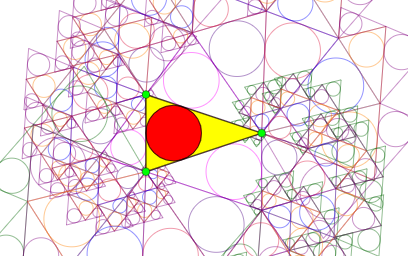
This example demonstrates the relationship between a fractal triangle and its incircle. It involves fractal geometry and the concept of an incircle. Using GeoGebra commands such as Segment, Incircle, Mirror, and Polygon, a series of similar triangles are constructed, each with an incircle that is tangent to the incircle of the original triangle. Suitable for high school mathematics education and learning.
GeoGebra Commands & Parameters
Segment(A, B) → fSegment(B, C) → gSegment(C, A) → hIncircle(A, B, C) → cMirror(l1, Midpoint[A, C]) → l1'Mirror(l7, Midpoint[A, C]) → l7'Mirror(l6, Midpoint[A, C]) → l6'Mirror(l5, Midpoint[A, C]) → l5'Mirror(l4, Midpoint[A, C]) → l4'Mirror(l3, Midpoint[A, C]) → l3'Mirror(l2, Midpoint[A, C]) → l2'Polygon(A, B, C) → t1, c_1, a, b
AI Drawing Prompt Reference
Draw a triangle by selecting three points and constructing its three sides, then construct the incircle of the original triangle. Next, use symmetry about a line that passes through the midpoint of a relevant side (linked to the triangle’s construction) to mirror the lines/edges corresponding to the triangle, creating multiple copies that form a chain of similar triangles. Keep the original incircle visible to highlight the relationship between the fractal-like triangular construction and the incircle. Finally, outline the original triangle as a polygon, preserving the key geometric structure and tangency context.
The prompt above was compiled from the original drawing commands and is for reference only.