
Four Strikes: Double-Digit Addition Math Game
Loading the math board and drawing, please wait…
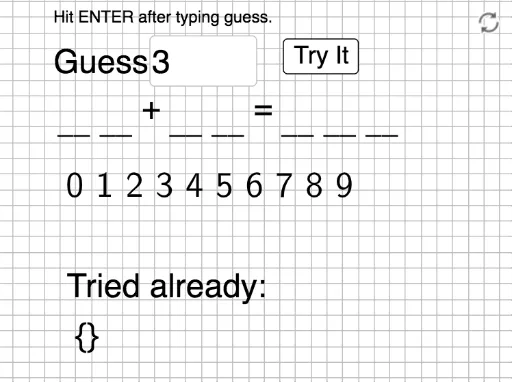
① This example is a math game called 'Four Strikes' that demonstrates practicing double-digit addition through a guessing game. ② The core mathematical concept is integer addition, specifically adding two-digit numbers, along with random digit arrangement and logical deduction. ③ Construction highlights: The game uses GeoGebra commands such as Shuffle to randomize digits, Textfield and InputBox1 for player input, and Vector and If to implement game logic. Objects include strikes, ng, guesses, g, gs, f, fs, e, es, d, ds, c, cs, b, bs, a, as, win, l1, sm, ec, fc, gc, button1, guess, InputBox1, and multiple text boxes (text1 to text5). ④ Suitable for upper elementary or middle school students, or for math education, to reinforce double-digit addition skills and serve as an interactive classroom activity.
GeoGebra Commands & Parameters
Shuffle({0, 1, 2, 3, 4, 5, 6, 7, 8, 9}) → l1, {3, 9, 0, 8, 4, 6, 2, 5, 7, 1}Textfield(guess) → InputBox1Vector(E1, E2) → evIf(e ≟ 0, {a, b, c, d, f, g}, {a, b, c, d, e, f, g}) → digits
AI Drawing Prompt Reference
Create an interactive math game interface for double-digit addition guessing. At the top, show a shuffled sequence of digits from 0 to 9 as a hint. In the center, place an input box for the player's guess. Below, display several slots that reveal feedback for each guess, indicating correct digits and positions. Next to it, include a strike counter using symbols like X's or dots to show remaining attempts. The layout should be clean and educational, with a title and brief instructions.
The prompt above was compiled from the original drawing commands and is for reference only.