
Four Basic Geometric Transformations: Reflection, Rotation, Enlargement & Transl
Loading the math board and drawing, please wait…
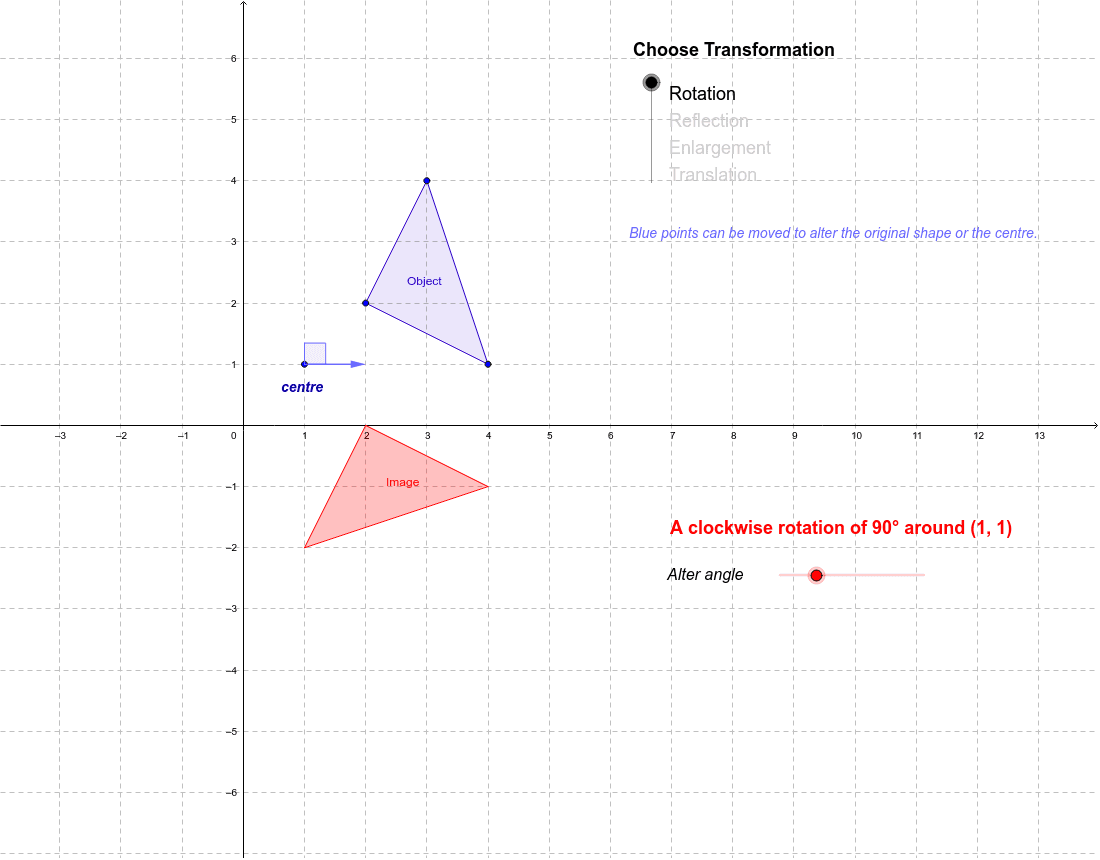
This GeoGebra example demonstrates the four fundamental geometric transformations—reflection, rotation, enlargement (dilation), and translation—using a polygon and its transformed copies. It visually illustrates how each transformation maps the original shape to a new position, orientation, or size. Core mathematical concepts include properties of isometries (reflection, rotation, translation) and similarity transformations (dilation), as well as the role of transformation parameters such as mirror lines, rotation centers, scale factors, and translation vectors. The construction employs GeoGebra commands: Polygon to define the base shape, Mirror for reflection, Rotate for rotation, Dilate for enlargement, and Translate for translation, supplemented by Ray, Vector, Point, Line, and Angle objects to visualize axes, centers, vectors, and angles. This resource is ideal for middle school to high school geometry classes, or introductory college geometry, helping students grasp how each transformation affects coordinates, side lengths, angles, and orientation, and fostering understanding of transformation composition.
GeoGebra Commands & Parameters
Polygon(C, D, B) → poly1, b, c, dDilate(C, a, A) → C'_1Dilate(D, a, A) → D'_1Dilate(B, a, A) → B'_1Polygon(C'_1, D'_1, B'_1) → poly1'_1, b', c', d'Ray(A, C) → eRay(A, B) → fRay(A, D) → gTranslate(C, Vector[(horz, vert)]) → C'_2Translate(D, Vector[(horz, vert)]) → D'_2Translate(B, Vector[(horz, vert)]) → B'_2Polygon(C'_2, D'_2, B'_2) → poly1'_2, b'_1, c'_1, d'_1Vector(C, C'_2) → uVector(B, B'_2) → vVector(D, D'_2) → wRotate(C, -α, A) → C'_3Rotate(D, -α, A) → D'_3Rotate(B, -α, A) → B'_3Polygon(C'_3, D'_3, B'_3) → poly1'_3, b'_2, c'_2, d'_2Point(xAxis) → ELine(F, E) → hMirror(C, h) → C'Mirror(D, h) → D'Mirror(B, h) → B'Polygon(C', D', B') → poly1', b'_3, c'_3, d'_3Vector(A, G) → zAngle(G, A, H) → β
AI Drawing Prompt Reference
Create a triangle as the original polygon. Reflect it across a line to produce a mirrored copy. Rotate it around a point by a specified angle to generate a rotated copy. Dilate it from a point with a scale factor to obtain a larger or smaller similar triangle. Translate it using a horizontal and vertical vector to place a shifted copy. Use rays, vectors, and angle markers to indicate the mirror line, rotation center, scale factor, and translation direction, illustrating the four basic geometric transformations.
The prompt above was compiled from the original drawing commands and is for reference only.