
Flower Surface: Dynamic Optimization with Triangles and Medians
Loading the math board and drawing, please wait…
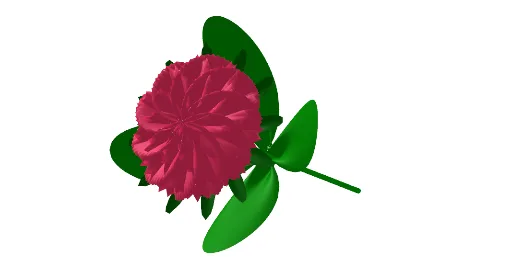
① This example demonstrates a flower-like 3D surface generated from triangle-related geometric elements (medians, distances, segments), whose shape evolves dynamically with parameter changes. ② Core mathematical concepts include scalene triangles, median lines, distance metrics, parametric surfaces, and optimization problems, incorporating ideas of similar triangles and variance. ③ Construction highlights: from the summary, the GeoGebra commands Surface, Distance, and Segment are used; objects include points O, p, q, segments m, a, c, b, plus auxiliary items texte1, images image1/image2, points A, B, m1, and function f, enabling shape optimization through parameter adjustments. ④ Suitable for high school to undergraduate mathematics education, this serves as a 3D visualization tool for exploring geometry-algebra connections, mathematical modeling, or computer-aided geometric design.
GeoGebra Commands & Parameters
Surface(x(O) + (((2 + sin((p * s) + (q * t))) * cos(s)) * sin(t)), y(O) + ((0.4 * (2 + sin((p * s) + (q * t)))) * cos(t)), z(O) + (((2 + sin((p * s) + (q * t))) * sin(s)) * sin(t)), s, 0, 6.28319, t, 0, 6.28319) → aSurface(x(O) + (((2 * j) * sin(i°)) * cos((((0.5 * m) * i))°)), y(O) + ((0.5 * (j - 1)) * cos((((0.5 * m) * i))°)^(2)) - 1, z(O) + (((2 * j) * cos(i°)) * cos((((0.5 * m) * i))°)), i, 0, 720, j, 0, 1.8) → cDistance(O, O) → OOSegment(O, A) → fSurface(x(B) + ((j * cos(i°)) * cos(((m1 / 4 * i))°)), y(B) + ((j - 1) * cos(((m1 / 4 * i))°)^(2)), z(B) + ((j * sin(i°)) * cos(((m1 / 4 * i))°)), i, 0, 720, j, 0, 4.8) → b
AI Drawing Prompt Reference
Create a dynamic 3D flower-like surface driven by triangle-related geometric elements such as medians, distances, and segments. The shape consists of two main petal-like surfaces: one generated by a parametric equation with two angular parameters creating undulating petals, and another with spiral layers controlled by rotation and scaling parameters. A line segment extends from the central point as an auxiliary structure. The overall form changes with parameter adjustments, altering petal density, size, and twist, suitable for visualizing geometry-algebra connections.
The prompt above was compiled from the original drawing commands and is for reference only.