
Finding the Sum of Interior Angles of a Polygon
Loading the math board and drawing, please wait…
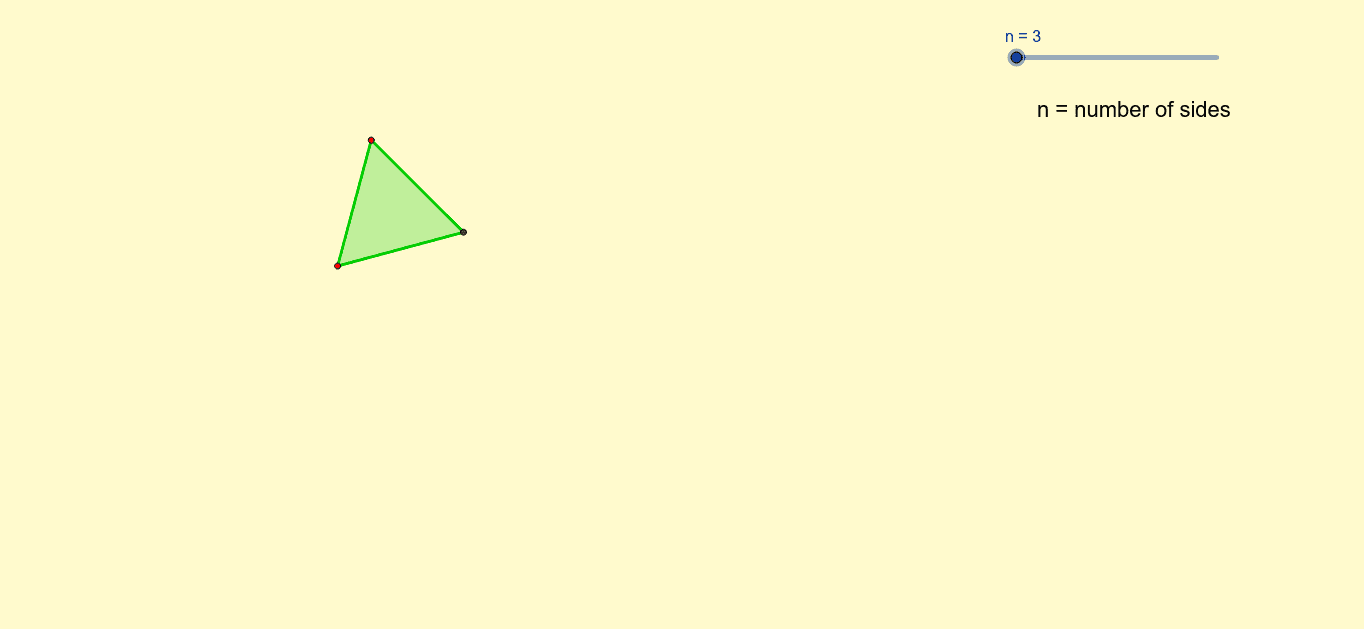
This example uses a slider animation to show how different polygons can be divided into triangles, helping students discover the relationship between the number of sides and the sum of interior angles. Key concepts include polygons and angles. It utilizes commands like Polygon and Segment in GeoGebra. Suitable for middle school and above students to explore the sum of interior angles of polygons.
GeoGebra Commands & Parameters
Polygon(A, B, n) → poly1, a, j, k, l, m, p, q, r, s, t, a_1, b, b_1, C, D, E, F, G, H, I, J, K, c, L, M, N, O, P, Q, R, S, T, d, e, f, g, h, iSegment(B, D) → c_1Segment(B, E) → d_1Segment(B, F) → e_1Segment(B, G) → f_1Segment(B, H) → g_1Segment(B, I) → h_1Segment(B, J) → i_1Segment(B, K) → j_1Segment(B, L) → k_1Segment(B, M) → l_1Segment(B, N) → m_1Segment(B, O) → n_1Segment(B, P) → p_1Segment(B, Q) → q_1Segment(B, R) → r_1Segment(B, S) → s_1Segment(B, T) → t_1