
Finding the Roots of a Quadratic Equation
Loading the math board and drawing, please wait…
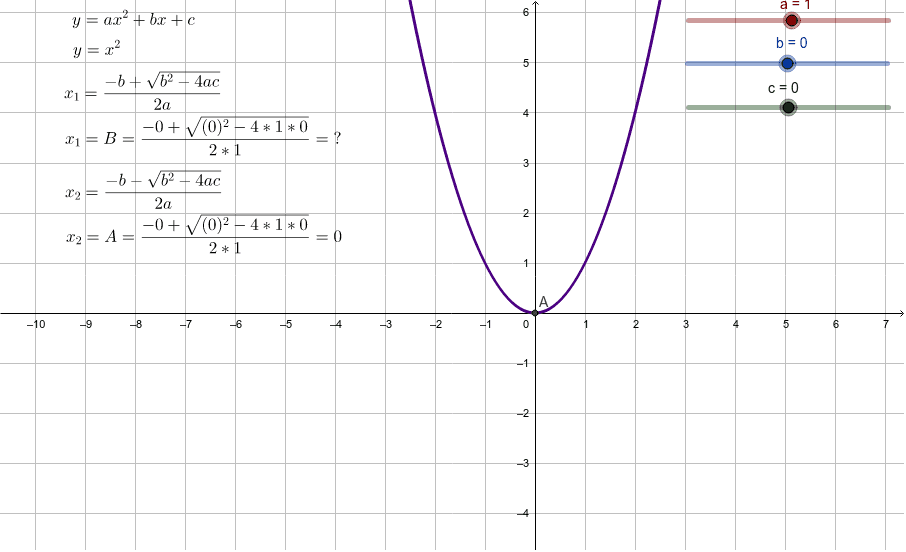
① This GeoGebra example demonstrates how to find the roots of a quadratic equation ax²+bx+c=0 by visualizing the intersections of the parabola with the x-axis. ② Core mathematical concepts include quadratic functions, the discriminant, the quadratic formula, and the relationship between roots and coefficients. ③ Construction highlights: the Root command is used to compute the roots directly, with objects a, b, c, d (likely coefficients or discriminant), text objects text1-text6 displaying the equation and root values, and points A and B marking the roots on the coordinate plane. ④ Suitable for middle and high school mathematics, ideal for classroom demonstrations, student exploration of root properties, or as an interactive tool to understand how the discriminant affects the number and nature of roots.
GeoGebra Commands & Parameters
Root((a * x^(2)) + (b * x) + c) → A, B
AI Drawing Prompt Reference
Draw a coordinate plane with a parabola opening upward, whose equation is controlled by three adjustable sliders. Mark the two intersection points of the parabola with the x-axis as the roots. Display the quadratic equation and the numeric values of the roots as text near the graph. As the sliders change, the parabola and root positions update, showing how the discriminant affects the number and nature of roots.
The prompt above was compiled from the original drawing commands and is for reference only.