
Finding the Missing Complementary Angle
Loading the math board and drawing, please wait…
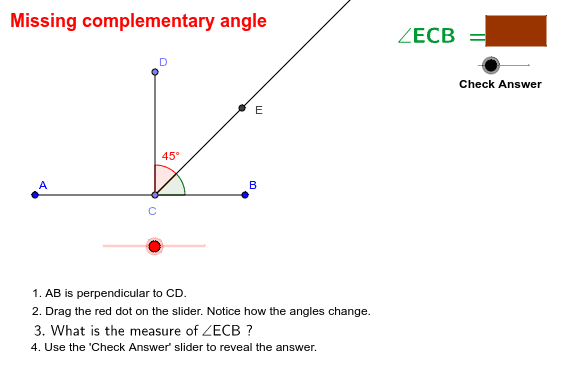
This example demonstrates how to identify and calculate a missing complementary angle through geometric construction. Key math concepts include the definition of complementary angles (sum of two angles equals 90 degrees). GeoGebra commands and objects used in the construction are Line, Point, OrthogonalLine, Segment, Rotate, Angle, Ray, Polygon, Vector, and Translate. Suitable for middle school geometry instruction to practice and reinforce the concept of complementary angles.
GeoGebra Commands & Parameters
Line(A, B) → aPoint(a) → COrthogonalLine(C, a) → bSegment(A, B) → dPoint(b) → DSegment(C, D) → eRotate(D, -α, C) → EAngle(E, C, D) → βRay(C, E) → cAngle(B, C, E) → γPolygon(F, G, H, I) → P, f, g, h, iVector((8, 6), (8 + j, 6)) → uTranslate(F, u) → F'Translate(G, u) → G'Translate(H, u) → H'Translate(I, u) → I'Polygon(F', G', H', I') → P', f', g', h', i'
AI Drawing Prompt Reference
Draw a right triangle with a 90-degree angle and a 45-degree angle. Ensure the two angles sum to 90 degrees.
The prompt above was compiled from the original drawing commands and is for reference only.