
Finding the Fourth Vertex of a Parallelogram
Loading the math board and drawing, please wait…
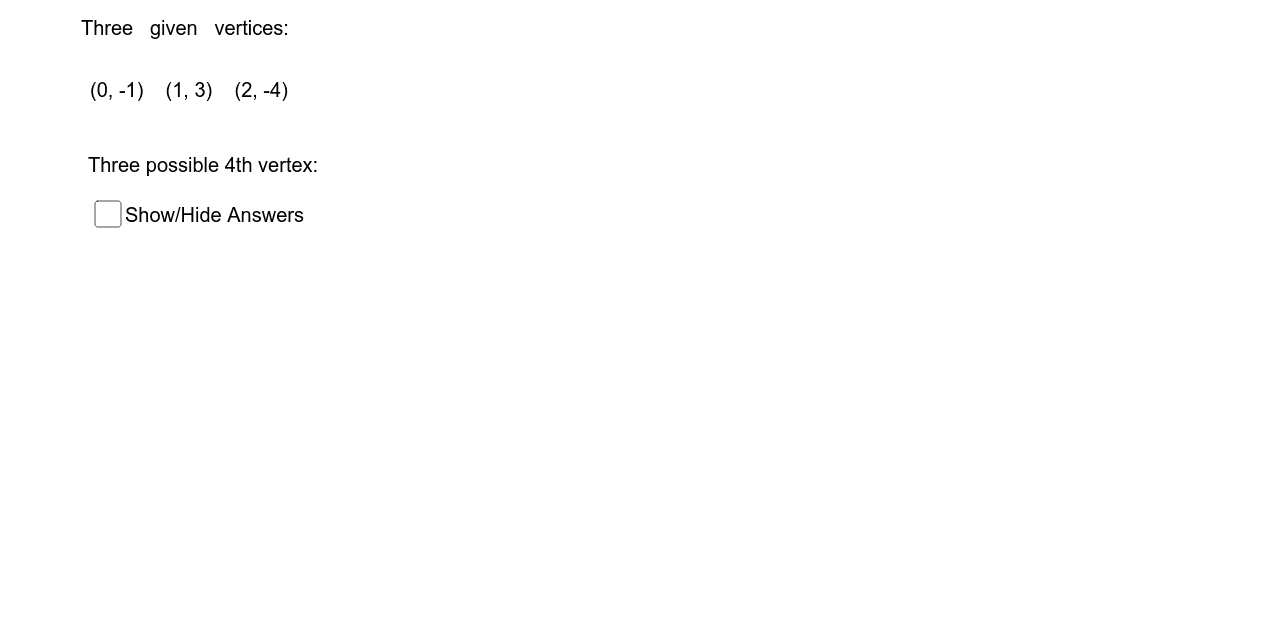
This GeoGebra interactive worksheet demonstrates how to find all possible locations of the fourth vertex of a parallelogram given three coordinate points. The core mathematical concepts involved include the geometric properties of parallelograms (specifically that the diagonals bisect each other), vector addition, and coordinate geometry calculations. In terms of construction, the applet utilizes the `Random` command to generate three starting points, A, B, and C, then uses `Segment` and `Line` tools to draw the sides and construct parallel lines, finally applying the `Intersect` command to calculate the coordinates of the three potential fourth vertices, D, E, and F. This tool is highly suitable for secondary school students and teachers studying vector algebra and coordinate geometry, providing an excellent visual and practical exercise for understanding geometric transformations and vertex coordinates.
GeoGebra Commands & Parameters
Random(-4, 4) → aRandom(-4, 4) → bRandom(-4, 4) → cRandom(-4, 4) → dRandom(-4, 4) → eRandom(-4, 4) → fSegment(A, B) → gSegment(B, C) → hSegment(A, C) → iLine(C, g) → jLine(A, h) → kLine(B, i) → lIntersect(k, l) → DIntersect(j, k) → EIntersect(j, l) → F
AI Drawing Prompt Reference
Generate three random points and connect them with segments to form a triangle. Through each vertex draw a line parallel to the opposite side; the three parallel lines intersect pairwise to produce three possible fourth vertices. Each of these vertices together with the original three points forms a parallelogram, illustrating the property that the diagonals of a parallelogram bisect each other and confirming the result via vector addition.
The prompt above was compiled from the original drawing commands and is for reference only.