
Find Factors Using Multiplication
Loading the math board and drawing, please wait…
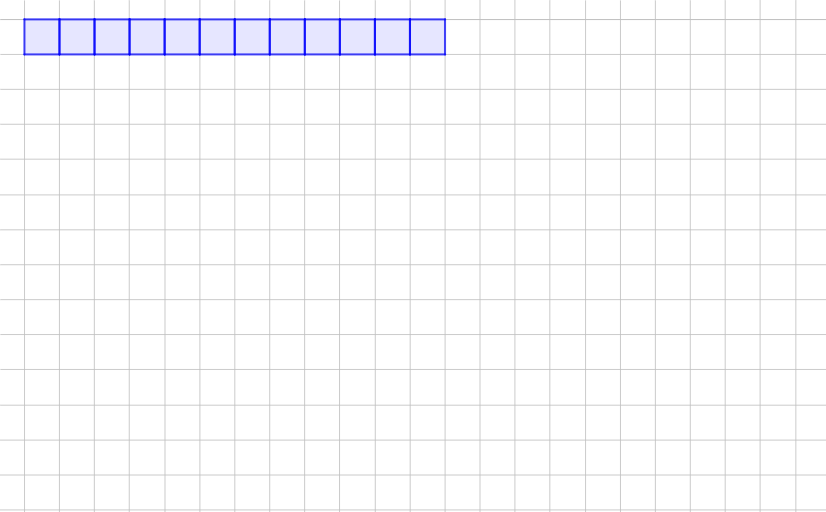
This example demonstrates how to find the factors of a number using multiplication. Key mathematical concepts include the concept of integers and factors. The Polygon command in GeoGebra is used to construct the figures. Suitable for high-grade elementary or low-grade middle school students to learn factorization.
GeoGebra Commands & Parameters
Polygon(A_{1}, A_{1} + (1, 0), A_{1} + (1, 1), A_{1} + (0, 1)) → q_{1}, a_{1}, f_{1}, g_{1}, h_{1}Polygon(A_{2}, A_{2} + (1, 0), A_{2} + (1, 1), A_{2} + (0, 1)) → q_{2}, a_{2}, f_{2}, g_{2}, h_{2}Polygon(A_{3}, A_{3} + (1, 0), A_{3} + (1, 1), A_{3} + (0, 1)) → q_{3}, a_{3}, f_{3}, g_{3}, h_{3}Polygon(A_{4}, A_{4} + (1, 0), A_{4} + (1, 1), A_{4} + (0, 1)) → q_{4}, a_{4}, f_{4}, g_{4}, h_{4}Polygon(A_{5}, A_{5} + (1, 0), A_{5} + (1, 1), A_{5} + (0, 1)) → q_{5}, a_{5}, f_{5}, g_{5}, h_{5}Polygon(A_{6}, A_{6} + (1, 0), A_{6} + (1, 1), A_{6} + (0, 1)) → q_{6}, a_{6}, f_{6}, g_{6}, h_{6}Polygon(A_{7}, A_{7} + (1, 0), A_{7} + (1, 1), A_{7} + (0, 1)) → q_{7}, a_{7}, f_{7}, g_{7}, h_{7}Polygon(A_{8}, A_{8} + (1, 0), A_{8} + (1, 1), A_{8} + (0, 1)) → q_{8}, a_{8}, f_{8}, g_{8}, h_{8}Polygon(A_{9}, A_{9} + (1, 0), A_{9} + (1, 1), A_{9} + (0, 1)) → q_{9}, a_{9}, f_{9}, g_{9}, h_{9}Polygon(A_{10}, A_{10} + (1, 0), A_{10} + (1, 1), A_{10} + (0, 1)) → q_{10}, a_{10}, f_{10}, g_{10}, h_{10}Polygon(A_{11}, A_{11} + (1, 0), A_{11} + (1, 1), A_{11} + (0, 1)) → q_{11}, a_{11}, f_{11}, g_{11}, h_{11}Polygon(A_{12}, A_{12} + (1, 0), A_{12} + (1, 1), A_{12} + (0, 1)) → q_{12}, a_{12}, f_{12}, g_{12}, h_{12}Polygon(A_{13}, A_{13} + (1, 0), A_{13} + (1, 1), A_{13} + (0, 1)) → q_{13}, a_{13}, f_{13}, g_{13}, h_{13}Polygon(A_{14}, A_{14} + (1, 0), A_{14} + (1, 1), A_{14} + (0, 1)) → q_{14}, a_{14}, f_{14}, g_{14}, h_{14}Polygon(A_{15}, A_{15} + (1, 0), A_{15} + (1, 1), A_{15} + (0, 1)) → q_{15}, a_{15}, f_{15}, g_{15}, h_{15}Polygon(A_{16}, A_{16} + (1, 0), A_{16} + (1, 1), A_{16} + (0, 1)) → q_{16}, a_{16}, f_{16}, g_{16}, h_{16}Polygon(A_{17}, A_{17} + (1, 0), A_{17} + (1, 1), A_{17} + (0, 1)) → q_{17}, a_{17}, f_{17}, g_{17}, h_{17}Polygon(A_{18}, A_{18} + (1, 0), A_{18} + (1, 1), A_{18} + (0, 1)) → q_{18}, a_{18}, f_{18}, g_{18}, h_{18}Polygon(A_{19}, A_{19} + (1, 0), A_{19} + (1, 1), A_{19} + (0, 1)) → q_{19}, a_{19}, f_{19}, g_{19}, h_{19}Polygon(A_{20}, A_{20} + (1, 0), A_{20} + (1, 1), A_{20} + (0, 1)) → q_{20}, a_{20}, f_{20}, g_{20}, h_{20}Polygon(A_{21}, A_{21} + (1, 0), A_{21} + (1, 1), A_{21} + (0, 1)) → q_{21}, a_{21}, f_{21}, g_{21}, h_{21}Polygon(A_{22}, A_{22} + (1, 0), A_{22} + (1, 1), A_{22} + (0, 1)) → q_{22}, a_{22}, f_{22}, g_{22}, h_{22}Polygon(A_{23}, A_{23} + (1, 0), A_{23} + (1, 1), A_{23} + (0, 1)) → q_{23}, a_{23}, f_{23}, g_{23}, h_{23}Polygon(A_{24}, A_{24} + (1, 0), A_{24} + (1, 1), A_{24} + (0, 1)) → q_{24}, a_{24}, f_{24}, g_{24}, h_{24}Polygon(A_{25}, A_{25} + (1, 0), A_{25} + (1, 1), A_{25} + (0, 1)) → q_{25}, a_{25}, f_{25}, g_{25}, h_{25}Polygon(A_{26}, A_{26} + (1, 0), A_{26} + (1, 1), A_{26} + (0, 1)) → q_{26}, a_{26}, f_{26}, g_{26}, h_{26}Polygon(A_{27}, A_{27} + (1, 0), A_{27} + (1, 1), A_{27} + (0, 1)) → q_{27}, a_{27}, f_{27}, g_{27}, h_{27}Polygon(A_{28}, A_{28} + (1, 0), A_{28} + (1, 1), A_{28} + (0, 1)) → q_{28}, a_{28}, f_{28}, g_{28}, h_{28}Polygon(A_{29}, A_{29} + (1, 0), A_{29} + (1, 1), A_{29} + (0, 1)) → q_{29}, a_{29}, f_{29}, g_{29}, h_{29}Polygon(A_{30}, A_{30} + (1, 0), A_{30} + (1, 1), A_{30} + (0, 1)) → q_{30}, a_{30}, f_{30}, g_{30}, h_{30}
AI Drawing Prompt Reference
Draw a row of 30 identical unit squares, each with side length 1, placed side by side without gaps. Each square is filled with a distinct color to represent different factors. The entire arrangement forms a long rectangular strip, illustrating the concept of factorization through multiplication. The squares are aligned horizontally, creating a clear visual for teaching integer factors.
The prompt above was compiled from the original drawing commands and is for reference only.