
Extrema of Functions of Two Variables
Loading the math board and drawing, please wait…
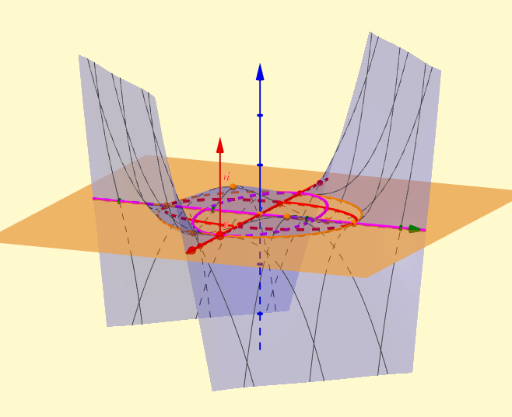
This example demonstrates the extrema of functions of two variables and their geometric significance. It involves core mathematical concepts like partial derivatives, Hessian matrix, and function extremum determination. Construction highlights include using commands like Derivative, IntersectPath, Vector, OrthogonalPlane, Length, etc. Suitable for university-level calculus and mathematics education.
GeoGebra Commands & Parameters
Derivative(f, x) → f_xDerivative(f_x, y) → f_{xy}Derivative(f_x, x) → f_{xx}Derivative(f, y) → f_yDerivative(f_y, y) → f_{yy}IntersectPath(g, f_x) → ndxIntersectPath(g, f_y) → ndyDerivative(f_y, x) → f_{yx}Textfield(f) → CasillaDeEntrada1Vector(((-f_x(P_1)), (-f_y(P_1)), 1) / sqrt(1 + f_x(P_1)^(2) + f_y(P_1)^(2))) → uVector(P_1, P_1 + u) → u'OrthogonalPlane(P_1, u') → aIntersectPath(a, f) → bTextfield(P) → CasillaDeEntrada2Length(lPc) → nJoin({{{"(x, y)", "f(x,y)", "f_x(x,y)", "f_y(x,y)", "f_{xx}(x,y)", "H(x,y)", "Tipo"}}, Sequence[{lPc(k), f(lPc(k)), f_x(lPc(k)), f_y(lPc(k)), f_{xx}(lPc(k)), H(lPc(k)), If[f_x(lPc(k)) ≠ 0 ∨ f_y(lPc(k)) ≠ 0, "No crítico", f_{xx}(lPc(k)) > 0 ∧ H(lPc(k)) > 0, "Mínimo relativo", f_{xx}(lPc(k)) < 0 ∧ H(lPc(k)) > 0, "Máximo relativo", H(lPc(k)) ≠ 0, "Punto de silla", "??"]}, k, 1, Length[lPc]]}) → tPcTableText(tPc, "|_") → texto2Sequence((x(lPc(k)), y(lPc(k)), f(lPc(k))), k, 1, n) → lPczSequence({lPc(k), f_x(lPc(k)), f_y(lPc(k)), f_{xx}(lPc(k)), H(lPc(k)), If[f_x(lPc(k)) ≠ 0 ∨ f_y(lPc(k)) ≠ 0, "No crítico", f_{xx}(lPc(k)) > 0 ∧ H(lPc(k)) > 0, "Mínimo relativo", f_{xx}(lPc(k)) < 0 ∧ H(lPc(k)) > 0, "Máximo relativo", H(lPc(k)) ≠ 0, "Punto de silla", "??"]}, k, 1, Length[lPc]) → lPc0