
Exterior Angle Bisector Theorem and Its Proof
Loading the math board and drawing, please wait…
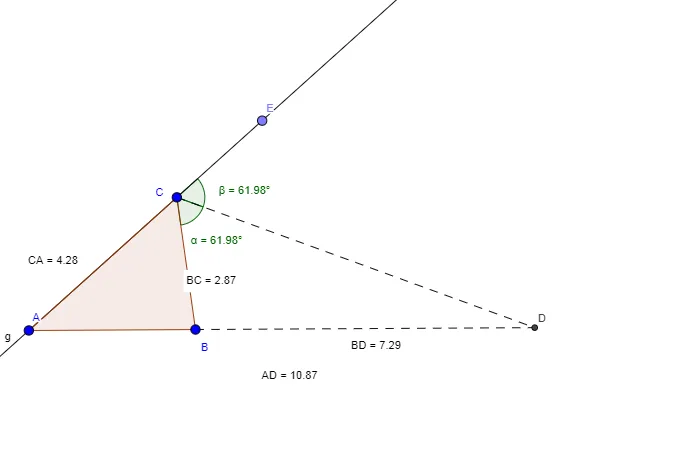
This GeoGebra example demonstrates the exterior angle bisector theorem: when the bisector of an exterior angle of a triangle intersects the extension of the opposite side, it divides that side externally into segments proportional to the adjacent sides. The core mathematical concepts include the exterior angle bisector theorem, ratio and proportion, triangle side-angle relationships, and geometric proof. Construction highlights: using GeoGebra commands such as Line, Polygon, Point, AngularBisector, Intersect, Segment, and Angle to build the triangle, the exterior angle bisector, and its intersection with the extended opposite side; Distance command measures relevant segment lengths, and text objects display the ratio; dynamic points or sliders allow reshaping the triangle to verify the theorem universally. Suitable for middle and high school geometry classes, math competition training, and dynamic geometry exploration, helping students grasp the proof logic and proportional properties of the exterior angle bisector theorem.
GeoGebra Commands & Parameters
Line(A, B) → fDistance(C, A) → distânciaDAPolygon(A, B, C) → pol1, d, a, a'Distance(B, C) → distânciaBCLine(A, C) → gLine(A, B) → hPoint(g) → D_2AngularBisector(D_2, C, B) → iIntersect(h, i) → DDistance(A, D) → distânciaADDistance(B, D) → distânciaBDSegment(C, D) → jSegment(B, D) → kAngle(B, C, D) → αAngle(D, C, D_2) → βPoint(g) → E
AI Drawing Prompt Reference
Draw a triangle with one side extended. Construct the bisector of an exterior angle at one vertex, and let it intersect the extension of the opposite side. Connect this intersection point to a vertex of the triangle, and label the relevant segment lengths and angles to illustrate that the exterior angle bisector divides the opposite side externally in proportion to the adjacent sides. The figure should include the triangle, the extended side, the angle bisector, the intersection point, and labeled segments and angles for clarity.
The prompt above was compiled from the original drawing commands and is for reference only.