
Exploring Triangle Angle Sum Theorem
Loading the math board and drawing, please wait…
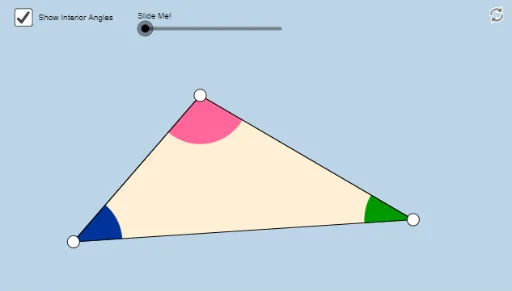
This GeoGebra applet uses transformational geometry tools to help students discover the triangle angle sum theorem. Key mathematical concepts include the sum of a triangle's interior angles and rotation. Using commands like Segment, Polygon, Circle, Angle, and Rotate, students can dynamically explore and verify the properties of the triangle angle sum theorem. Suitable for middle school and above students learning about geometric transformations and triangle angle sum theorems.
GeoGebra Commands & Parameters
Segment(B, C) → eSegment(C, A) → fMin(f, e) → mSegment(A, B) → dMin(d, f) → oMin(m, o) → uPolygon(A, B, C) → poly1, c, a, bRay(A, B) → hRay(B, C) → iRay(C, A) → jCircle(C, (0.25 * u)) → pCircle(A, (0.25 * u)) → qCircle(B, (0.25 * u)) → rIntersect(p, f) → D,Intersect(p, e, 1) → EIntersect(r, e, 1) → FIntersect(r, d, 1) → GIntersect(q, d, 1) → HIntersect(q, f, 1) → IIntersect(r, h, 2) → JIntersect(q, j, 2) → KIntersect(p, i, 2) → LMidpoint(f) → MMidpoint(e) → NCircleSector(A, H, I) → sCircleSector(B, F, G) → tCircleSector(C, D, E) → c_1Angle(A, C, B) → αCircleSector(C, E, D) → d_1CircleSector(A, I, H) → e_1CircleSector(B, G, F) → f_1Min(d, e) → nRotate(s, If[0 < l ≤ 1, (((-l) * 180))°, (-(180°))], M) → s'Rotate(A, If[0 < l ≤ 1, (((-l) * 180))°, (-(180°))], M) → A'Segment(M, A') → a_1Rotate(H, (-(180°)), M) → H'Line(H', C) → b_1Rotate(B, If[0 < l ≤ 1, ((l * 180))°, 180°], N) → B'Rotate(t, If[0 < l ≤ 1, ((l * 180))°, 180°], N) → t'Segment(N, B') → g_1Segment(C, M) → h_1Segment(M, A) → i_1Segment(C, N) → j_1Segment(N, B) → k_1Rotate(A, If[0 < l ≤ 1, ((l * 180))°, (-(180°))], M) → A'_1Rotate(B, If[0 < l ≤ 1, (((-l) * 180))°, (-(180°))], N) → B'_1Segment(N, B'_1) → l_1Segment(M, A'_1) → m_1Rotate(e_1, If[0 < l ≤ 1, ((l * 180))°, (-(180°))], M) → p_1Rotate(f_1, If[0 < l ≤ 1, (((-l) * 180))°, (-(180°))], N) → q_1CircleSector(C, L, D) → r_1CircleSector(A, K, H) → s_1CircleSector(B, J, F) → t_1CircleSector(A, H, K) → c_2CircleSector(B, F, J) → d_2CircleSector(C, D, L) → e_2Dilate(A, 1 - v, C) → A'_2Dilate(B, 1 - v, C) → B'_2Vector(A, A'_2) → wVector(B, B'_2) → u_1Translate(s_1, w) → f_2CircleArc(A, K, H) → g_2Translate(t_1, u_1) → h_2CircleArc(B, J, F) → k_2Translate(c_2, w) → p_2CircleArc(A, H, K) → q_2Translate(d_2, u_1) → r_2CircleArc(B, F, J) → s_2
AI Drawing Prompt Reference
Draw a triangle and display its angle sum. Rotate the triangle's vertices to observe the constant sum of interior angles. Use circles and sectors to represent each angle, and employ a slider to dynamically adjust the rotation angle, verifying the triangle angle sum theorem.
The prompt above was compiled from the original drawing commands and is for reference only.