
Exploring the Unit Circle by Alison Schucht
Loading the math board and drawing, please wait…
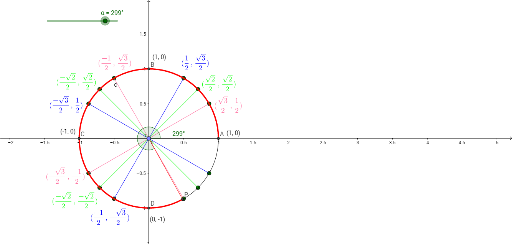
This example demonstrates the relationship between any point on the unit circle and its corresponding trigonometric values. It involves core mathematical concepts such as the circle, trigonometric functions, coordinate geometry, and angles. The construction uses GeoGebra commands like Point, Circle, Rotate, Sequence, Segment, Angle, and CircleArc. It is suitable for high school mathematics teaching and learning the geometric meaning of the unit circle and trigonometric functions.
GeoGebra Commands & Parameters
Point(xAxis) → OCircle(O, 1) → cRotate(A, α, O) → PSequence(Rotate[A, ((90 * k) + 30)°, O], k, 0, 3) → list1Sequence(Rotate[A, ((90 * k) + 60)°, O], k, 0, 3) → list2Sequence(Rotate[A, ((90 * k) + 45)°, O], k, 0, 3) → list3Segment(A, C) → fSegment(B, D) → gSequence(Segment[O, Element[list1, k]], k, 1, 4) → list4Sequence(Segment[O, Element[list2, k]], k, 1, 4) → list5Sequence(Segment[O, Element[list3, k]], k, 1, 4) → list6Rotate(A, α, O) → A'Angle(A, O, A') → βCircleArc(O, A, P) → dSegment(O, P) → h
AI Drawing Prompt Reference
Draw a unit circle and mark four points on it. Connect each point to the center of the circle with a line segment. Then, draw angles of 30°, 60°, and 45° at the center, with each angle having its corresponding line segments. Finally, label the cosine and sine values for each point on the circle and connect the points to their respective values with arcs.
The prompt above was compiled from the original drawing commands and is for reference only.