
Exploring the Angle Sum Property of a Triangle
Loading the math board and drawing, please wait…
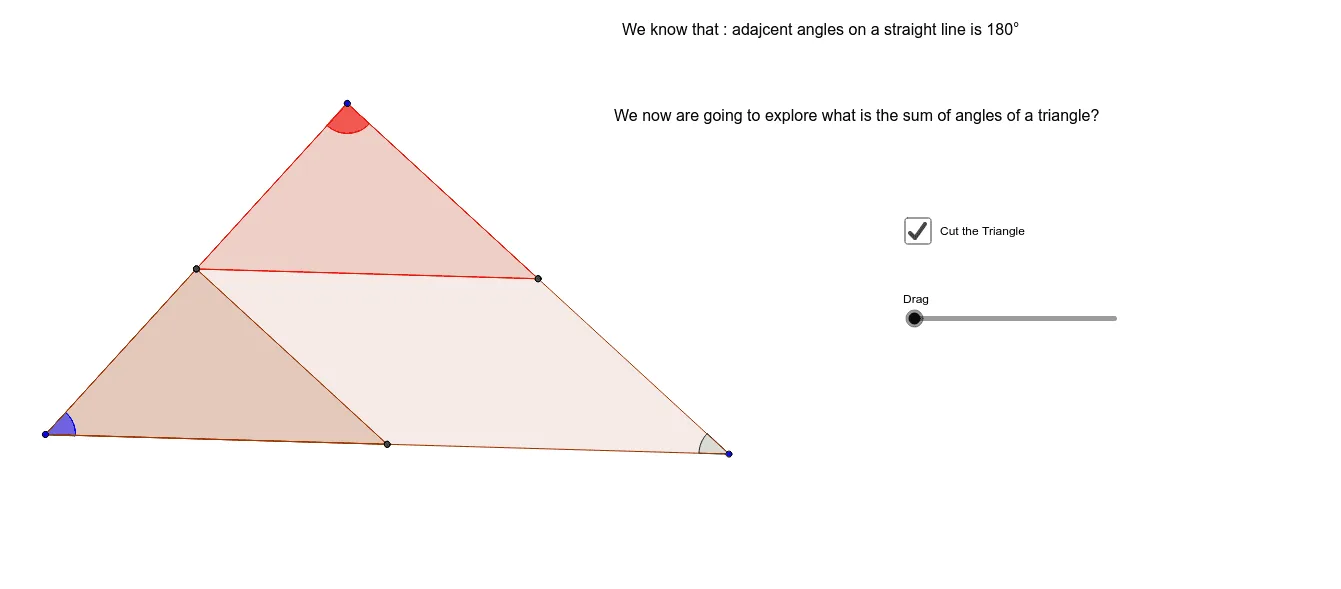
This example demonstrates the angle sum property of a triangle. Key mathematical concepts include the angle sum theorem of a triangle. By constructing a triangle and its angles, using rotation, vector, and translation commands, the invariance of the angle sum is explored. Suitable for middle school and above students to learn geometric construction and triangle properties.
GeoGebra Commands & Parameters
If(v < 0, (-(v + 1)), 1) → v1If(v > 0, v, 0) → v2Polygon(A, B, C) → t1, c, a, bAngle(B, A, C) → αAngle(A, C, B) → βAngle(C, B, A) → γMidpoint(c) → DMidpoint(a) → EMidpoint(b) → FPolygon(A, D, F) → t2, f, a_1, dRotate(A, (v1 * 180°), F) → A'Rotate(D, (v1 * 180°), F) → D'Rotate(F, (v1 * 180°), F) → F'Polygon(A', D', F') → t2', f', a', d'Polygon(D, B, E) → t3, e, d_1, b_1Vector(B, C) → uTranslate(D, Vector[(v2 * u)]) → D'_1Translate(B, Vector[(v2 * u)]) → B'Translate(E, Vector[(v2 * u)]) → E'Polygon(D'_1, B', E') → t3', e', d'_1, b'InteriorAngles(t2') → δ, ε, ζInteriorAngles(t3') → η, θ, ι