
Exploring SSA Condition for Triangles
Loading the math board and drawing, please wait…
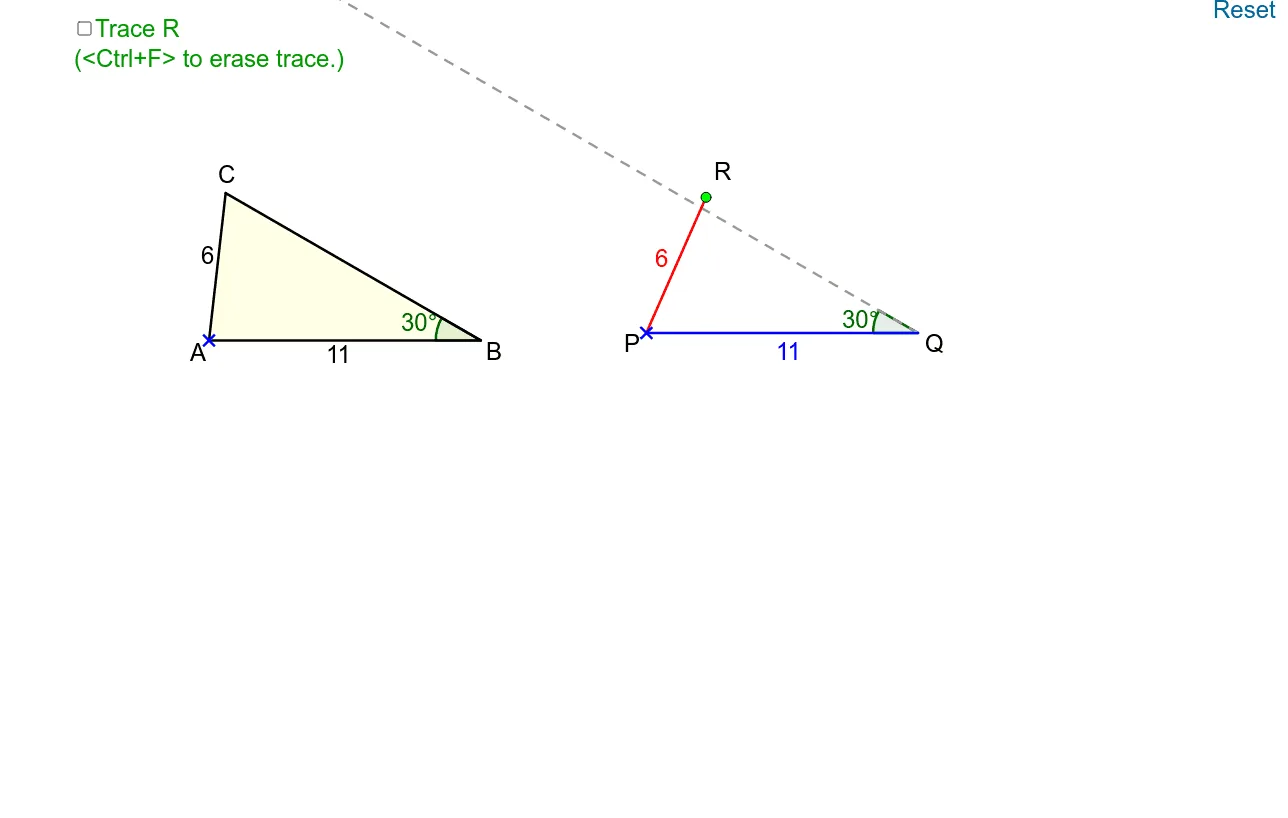
This example demonstrates constructing triangles under the SSA (two sides and a non-included angle) condition. Key concepts include the uniqueness of triangles under this condition. Using GeoGebra commands such as Point, Rotate, Intersect, etc., dynamic exploration of triangle construction under different angles is possible. Suitable for high school geometry courses.
GeoGebra Commands & Parameters
Point(Semicircle[(x(H) - 4, y(H)), (x(H) + 4, y(H))]) → JRotate(A, 330*°, B) → A'Angle(A', B, A) → αIntersect(Circle[A, 6], Line[B, A']) → C_1, CPolygon(A, B, C) → poly1, c, a, bPoint(Ray[D, (x(D) + 1, y(D))]) → ESegment(D, E) → dPoint(Ray[F, (x(F) + 1, y(F))]) → GSegment(F, G) → eAngle(J, H, I) → βRotate(P, -γ, Q) → P'Angle(P', Q, P) → δPoint(Circle[P, d]) → RRotate(I, -γ, H) → I'Angle(I', H, I) → εSegment(I, H) → gSegment(J, H) → hRay(Q, P') → iIntersect(OrthogonalLine[R, i], i) → KPolygon(P, Q, R) → poly2, r, p, qIf(Distance[R, K] < 0.01, true, false) → on