
Exploring Sine, Cosine, and Tangent with Triangles
Loading the math board and drawing, please wait…
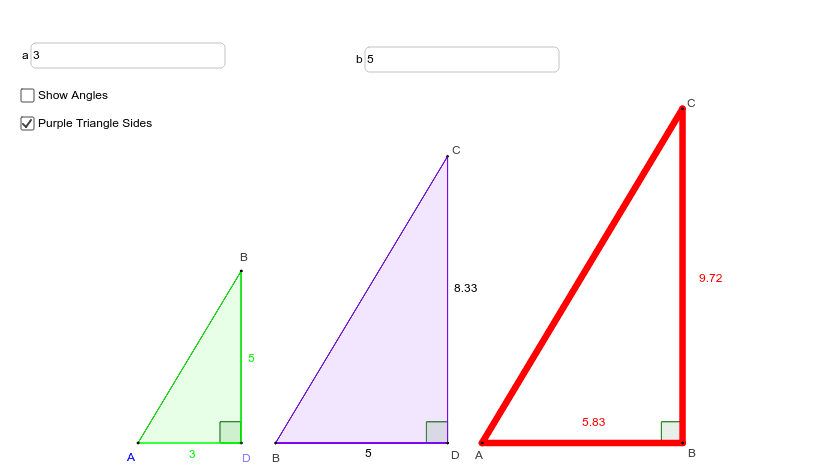
This example demonstrates the geometric meaning of sine, cosine, and tangent functions through dynamic right triangles. Key math concepts include the definition of trigonometric functions, properties of right triangles, and angle measurement. Construction involves commands like Line, Circle, Intersect, OrthogonalLine, Segment, Polygon, Point, and Angle to create and measure triangle elements. Suitable for middle school and above, helping students visually connect trigonometry with geometric shapes.
GeoGebra Commands & Parameters
Textfield(a_3) → inputBox1Textfield(b) → inputBox2Line(A, B_1) → dCircle(A, a_3) → eIntersect(e, d, 2) → DOrthogonalLine(D, d) → fCircle(D, b) → gIntersect(g, f, 2) → BCircle(D, b^(2) / a_3) → cIntersect(c, d, 2) → CSegment(A, B) → hSegment(B, C) → iSegment(A, C) → jSegment(B, D) → kPolygon(A, D, B) → poly1, d_1, a_1, c_1Circle(F, a_3) → pPoint(p) → HSegment(F, H) → lSegment(A, B) → mCircle(F, m) → qCircle(H, b) → rIntersect(q, r, 1) → ISegment(F, I) → nSegment(I, H) → sSegment(D, C) → b_1Segment(A, C) → l_1Segment(D, C) → m_1Line(F, H) → tCircle(H, 1) → e_1Intersect(e_1, t, 2) → JCircle(J, k) → f_1Intersect(f_1, t, 2) → KCircle(J, i) → g_1OrthogonalLine(K, t) → h_1Intersect(g_1, h_1, 2) → LSegment(J, L) → i_1Segment(L, K) → j_1Segment(K, J) → k_1Circle(K, 1) → p_1Intersect(p_1, t, 2) → NCircle(N, h) → q_1Intersect(q_1, t, 2) → B_3OrthogonalLine(B_3, t) → n_1Circle(N, j) → r_1Intersect(r_1, n_1, 2) → PSegment(N, P) → s_1Segment(P, B_3) → t_1Segment(B_3, N) → a_2Polygon(I, H, F) → poly2, f_2, i_2, h_2Polygon(B, C, D) → poly3, c_2, d_2, e_2Polygon(L, K, J) → poly4, j_2, l_2, k_2Angle(B, D, A) → αAngle(A, B, C) → βSegment(A, D) → aSegment(F, H) → a_5Segment(I, H) → b_2Segment(J, K) → g_2Segment(J, K) → m_2Segment(B, D) → n_2Angle(I, H, F) → γAngle(L, K, J) → δAngle(P, B_3, N) → εAngle(H, F, I) → ζAngle(K, J, L) → ηAngle(B_3, N, P) → θ
AI Drawing Prompt Reference
Draw a right triangle with labeled vertices. Construct a circle with one leg as the diameter, intersecting the other leg at a point. Connect this point to the right angle vertex to form a new triangle. Label all angles and side lengths, demonstrating the geometric meaning of sine, cosine, and tangent functions.
The prompt above was compiled from the original drawing commands and is for reference only.