
Exploring Reflections 4: Mirror Sequences of Polygons and Tangents
Loading the math board and drawing, please wait…
In collections
Geometry Transformations
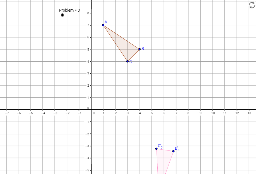
① This example demonstrates how to use the Mirror command in GeoGebra to reflect polygons, tangent lines, and parametric curves multiple times, generating a series of symmetric figures that visually illustrate the effects of reflection. ② Core mathematical concepts include reflection (axial symmetry), tangent lines, translation, parametric curves, and sequences, integrating transformation geometry with function graphing. ③ Construction highlights: The Polygon command creates the base polygon, and the Mirror command reflects the polygon, its edges, and tangent objects to produce multiple mirrored copies (e.g., A', B', C', poly1'), involving slope objects (Slope), parametric curves (c, d), and repeated reflections to form a sequence. ④ Suitable for middle school geometry or introductory college transformation courses, this example helps students understand reflection properties, symmetry, and the implementation of transformations in dynamic geometry software, while also exploring interactions with sequences and parametric curves.
GeoGebra Commands & Parameters
Polygon(A, B, C) → poly1, c, a, b_1Mirror(A, d) → A'Mirror(B, d) → B'Mirror(C, d) → C'Polygon(A', B', C') → poly1', c', a', b'Mirror(A, e) → A'_2Mirror(B, e) → B'_2Mirror(C, e) → C'_2Polygon(A'_2, B'_2, C'_2) → poly1'_1, c'_1, a'_1, b'_1Mirror(A, f) → A'_3Mirror(B, f) → B'_3Mirror(C, f) → C'_3Polygon(A'_3, B'_3, C'_3) → poly1'_2, c'_2, a'_2, b'_2Mirror(A, g) → A'_4Mirror(B, g) → B'_4Mirror(C, g) → C'_4Polygon(A'_4, B'_4, C'_4) → poly1'_3, c'_3, a'_3, b'_3
AI Drawing Prompt Reference
Draw a triangle, then reflect it across a straight line to create a mirrored triangle, connecting the reflected vertices. Next, reflect the original triangle across three other distinct lines one by one, each time forming a new triangle from the reflected points. The final image shows the original triangle and four mirrored triangles positioned around different axes, illustrating multiple reflections. All triangles are solid polygons, and the reflection axes are dashed lines, clearly demonstrating the symmetry transformations.
The prompt above was compiled from the original drawing commands and is for reference only.