
Exploring Quadrilateral Properties with Geometric Construction
Loading the math board and drawing, please wait…
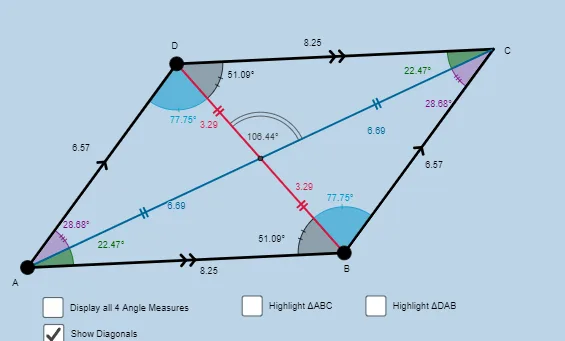
This example demonstrates how geometric properties of quadrilaterals change under specific construction choices. By building a quadrilateral from key points and adding constraints through intersections, midpoints, and angle measurements, it highlights relationships among sides/diagonals and the corresponding angles. The core concepts include general quadrilateral geometry, constructing and analyzing segment/line configurations, identifying intersection points and midpoints, measuring angles to compare geometric invariants, and using mirror (symmetry) transformations to generate corresponding points and test hypotheses about preserved angle or positional relations. The construction relies on GeoGebra commands such as Segment, Line, Intersect, Midpoint, Angle, Polygon, and Mirror, along with objects like A, B, C, D, their mirrored counterparts (e.g., A', B', C'), quadrilateral polygons (poly1, poly2), and multiple angle labels (α, β, γ, δ, ε, ζ, η, θ) to track the relationships. Suitable for middle/high school geometry exploration, classroom demonstrations, and geometry problem-solving workflows.
GeoGebra Commands & Parameters
Segment(A, B) → aSegment(A, D) → bLine(D, a) → cLine(B, b) → dIntersect(c, d) → CSegment(D, C) → eSegment(B, C) → fMidpoint(A, C) → ESegment(A, E) → gSegment(E, C) → hSegment(D, E) → iSegment(E, B) → jAngle(B, A, E) → αAngle(D, C, E) → βAngle(E, A, D) → γAngle(C, B, E) → δAngle(A, D, E) → εAngle(E, B, A) → ζAngle(E, D, C) → ηAngle(E, C, B) → θAngle(C, E, D) → ιPolygon(A, B, C) → poly1, c_1, a_1, b_1Mirror(A, g) → A'Mirror(B, g) → B'Mirror(C, g) → C'Polygon(A', B', C') → poly1', c', a', b'Polygon(A, B, D) → poly2, d_1, a_2, b_2Mirror(A, j) → A'_1Mirror(B, j) → B'_1Mirror(D, j) → D'Polygon(A'_1, B'_1, D') → poly2', d', a'_1, b'_1Angle(B, A, D) → κAngle(A, D, C) → λAngle(D, C, B) → μAngle(C, B, A) → νPolygon(A, B, C, D) → poly3, a_3, b_3, c_2, d_2
AI Drawing Prompt Reference
Draw a quadrilateral ABCD, connect A and B, A and D, D and A's perpendicular line, B and D's perpendicular line, which intersect at point C. Connect D and C, B and C, and the midpoint E of A and C, then connect A and E, E and C, D and E, and E and B. Measure angles BAC, DCB, AED, CEB, AED, BEA, DEB, and CEB. Reflect points A, B, and C over line segment AE to form a new quadrilateral A'B'C'. Connect A and B, B and D, D and A, and measure angles BAD, ADC, CBA, and ABC. Finally, form the complete quadrilateral ABCD.
The prompt above was compiled from the original drawing commands and is for reference only.