
Exploring Quadrilateral Area
Loading the math board and drawing, please wait…
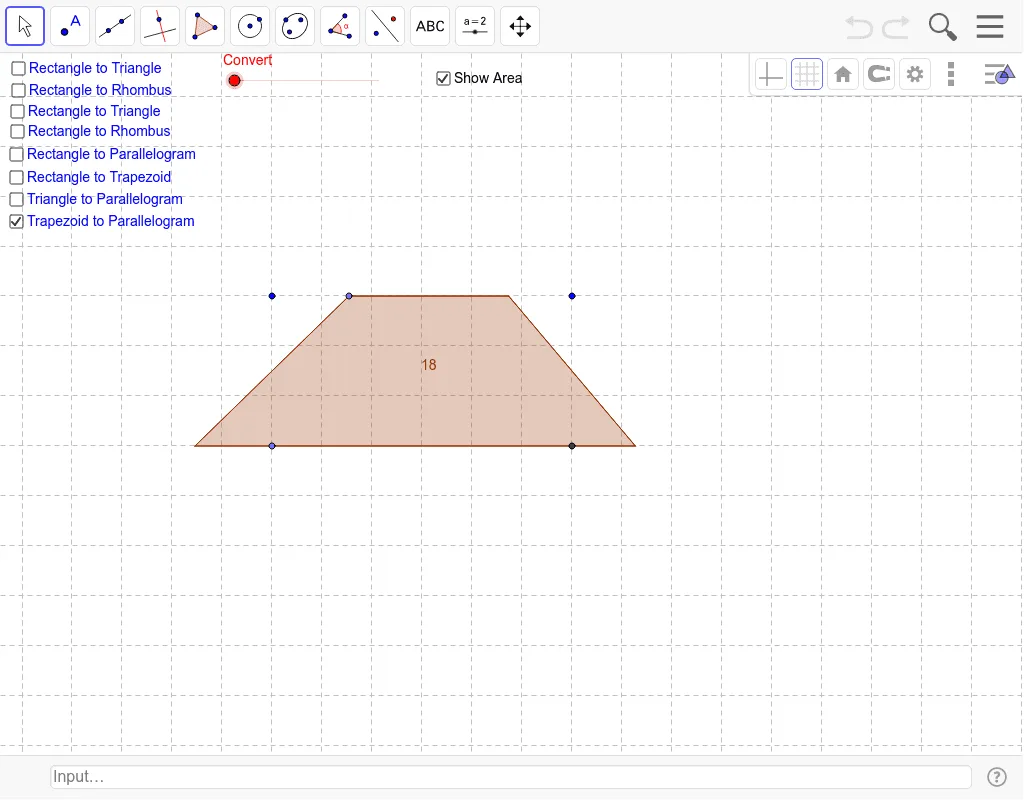
This example demonstrates how to explore the area of a quadrilateral through geometric construction. Key mathematical concepts include polygons, angles, transformations, and slider animation. Using GeoGebra commands such as Line, Polygon, Rotate, and Mirror, dynamic construction and observation of quadrilateral changes are achieved. Suitable for middle school and above students and teachers.
GeoGebra Commands & Parameters
Line(A, B) → aOrthogonalLine(A, a) → bPoint(b) → CLine(C, a) → cOrthogonalLine(B, a) → dIntersect(c, d) → DSegment(A, B) → ePoint(e) → ESegment(E, C) → fSegment(E, D) → gMidpoint(f) → FMidpoint(g) → GSemicircle(E, D) → hOrthogonalLine(E, e) → iIntersect(c, i) → HSemicircle(B, H) → kSemicircle(D, E) → p_1Semicircle(H, A) → qSemicircle(C, E) → rSemicircle(E, C) → sRotate(E, -α, G) → E'Angle(E', G, E) → βRotate(B, -α, G) → B'Angle(B', G, B) → γRotate(D, -α, G) → D'Angle(D', G, D) → δPolygon(E', B', D') → poly1, d', e', b'Rotate(A, α, F) → A'Angle(A, F, A') → εRotate(E, α, F) → E'_1Angle(E, F, E'_1) → ζRotate(C, α, F) → C'Angle(C, F, C') → ηPolygon(A', C', E'_1) → poly2, e'_1, a', c'Midpoint(e) → IMidpoint(A, C) → JMidpoint(C, D) → KMidpoint(B, D) → LPolygon(J, I, L, K) → poly3, j_1, i_1, l, k_1Midpoint(j_1) → MMidpoint(i_1) → NMidpoint(l) → OMidpoint(k_1) → PRotate(J, α, P) → J'Angle(J, P, J') → θRotate(C, α, P) → C'_1Angle(C, P, C'_1) → ιRotate(K, α, P) → K'Angle(K, P, K') → κPolygon(J', C'_1, K') → poly4, k', j', c'_1Rotate(K, -α, O) → K'_1Angle(K'_1, O, K) → λRotate(L, -α, O) → L'Angle(L', O, L) → μRotate(D, -α, O) → D'_1Angle(D'_1, O, D) → νPolygon(K'_1, D'_1, L') → poly5, l', k'_1, d'_1Rotate(A, -α, M) → A'_1Angle(A'_1, M, A) → ξRotate(I, -α, M) → I'Angle(I', M, I) → οRotate(J, -α, M) → J'_1Angle(J'_1, M, J) → ρPolygon(J'_1, A'_1, I') → poly6, i', j'_1, a'_1Rotate(B, α, N) → B'_1Angle(B, N, B'_1) → σRotate(L, α, N) → L'_1Angle(L, N, L'_1) → τRotate(I, α, N) → I'_1Angle(I, N, I'_1) → υPolygon(B'_1, L'_1, I'_1) → poly7, i'_1, b'_1, l'_1Segment(A', C') → n_2Polygon(C, E, D) → poly8, d_1, c_1, e_1Midpoint(A, C) → QMidpoint(D, C) → RMidpoint(A, B) → SMidpoint(B, D) → TSegment(Q, T) → tSegment(S, R) → a_1Intersect(t, a_1) → UPoint(e) → VMirror(V, U) → V'Polygon(C, Q, V, B, T, V') → poly9, c_2, q_1, v, b_1, t_1, v'Rotate(A, α, Q) → A'_2Angle(A, Q, A'_2) → ϕRotate(V, α, Q) → V'_1Angle(V, Q, V'_1) → χPolygon(Q, V'_1, A'_2) → poly10, a'_2, q_2, v'_1Rotate(V', α, T) → V''Angle(V', T, V'') → ψRotate(D, α, T) → D'_2Angle(D, T, D'_2) → ωPolygon(V'', D'_2, T) → poly11, t_2, v'', d'_2Segment(C, D) → f_1Segment(C, V') → g_1Segment(V, B) → h_1Segment(Q, C) → l_1Midpoint(A, C) → WMidpoint(B, D) → ZSegment(V, B) → m_1Point(m_1) → A_1Polygon(W, C, D, Z, A_1, V) → poly12, w, c_3, d_2, z, u_2, v_1Rotate(A_1, -α, Z) → B_1Angle(B_1, Z, A_1) → α_1Rotate(B, -α, Z) → B'_2Angle(B'_2, Z, B) → β_1Polygon(B_1, Z, B'_2) → poly13, b'_2, b_2, z_1Segment(E, C) → n_1Segment(C, D) → r_1Segment(E, D) → s_1Midpoint(s_1) → C_1Rotate(E, α, C_1) → E'_2Angle(E, C_1, E'_2) → γ_1Rotate(C, α, C_1) → C'_2Angle(C, C_1, C'_2) → δ_1Rotate(D, α, C_1) → D'_3Angle(D, C_1, D'_3) → ε_1Polygon(E'_2, C'_2, D'_3) → poly14, d'_3, e'_2, c'_2Midpoint(A, C) → D_1Midpoint(B, D) → E_1Mirror(V, D_1) → V'_2Mirror(A_1, E_1) → F_1Polygon(V, V'_2, F_1, A_1) → poly15, v_2, v'_2, f_2, a_2Midpoint(A_1, F_1) → G_1Rotate(A_1, α, G_1) → H_1Angle(A_1, G_1, H_1) → ζ_1Rotate(V, α, G_1) → V'_3Angle(V, G_1, V'_3) → η_1Rotate(V'_2, α, G_1) → I_1Angle(V'_2, G_1, I_1) → θ_1Rotate(F_1, α, G_1) → J_1Angle(F_1, G_1, J_1) → ι_1Polygon(V'_3, I_1, J_1, H_1) → poly16, v'_3, i_2, j_2, h_2Polygon(E'_1, A', C') → poly17, c'_3, e'_3, a'_3Polygon(A, C, D, B) → poly18, a_3, c_4, d_3, b_3Polygon(C, E, D) → poly19, d_4, c_5, e_2Polygon(E', B', D') → poly20, d'_4, e'_4, b'_3Polygon(A'_1, J'_1, I') → poly21, i'_2, a'_4, j'_2Polygon(B'_1, I'_1, L'_1) → poly22, l'_2, b'_4, i'_3Polygon(J', K', C'_1) → poly23, c'_4, j'_3, k'_2Polygon(K'_1, D'_1, L') → poly24, l'_3, k'_3, d'_5Polygon(A, C, D, B) → poly25, a_4, c_6, d_5, b_4Polygon(I, J, K, L) → poly26, i_3, j_3, k_2, l_2Polygon(V'_1, A'_2, Q) → poly27, q_3, v'_4, a'_5Polygon(D'_2, T, V'') → poly28, v''_1, d'_6, t_3Polygon(V, V'_1, V', V'') → poly29, v_3, v'_5, v'_6, v''_2Polygon(A, C, D, B) → poly30, a_5, c_7, d_6, b_5Point(b_5) → K_1Polygon(V'_1, A'_2, Q) → poly31, q_4, v'_7, a'_6Polygon(B_1, Z, B'_2) → poly32, b'_5, b_6, z_2Polygon(V, V'_1, B_1, A_1) → poly33, v_4, v'_8, b_7, a_6Polygon(A, C, D, B) → poly34, a_7, c_8, d_7, b_8Polygon(E, C, D) → poly35, d_8, e_3, c_9Polygon(D'_3, E'_2, C'_2) → poly36, c'_5, d'_7, e'_5Polygon(C'_2, E, C, D) → poly37, c'_6, e_4, c_{10}, d_9Polygon(V, V'_2, F_1, A_1) → poly38, v_5, v'_9, f_3, a_8Polygon(J_1, H_1, V'_3, I_1) → poly39, j_4, h_3, v'_{10}, i_4Polygon(V, V'_2, V'_3, I_1) → poly40, v_6, v'_{11}, v'_{12}, i_5Midpoint(A, E) → L_1Midpoint(E, B) → M_1Mirror(C, L_1) → C'_3Polygon(A, C, D, B) → poly41, a_9, c_{11}, d_{10}, b_9Polygon(L_1, C, D, M_1) → poly42, l_3, c_{12}, d_{11}, m_2Mirror(A, L_1) → A'_3Mirror(A'_3, L_1) → O_1Intersect(l_3, c_{12}) → P_1Rotate(O_1, -α, L_1) → Q_1Angle(Q_1, L_1, O_1) → κ_1Rotate(P_1, -α, L_1) → R_1Angle(R_1, L_1, P_1) → λ_1Polygon(Q_1, R_1, L_1) → poly43, l_4, q_5, r_2Rotate(D, α, M_1) → D'_4Angle(D, M_1, D'_4) → μ_1Rotate(B, α, M_1) → B'_3Angle(B, M_1, B'_3) → ν_1Polygon(M_1, B'_3, D'_4) → poly44, d'_8, m_3, b'_6Polygon(R_1, C, D) → poly45, d_{12}, r_3, c_{13}Circle(C, D) → p_2Line(A, B) → g_2Intersect(p_2, g_2) → N_1, S_1Polygon(A, C, D, B) → poly46, a_{10}, c_{14}, d_{13}, b_{10}Polygon(C, S_1, B, D) → poly47, c_{15}, s_2, b_{11}, d_{14}Segment(A, B) → g_3Midpoint(g_3) → T_1Rotate(A, -α, T_1) → A'_4Angle(A'_4, T_1, A) → ξ_1Segment(C, D) → k_3Midpoint(c_{14}) → U_1Rotate(C, -α, U_1) → C'_4Angle(C'_4, U_1, C) → ο_1Midpoint(S_1, B) → V_1Mirror(A, V_1) → A'_5Midpoint(S_1, A'_5) → W_1Rotate(S_1, -α, W_1) → Z_1Angle(Z_1, W_1, S_1) → ρ_1Polygon(A'_4, C'_4, Z_1) → poly48, z_3, a'_7, c'_7Polygon(C, S_1, Z_1, D) → poly49, c_{16}, s_3, z_4, d_{15}
AI Drawing Prompt Reference
Draw a quadrilateral by constructing lines, points, and arcs to explore its area. Start by drawing line segment AB, then construct a perpendicular line to AB, find the foot of the perpendicular C, draw line segment BC, construct its perpendicular line, and find the foot of the perpendicular D. Connect AD and BC, find the midpoints F and G of AD and BC, construct arcs with diameters E and D, E and C, then rotate points E, B, D to get E', B', D'. Construct quadrilateral E'B'D'. Next, rotate points A, E, C to get A', E'_1, C', and construct quadrilateral A'C'E'_1. Finally, find the midpoints I, J, L, K of line segments AB, EC, and construct quadrilateral JKIL, then rotate points J, C, K to get J', C'_1, K'.
The prompt above was compiled from the original drawing commands and is for reference only.