
Exploring Geometric Dilations and Scale Factors
Loading the math board and drawing, please wait…
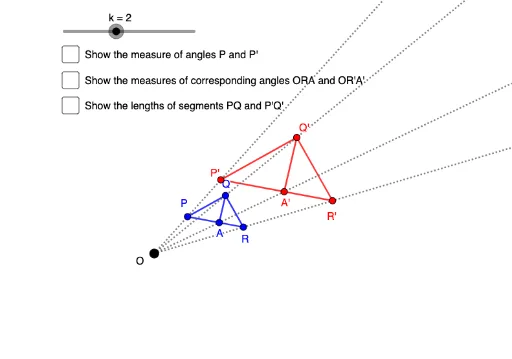
This GeoGebra example dynamically demonstrates the geometric phenomenon of dilations (similarity transformations), showing how points and segments scale relative to a center of dilation. Core mathematical concepts include the center of dilation, scale factor (similarity ratio), properties of similar figures, and the proportional scaling of distances. To construct this, the model uses Point and Segment to build the initial segment PQ, the Dilate command to generate the scaled points P' and Q', and Ray to draw auxiliary lines. The Distance command measures distancePQ and distanceP'Q', while Text objects dynamically display the numerical ratios, providing an interactive way to visualize how distances scale under similarity transformations. It is highly suitable for middle school or high school geometry curricula, specifically for teaching similarity, scale factors, and geometric constructions.
GeoGebra Commands & Parameters
Segment(P, Q) → fSegment(Q, R) → gSegment(R, P) → hDilate(P, k, O) → P'Dilate(Q, k, O) → Q'Dilate(R, k, O) → R'Segment(P', R') → iSegment(P', Q') → jSegment(R', Q') → k_1Ray(O, P) → lRay(O, Q) → mRay(O, R) → nDistance(O, P) → distanceABDistance(O, P') → distanceAB'Point(h) → ASegment(Q, A) → pDilate(A, k, O) → A'Ray(O, A) → qSegment(Q', A') → rDistance(P, Q) → distancePQDistance(P', Q') → distanceP'Q'Angle(Q', P', R') → αAngle(Q, P, R) → βAngle(O, R, A) → γAngle(O, R', A') → δDistance(P, Q) → cDistance(P', Q') → d