
Exploring Fractal Tree Branches
Loading the math board and drawing, please wait…
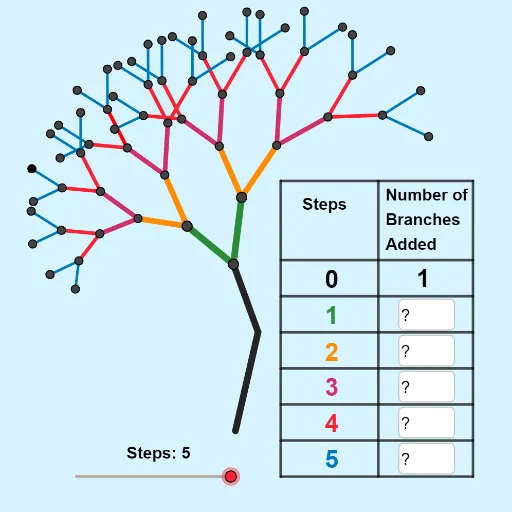
This example demonstrates how to create a fractal tree using GeoGebra's sequence command and investigates the number of branches. Key math concepts include fractal geometry, recursive sequences, and geometric transformations. Construction highlights the use of commands like Segment, Point, Angle, Rotate, Ray, Circle, Intersect, and objects such as treebranch and Textfield. Suitable for high school and above students learning about fractal patterns and mathematical modeling.
GeoGebra Commands & Parameters
Segment(M_5, N_5) → g_7Point(g_7) → S_5Segment(A, B) → aSegment(B, C) → bSegment(B, D) → cAngle(C, B, A) → αSegment(B, D') → rSegment(E, F) → hRotate(E, (-α), F) → E'Angle(E', F, E) → εRay(F, E') → iCircle(F, (b / a * Distance[E, F])) → kIntersect(k, i, 1) → GAngle(A, B, D) → βRotate(E, β, F) → E'_1Angle(E, F, E'_1) → γRay(F, E'_1) → dCircle(F, (c / a * Distance[F, E])) → eIntersect(e, d, 1) → HSegment(F, G) → fSegment(F, H) → gtreebranch(A, B, C, D, B', C') → I, J, j, ltreebranch(A, B, C, D, B', D') → K, L, m, n_1treebranch(A, B, C, D, C', I) → M, N, p, qtreebranch(A, B, C, D, Element[list1, 1], Element[list2, 2]) → O, P, s, ttreebranch(A, B, C, D, Element[list1, 2], Element[list2, 3]) → Q, R, a_1, b_1treebranch(A, B, C, D, Element[list1, 2], Element[list2, 4]) → S, T, c_1, d_1treebranch(A, B, C, D, Element[list2, 1], Element[list3, 1]) → U, V, e_1, f_1treebranch(A, B, C, D, Element[list2, 1], Element[list3, 2]) → W, Z, g_1, h_1treebranch(A, B, C, D, Element[list2, 2], Element[list3, 3]) → A_1, B_1, i_1, j_1treebranch(A, B, C, D, Element[list2, 2], Element[list3, 4]) → C_1, D_1, k_1, l_1treebranch(A, B, C, D, Element[list2, 3], Element[list3, 5]) → E_1, F_1, m_1, p_1treebranch(A, B, C, D, Element[list2, 3], Element[list3, 6]) → G_1, H_1, q_1, r_1treebranch(A, B, C, D, Element[list2, 4], Element[list3, 7]) → I_1, J_1, s_1, t_1treebranch(A, B, C, D, Element[list2, 4], Element[list3, 8]) → K_1, L_1, a_2, b_2treebranch(A, B, C, D, Element[list3, 1], Element[list4, 1]) → M_1, N_1, c_2, d_2treebranch(A, B, C, D, Element[list3, 1], Element[list4, 2]) → O_1, P_1, e_2, f_2treebranch(A, B, C, D, Element[list3, 2], Element[list4, 3]) → Q_1, R_1, g_2, h_2treebranch(A, B, C, D, Element[list3, 2], Element[list4, 4]) → S_1, T_1, i_2, j_2treebranch(A, B, C, D, Element[list3, 3], Element[list4, 5]) → U_1, V_1, k_2, l_2treebranch(A, B, C, D, Element[list3, 3], Element[list4, 6]) → W_1, Z_1, m_2, n_2treebranch(A, B, C, D, Element[list3, 4], Element[list4, 7]) → A_2, B_2, p_2, q_2treebranch(A, B, C, D, Element[list3, 4], Element[list4, 8]) → C_2, D_2, r_2, s_2treebranch(A, B, C, D, Element[list3, 5], Element[list4, 9]) → E_2, F_2, t_2, a_3treebranch(A, B, C, D, Element[list3, 5], Element[list4, 10]) → G_2, H_2, b_3, c_3treebranch(A, B, C, D, Element[list3, 6], Element[list4, 11]) → I_2, J_2, d_3, e_3treebranch(A, B, C, D, Element[list3, 6], Element[list4, 12]) → K_2, L_2, f_3, g_3treebranch(A, B, C, D, Element[list3, 7], Element[list4, 13]) → M_2, N_2, h_3, i_3treebranch(A, B, C, D, Element[list3, 7], Element[list4, 14]) → O_2, P_2, j_3, k_3treebranch(A, B, C, D, Element[list3, 8], Element[list4, 15]) → Q_2, R_2, l_3, m_3treebranch(A, B, C, D, Element[list3, 8], Element[list4, 16]) → S_2, T_2, n_3, p_3treebranch(A, B, C, D, Element[list4, 1], Element[list5, 1]) → U_2, V_2, q_3, r_3treebranch(A, B, C, D, Element[list4, 1], Element[list5, 2]) → W_2, Z_2, s_3, t_3treebranch(A, B, C, D, Element[list4, 2], Element[list5, 3]) → A_3, B_3, a_4, b_4treebranch(A, B, C, D, Element[list4, 2], Element[list5, 4]) → C_3, D_3, c_4, d_4treebranch(A, B, C, D, Element[list4, 3], Element[list5, 5]) → E_3, F_3, e_4, f_4treebranch(A, B, C, D, Element[list4, 3], Element[list5, 6]) → G_3, H_3, g_4, h_4treebranch(A, B, C, D, Element[list4, 4], Element[list5, 7]) → I_3, J_3, i_4, j_4treebranch(A, B, C, D, Element[list4, 4], Element[list5, 8]) → K_3, L_3, k_4, l_4treebranch(A, B, C, D, Element[list4, 5], Element[list5, 9]) → M_3, N_3, m_4, n_4treebranch(A, B, C, D, Element[list4, 5], Element[list5, 10]) → O_3, P_3, p_4, q_4treebranch(A, B, C, D, Element[list4, 6], Element[list5, 11]) → Q_3, R_3, r_4, s_4treebranch(A, B, C, D, Element[list4, 6], Element[list5, 12]) → S_3, T_3, t_4, a_5treebranch(A, B, C, D, Element[list4, 7], Element[list5, 13]) → U_3, V_3, b_5, c_5treebranch(A, B, C, D, Element[list4, 7], Element[list5, 14]) → W_3, Z_3, d_5, e_5treebranch(A, B, C, D, Element[list4, 8], Element[list5, 15]) → A_4, B_4, f_5, g_5treebranch(A, B, C, D, Element[list4, 8], Element[list5, 16]) → C_4, D_4, h_5, i_5treebranch(A, B, C, D, Element[list4, 9], Element[list5, 17]) → E_4, F_4, j_5, k_5treebranch(A, B, C, D, Element[list4, 9], Element[list5, 18]) → G_4, H_4, l_5, m_5treebranch(A, B, C, D, Element[list4, 10], Element[list5, 19]) → I_4, J_4, n_5, p_5treebranch(A, B, C, D, Element[list4, 10], Element[list5, 20]) → K_4, L_4, q_5, r_5treebranch(A, B, C, D, Element[list4, 11], Element[list5, 21]) → M_4, N_4, s_5, t_5treebranch(A, B, C, D, Element[list4, 11], Element[list5, 22]) → O_4, P_4, a_6, b_6treebranch(A, B, C, D, Element[list4, 12], Element[list5, 23]) → Q_4, R_4, c_6, d_6treebranch(A, B, C, D, Element[list4, 12], Element[list5, 24]) → S_4, T_4, e_6, f_6treebranch(A, B, C, D, Element[list4, 13], Element[list5, 25]) → U_4, V_4, g_6, h_6treebranch(A, B, C, D, Element[list4, 13], Element[list5, 26]) → W_4, Z_4, i_6, j_6treebranch(A, B, C, D, Element[list4, 14], Element[list5, 27]) → A_5, B_5, k_6, l_6treebranch(A, B, C, D, Element[list4, 14], Element[list5, 28]) → C_5, D_5, m_6, n_6treebranch(A, B, C, D, Element[list4, 15], Element[list5, 29]) → E_5, F_5, p_6, q_6treebranch(A, B, C, D, Element[list4, 15], Element[list5, 30]) → G_5, H_5, r_6, s_6treebranch(A, B, C, D, Element[list4, 16], Element[list5, 31]) → I_5, J_5, t_6, a_7treebranch(A, B, C, D, Element[list4, 16], Element[list5, 32]) → K_5, L_5, b_7, c_7Segment(A, Base) → f_7Segment(O_5, N_5) → h_7Segment(M_5, P_5) → i_7Segment(P_5, O_5) → j_7Point(i_7) → Q_5Segment(Q_5, R_5) → k_7Segment(U_5, V_5) → m_7Segment(W_5, Z_5) → l_7Segment(A_6, B_6) → n_7Segment(D_6, C_6) → p_7Segment(S_5, T_5) → q_7Segment(E_6, F_6) → r_7Textfield(ans1) → InputBox1Textfield(ans2) → InputBox2Textfield(ans3) → InputBox3Textfield(ans4) → InputBox4Textfield(ans5) → InputBox5
AI Drawing Prompt Reference
Draw a fractal tree starting from point A, generating branches through rotation and scaling. First, draw the initial branches AB and AC, then rotate and scale around point B to generate new branches BD and BE. Draw new angles and circles, find new intersection points G and H, and connect these points to form new branches. Repeat this process to generate multiple levels of branches, forming a complex fractal tree structure.
The prompt above was compiled from the original drawing commands and is for reference only.