
Exploring Equivalent Fractions
Loading the math board and drawing, please wait…
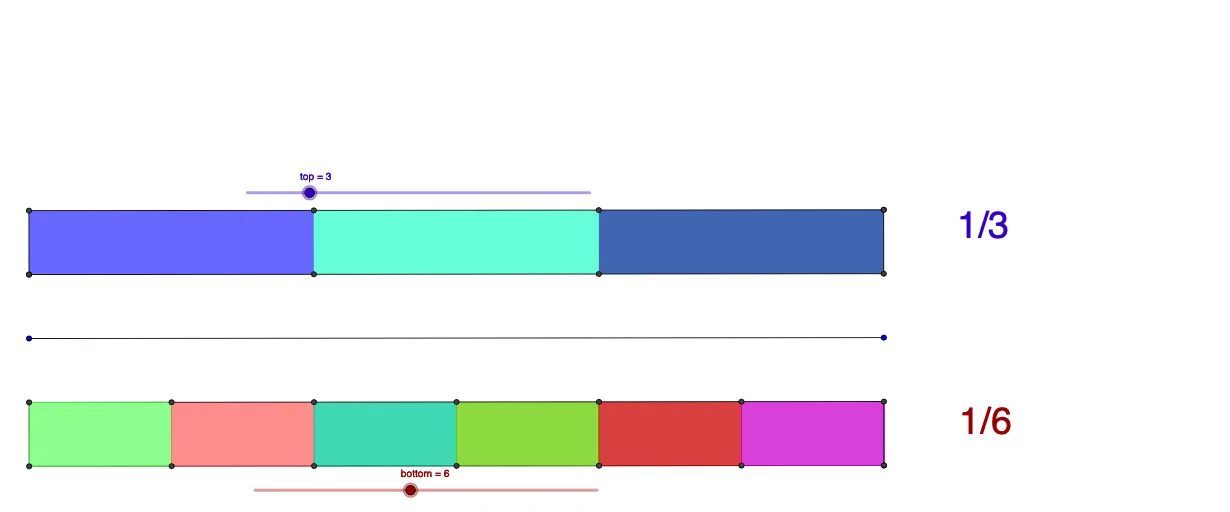
This example demonstrates how to find equivalent fractions using geometric transformations. Key mathematical concepts include the equivalence of fractions. Using GeoGebra commands such as Segment, OrthogonalLine, Point, Circle, Intersect, Dilate, and Polygon, an equivalent fraction model is constructed. Suitable for high-grade elementary or junior high school students to learn the basic concepts and equivalence of fractions.
GeoGebra Commands & Parameters
Segment(A, B) → aOrthogonalLine(A, a) → bOrthogonalLine(B, a) → cPoint(b) → CCircle(A, C) → dIntersect(d, b) → D, ECircle(C, A) → eCircle(E, A) → fIntersect(e, b, 2) → FIntersect(f, b, 2) → GOrthogonalLine(F, b) → gOrthogonalLine(C, b) → hOrthogonalLine(E, b) → iOrthogonalLine(G, b) → jIntersect(c, h) → HIntersect(c, g) → IIntersect(c, i) → JIntersect(c, j) → KSegment(F, I) → kSegment(I, H) → lSegment(H, C) → mSegment(C, F) → nSegment(E, J) → pSegment(J, K) → qSegment(K, G) → rSegment(G, E) → sDilate(H, 1 / top, C) → H'Dilate(H, 2 / top, C) → H'_1Dilate(H, 3 / top, C) → H'_2Dilate(H, 4 / top, C) → H'_3Dilate(H, 5 / top, C) → H'_4Dilate(H, 6 / top, C) → H'_5Dilate(H, 7 / top, C) → H'_6Dilate(H, 8 / top, C) → H'_7Dilate(H, 9 / top, C) → H'_8Dilate(H, 10 / top, C) → H'_9Dilate(H, 11 / top, C) → H'_{10}OrthogonalLine(H', m) → tOrthogonalLine(H'_1, m) → a_1OrthogonalLine(H'_2, m) → b_1OrthogonalLine(H'_3, m) → c_1OrthogonalLine(H'_4, m) → d_1OrthogonalLine(H'_5, m) → e_1OrthogonalLine(H'_6, m) → f_1OrthogonalLine(H'_7, m) → g_1OrthogonalLine(H'_8, m) → h_1OrthogonalLine(H'_9, m) → i_1OrthogonalLine(H'_{10}, m) → j_1Intersect(t, k) → LIntersect(a_1, k) → MIntersect(b_1, k) → NIntersect(c_1, k) → OIntersect(d_1, k) → PIntersect(e_1, k) → QIntersect(f_1, k) → RIntersect(g_1, k) → SIntersect(h_1, k) → TIntersect(i_1, k) → UIntersect(j_1, k) → VPolygon(C, F, L, H') → poly1, c_2, f_2, l_1, h'Polygon(L, M, H'_1, H') → poly2, l_2, m_1, h'_1, h'_2Polygon(M, N, H'_2, H'_1) → poly3, m_2, n_1, h'_3, h'_4Polygon(N, O, H'_3, H'_2) → poly4, n_2, o, h'_5, h'_6Polygon(O, P, H'_4, H'_3) → poly5, o_1, p_1, h'_7, h'_8Polygon(P, Q, H'_5, H'_4) → poly6, p_2, q_1, h'_9, h'_{10}Polygon(Q, R, H'_6, H'_5) → poly7, q_2, r_1, h'_{11}, h'_{12}Polygon(R, S, H'_7, H'_6) → poly8, r_2, s_1, h'_{13}, h'_{14}Polygon(S, T, H'_8, H'_7) → poly9, s_2, t_1, h'_{15}, h'_{16}Polygon(T, U, H'_9, H'_8) → poly10, t_2, u, h'_{17}, h'_{18}Polygon(U, V, H'_{10}, H'_9) → poly11, u_1, v, h'_{19}, h'_{20}Polygon(V, I, H, H'_{10}) → poly12, v_1, i_2, h_2, h'_{21}Dilate(J, 1 / bottom, E) → J'Dilate(J, 2 / bottom, E) → J'_1Dilate(J, 3 / bottom, E) → J'_2Dilate(J, 4 / bottom, E) → J'_3Dilate(J, 5 / bottom, E) → J'_4Dilate(J, 6 / bottom, E) → J'_5Dilate(J, 7 / bottom, E) → J'_6Dilate(J, 8 / bottom, E) → J'_7Dilate(J, 9 / bottom, E) → J'_8Dilate(J, 10 / bottom, E) → J'_9Dilate(J, 11 / bottom, E) → J'_{10}OrthogonalLine(J', p) → k_1OrthogonalLine(J'_1, p) → a_2OrthogonalLine(J'_2, p) → b_2OrthogonalLine(J'_3, p) → d_2OrthogonalLine(J'_4, p) → e_2OrthogonalLine(J'_5, p) → g_2OrthogonalLine(J'_6, p) → j_2OrthogonalLine(J'_7, p) → k_2OrthogonalLine(J'_8, p) → a_3OrthogonalLine(J'_9, p) → b_3OrthogonalLine(J'_{10}, p) → c_3Intersect(k_1, r) → WIntersect(a_2, r) → ZIntersect(b_2, r) → A_1Intersect(d_2, r) → B_1Intersect(e_2, r) → C_1Intersect(g_2, r) → D_1Intersect(j_2, r) → E_1Intersect(k_2, r) → F_1Intersect(a_3, r) → G_1Intersect(b_3, r) → H_1Intersect(c_3, r) → I_1Polygon(E, J', W, G) → poly13, e_3, j', w, g_3Polygon(J', J'_1, Z, W) → poly14, j'_1, j'_2, z, w_1Polygon(J'_1, J'_2, A_1, Z) → poly15, j'_3, j'_4, a_4, z_1Polygon(J'_2, J'_3, B_1, A_1) → poly16, j'_5, j'_6, b_4, a_5Polygon(J'_3, J'_4, C_1, B_1) → poly17, j'_7, j'_8, c_4, b_5Polygon(J'_4, J'_5, D_1, C_1) → poly18, j'_9, j'_{10}, d_3, c_5Polygon(J'_5, J'_6, E_1, D_1) → poly19, j'_{11}, j'_{12}, e_4, d_4Polygon(J'_6, J'_7, F_1, E_1) → poly20, j'_{13}, j'_{14}, f_3, e_5Polygon(J'_7, J'_8, G_1, F_1) → poly21, j'_{15}, j'_{16}, g_4, f_4Polygon(J'_8, J'_9, H_1, G_1) → poly22, j'_{17}, j'_{18}, h_3, g_5Polygon(J'_9, J'_{10}, I_1, H_1) → poly23, j'_{19}, j'_{20}, i_3, h_4Polygon(J'_{10}, J, K, I_1) → poly24, j'_{21}, j_3, k_3, i_4
AI Drawing Prompt Reference
Draw a geometric diagram to show how to find equivalent fractions through geometric transformations. Start by drawing a line segment, then draw perpendicular lines at both ends of the segment. Take a point on the segment and draw a circle with this point as the center, intersecting the perpendicular lines at two points. Draw circles with these two points as centers, intersecting the perpendicular lines at four more points. Connect these points to form a quadrilateral, and then demonstrate equivalent fractions by scaling and drawing perpendicular lines from one side of the quadrilateral.
The prompt above was compiled from the original drawing commands and is for reference only.