
Exploring Diagonals of Polygons (Geometry Chapter 8 Unit 2)
Loading the math board and drawing, please wait…
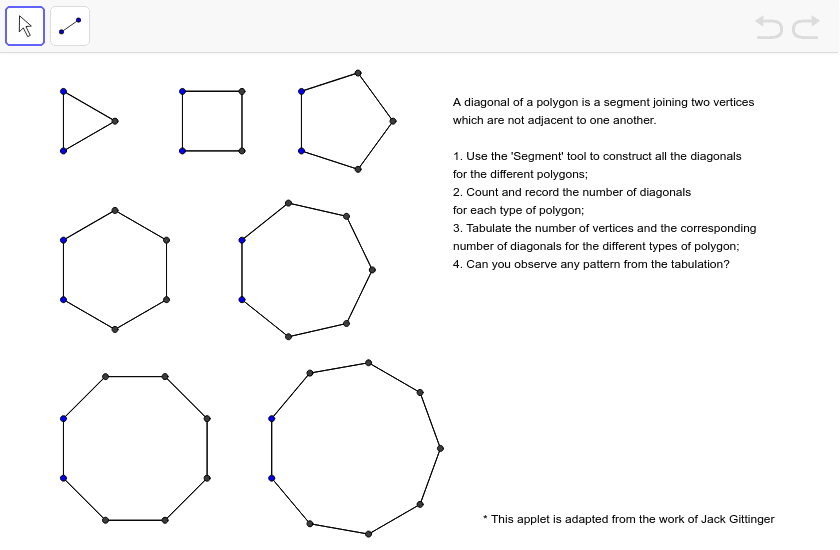
①This example dynamically constructs multiple polygons to visually demonstrate the pattern of the number of diagonals in polygons: from each vertex of an n-gon, (n-3) diagonals can be drawn, and the total number of diagonals is n(n-3)/2. ②Core mathematical concepts include definitions of sides, vertices, and diagonals of polygons, as well as combinatorial counting, covering polygons from triangles to hexagons. ③Construction highlights: Based on the construction summary, the GeoGebra Polygon command is used to create several polygons (poly1, poly2, poly3, poly4), with vertices labeled A, B, C, D, E, F, G, H, I, J, K, L, M, N, O, P, Q, R, and line segments (c, a, b, d, e, f, g, h, i, j, k, l, m, n, p, q, r, s) connecting vertices to display diagonals, likely using different colors or styles to distinguish sides from diagonals. ④Suitable for middle school geometry or introductory high school combinatorics, this example can be used for classroom demonstrations or student self-exploration of the relationship between the number of sides and diagonals, fostering observation and induction skills.
GeoGebra Commands & Parameters
Polygon(A, B, 3) → poly1, c, a, b, CPolygon(D, E, 4) → poly2, d, e, f, g, F, GPolygon(H, I, 5) → poly3, h, i, j, k, l, J, K, LPolygon(M, N, 6) → poly4, m, R, n, p, q, r, s, O, P, QPolygon(S, T, 7) → poly5, s_1, W, Z, A_1, t, a_1, b_1, c_1, d_1, e_1, U, VPolygon(B_1, C_1, 8) → poly6, b_2, E_1, F_1, G_1, H_1, I_1, c_2, f_1, g_1, h_1, i_1, j_1, k_1, D_1Polygon(J_1, K_1, 9) → poly7, j_2, L_1, M_1, N_1, O_1, P_1, Q_1, R_1, k_2, l_1, m_1, n_1, p_1, q_1, r_1, t_1
AI Drawing Prompt Reference
Draw a sequence of regular polygons from triangle to nonagon, each placed separately with vertices labeled in order. From each vertex, draw diagonals to all non-adjacent vertices, using distinct colors or line styles to differentiate sides from diagonals. Show that triangles have no diagonals, quadrilaterals have two, pentagons five, hexagons nine, heptagons fourteen, octagons twenty, and nonagons twenty-seven, visually demonstrating the pattern of diagonal counts increasing with the number of sides.
The prompt above was compiled from the original drawing commands and is for reference only.