
Exploring Congruent Triangles: SSS Theorem in GeoGebra
Loading the math board and drawing, please wait…
In collections
Module 1: Eureka Congruence, Transformations, Constructions
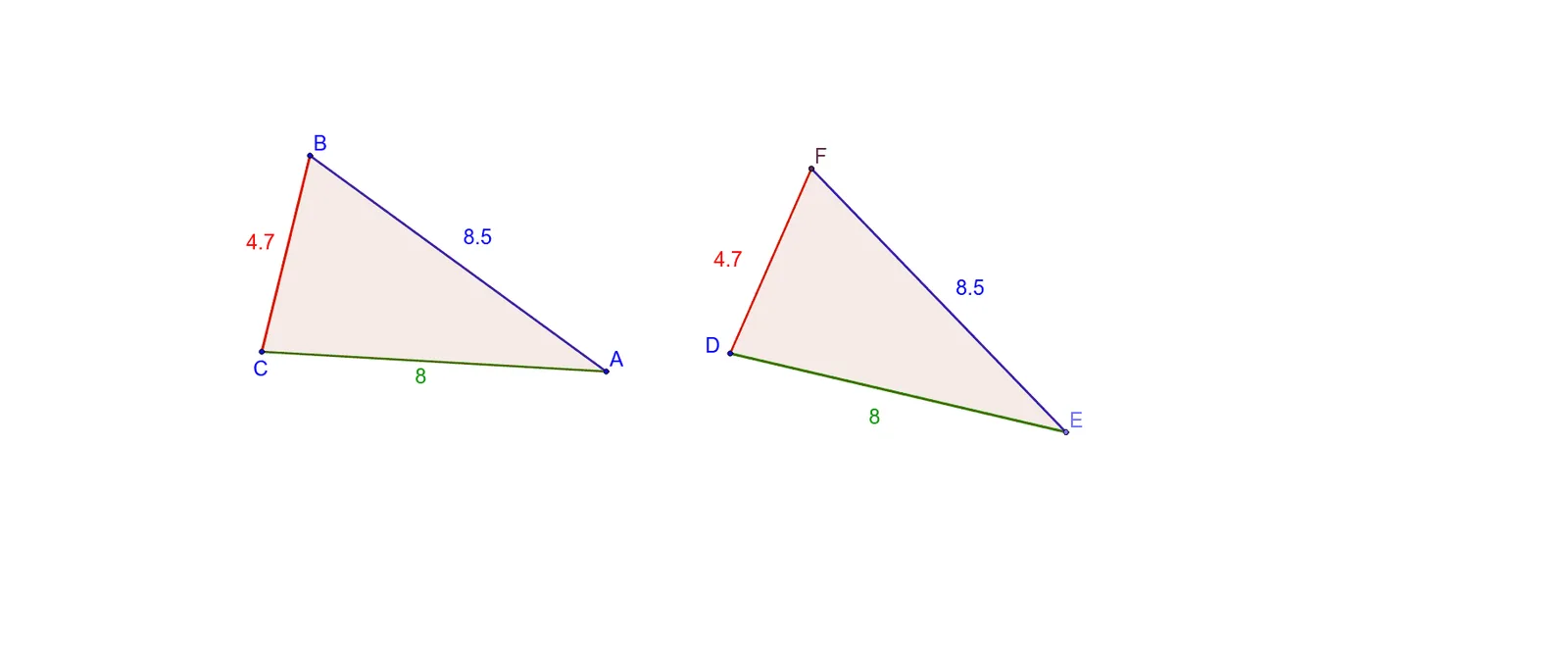
This example demonstrates the SSS congruence theorem for triangles using GeoGebra. Key mathematical concepts include triangle congruence, geometric construction, and coordinate geometry. The construction involves using Circle, Segment, Point, and Intersect commands to create triangles and verify congruence. Suitable for middle school or high school students to understand triangle properties and congruence theorems.
GeoGebra Commands & Parameters
Circle(A, B) → cCircle(C, B) → dSegment(C, A) → aSegment(C, B) → bSegment(B, A) → ePoint(Circle[D, abs(a)]) → ESegment(D, E) → fCircle(D, b) → gCircle(E, e) → hIntersect(g, h, 1) → FSegment(F, D) → iSegment(F, E) → jPolygon(C, B, A) → poly1, a_1, c_1, b_1Polygon(D, F, E) → poly2, e_1, d_1, f_1
AI Drawing Prompt Reference
Draw two congruent triangles, triangle ABC and triangle DEF. First, draw a circle with center C and radius equal to line segment CA, then draw another circle with center C and radius equal to line segment CB. Next, draw line segments CA and CB. Then, find a point D on the circle centered at C such that line segment CD equals line segment CA, and draw a circle with center D and radius equal to line segment DB, and another circle with center D and radius equal to line segment DE. Finally, find the intersection point E of the two circles and draw line segments DE and EF to form triangle DEF.
The prompt above was compiled from the original drawing commands and is for reference only.