
Exploring Complex Roots of Polynomials via Geometric Construction
Loading the math board and drawing, please wait…
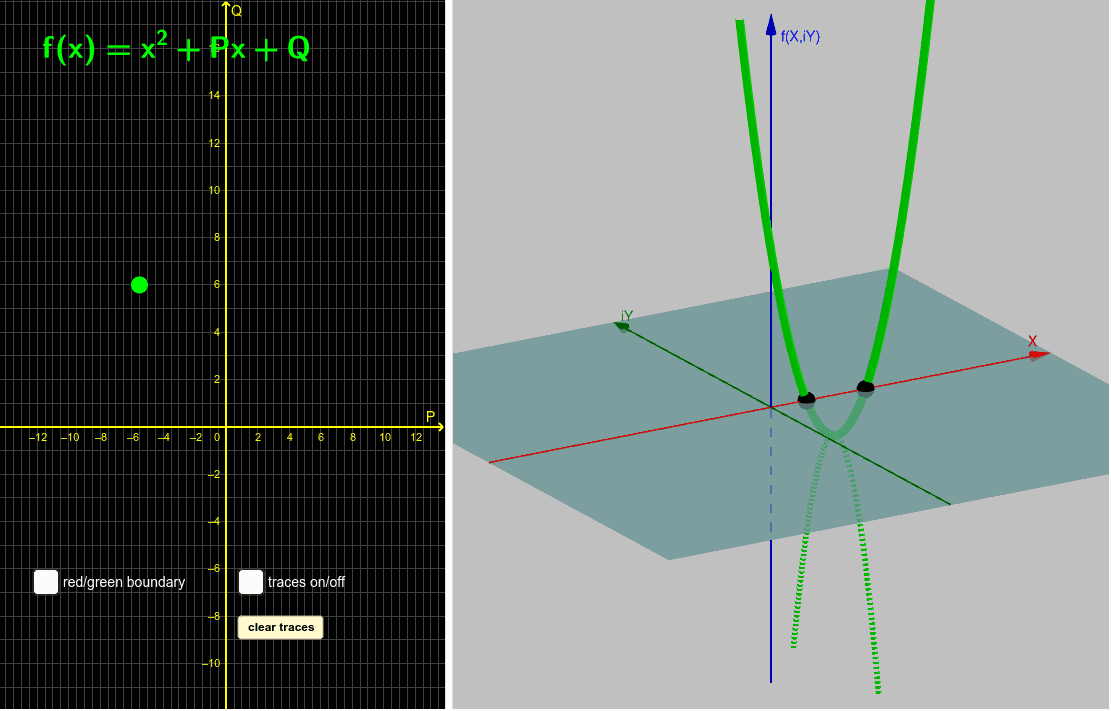
This GeoGebra example investigates conjectures about the complex roots of polynomials by visualizing their positions in the complex plane. Users can manipulate polynomial coefficients using sliders and observe how the roots move, intersect, and form patterns. The construction employs the Intersect command and CurveCartesian objects to compute roots dynamically, providing an interactive way to explore root distribution, parametric equations, and geometric loci. Ideal for high‑school and undergraduate students studying complex numbers, polynomial theory, and geometric methods, as well as for competition preparation.
GeoGebra Commands & Parameters
Intersect(xAxis, c) → ACurveCartesian(t, 0, t^(2) + (P * t) + Q, t, -10, 10) → aCurveCartesian(((-P)) / 2, t + P / 2, (-(t^(2) + (P * t) + Q)) + (2 * (Q - P^(2) / 4)), t, -10, 10) → b
AI Drawing Prompt Reference
Draw a horizontal real axis in the complex plane. Construct an upward-opening parabola whose vertex depends on parameters P and Q, and mark its intersection with the real axis as point A. Then draw a second parametric curve with a fixed x-coordinate equal to the parabola's vertex x, while its y-coordinate varies with parameter t, following a quadratic expression in P, Q, and t, creating a symmetric curved shape. Together, these curves illustrate the geometric positions of polynomial roots, allowing observation of root movement and distribution as P and Q change.
The prompt above was compiled from the original drawing commands and is for reference only.