
Exploring Angle-Side-Angle Theorem
Loading the math board and drawing, please wait…
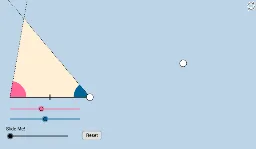
This example dynamically illustrates the ASA Triangle Congruence Theorem. By adjusting angles and sides, observe how the triangle changes. Key mathematical concepts include triangle congruence, angle and side relationships. GeoGebra commands used include Rotate, Angle, Ray, Point, Intersect, Polygon, Segment, etc. Suitable for middle school and above students to learn geometric construction of triangle congruence.
GeoGebra Commands & Parameters
Rotate(B, α, A) → B'Angle(B, A, B') → βRay(A, B') → fPoint(f) → CRotate(A, (-γ), B) → A'Angle(A', B, A) → δRay(B, A') → gIntersect(f, g) → DPolygon(A, B, D) → poly1, d, a_1, bSegment(A, B) → hSegment(D, B) → iSegment(D, A) → jMin({h, i, j}) → cCircle(A, (0.2 * c)) → eCircle(B, (0.2 * c)) → kIntersect(e, h) → E,Intersect(e, j) → F, IIntersect(k, h) → G,Intersect(k, i) → H, JCircleSector(A, E, F) → pCircleSector(B, H, G) → qRotate(K, β, L) → K'Angle(K, L, K') → εCircle(L, h) → rRay(L, K) → mIntersect(r, m, 1) → MRay(L, K') → nRotate(L, (-γ), M) → L'Angle(L', M, L) → ζRay(M, L') → sIntersect(n, s) → NDilate(A, If[0 < l ≤ 1, 1 - l, 0], L) → A'_1Vector(A, A'_1) → uTranslate(p, u) → p'Line(L, h) → tTranslate(F, u) → F'Point(t) → OAngle(M, L, O) → ηRotate(p', If[1 < l ≤ 2, ((-(l - 1)) * η), (-η)], L) → p''Point(t) → PAngle(P, L, M) → θDilate(B, If[2 < l ≤ 3, 3 - l, 0], L) → B'_1Vector(B, B'_1) → vTranslate(A, v) → A'_2Translate(B, v) → B'_2Segment(A'_2, B'_2) → h'Rotate(A'_2, If[3 < l ≤ 4, ((l - 3) * θ), θ], L) → QRotate(B'_2, If[3 < l ≤ 4, ((l - 3) * θ), θ], L) → RSegment(Q, R) → h''Dilate(B, If[4 < l ≤ 5, 5 - l, 0], M) → B'_3Vector(B, B'_3) → wTranslate(q, w) → q'Line(M, g) → f_1Point(f_1) → SAngle(N, M, S) → τRotate(q', If[5 < l ≤ 6, ((l - 5) * ((2 * π) - τ)), (2 * π) - τ], M) → q''Dilate(B, If[6 < l ≤ 7, 7 - l, 0], M) → B'_4Vector(B, B'_4) → u_1Translate(A, u_1) → A'_3Translate(B, u_1) → B'_5Translate(D, u_1) → D'Polygon(A'_3, B'_5, D') → poly1', d', a'_3, b'_5Rotate(A'_3, If[7 < l ≤ 8, ((-(l - 7)) * τ), (-τ)], M) → TRotate(B'_5, If[7 < l ≤ 8, ((-(l - 7)) * τ), (-τ)], M) → URotate(D', If[7 < l ≤ 8, ((-(l - 7)) * τ), (-τ)], M) → D''Polygon(T, U, D'') → poly1'', d'', t_1, u_2