
Exploring a Hexagon Made with Pascal's Triangles
Loading the math board and drawing, please wait…
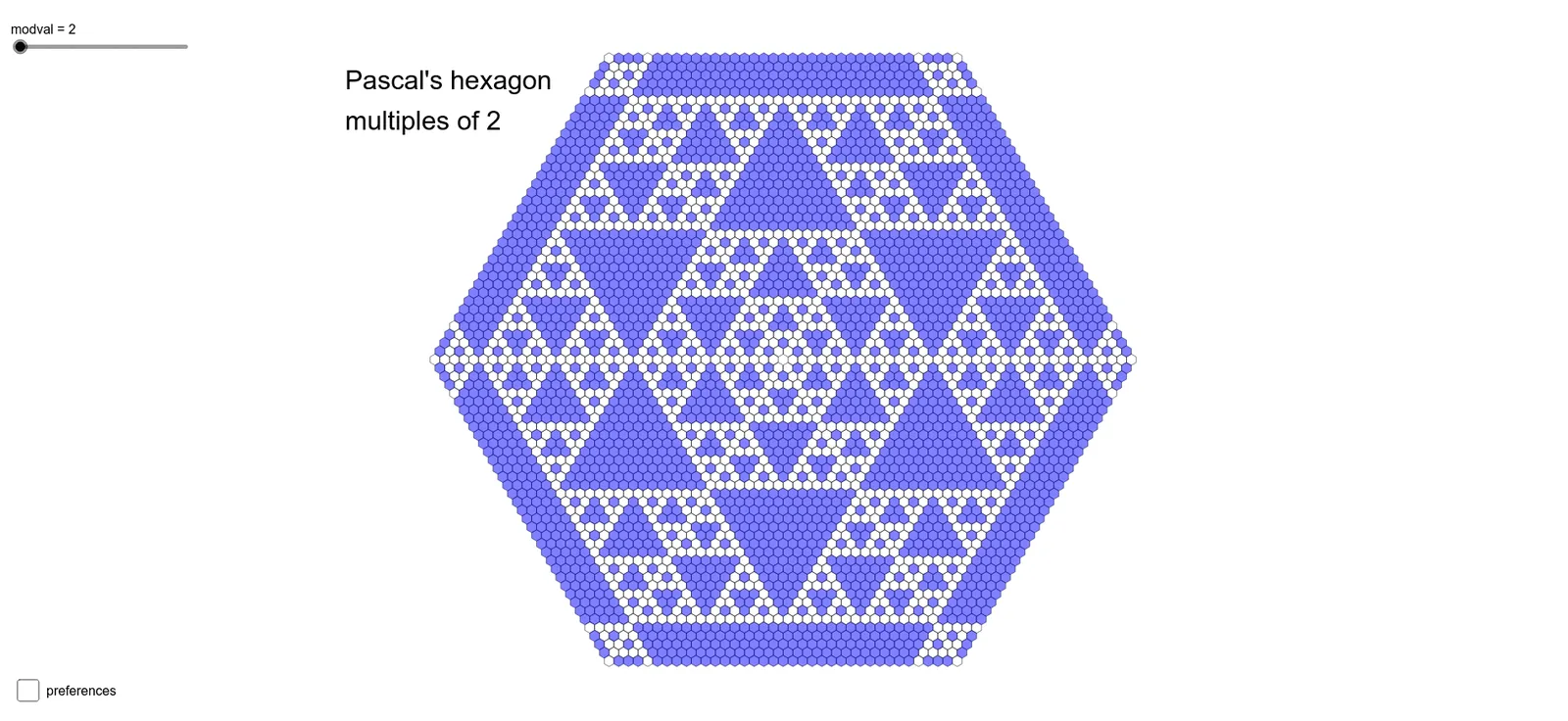
This example demonstrates how to construct a hexagon using Pascal's triangle and color-code its multiples. It illustrates the connection between Pascal's triangle and hexagons, highlighting how different numbers' multiples can be distinguished by color. The core math concepts involved include combinatorics, sequences, and modular arithmetic. The construction utilizes GeoGebra commands such as Rotate, Polygon, Vector, Sequence, along with objects like zoom, R, G, B, nrows, modval, a, O, C, A, D, poly1, f, g, h, i, j, k, D_1, E, F, H, u, v, Gasket, pascalvalue, MultiplesGasket, text1, text2, I, J. This is suitable for high school and above students to understand the relationship between combinatorial mathematics and geometric shapes, as well as the application of sequences and modular arithmetic.
GeoGebra Commands & Parameters
Rotate(C, 30°, O) → ARotate(C, (-(30°)), O) → DPolygon(D, A, 6) → poly1, f, H, g, h, i, j, k, D_1, E, FVector(H, A) → uVector(A, E) → vSequence(Rotate[Sequence[Sequence[Polygon[A + (J * u) + (K * v) + (0, 1), A + (J * u) + (K * v), 6], K, 0, J - 1], J, 0, nrows], (N * π / 3)], N, 0, 5) → GasketSequence(Sequence[nCr[L, M], M, 0, L - 1], L, 0, nrows) → pascalvalueSequence(Rotate[Sequence[Sequence[If[Mod[Element[Element[pascalvalue, S + 1], T + 1], modval] ≟ 0, Polygon[A + (S * u) + (T * v) + (0, 1), A + (S * u) + (T * v), 6]], T, 0, S - 1], S, 0, nrows], (N * π / 3)], N, 0, 5) → MultiplesGasket