
Incenter Construction of a Triangle
Loading the math board and drawing, please wait…
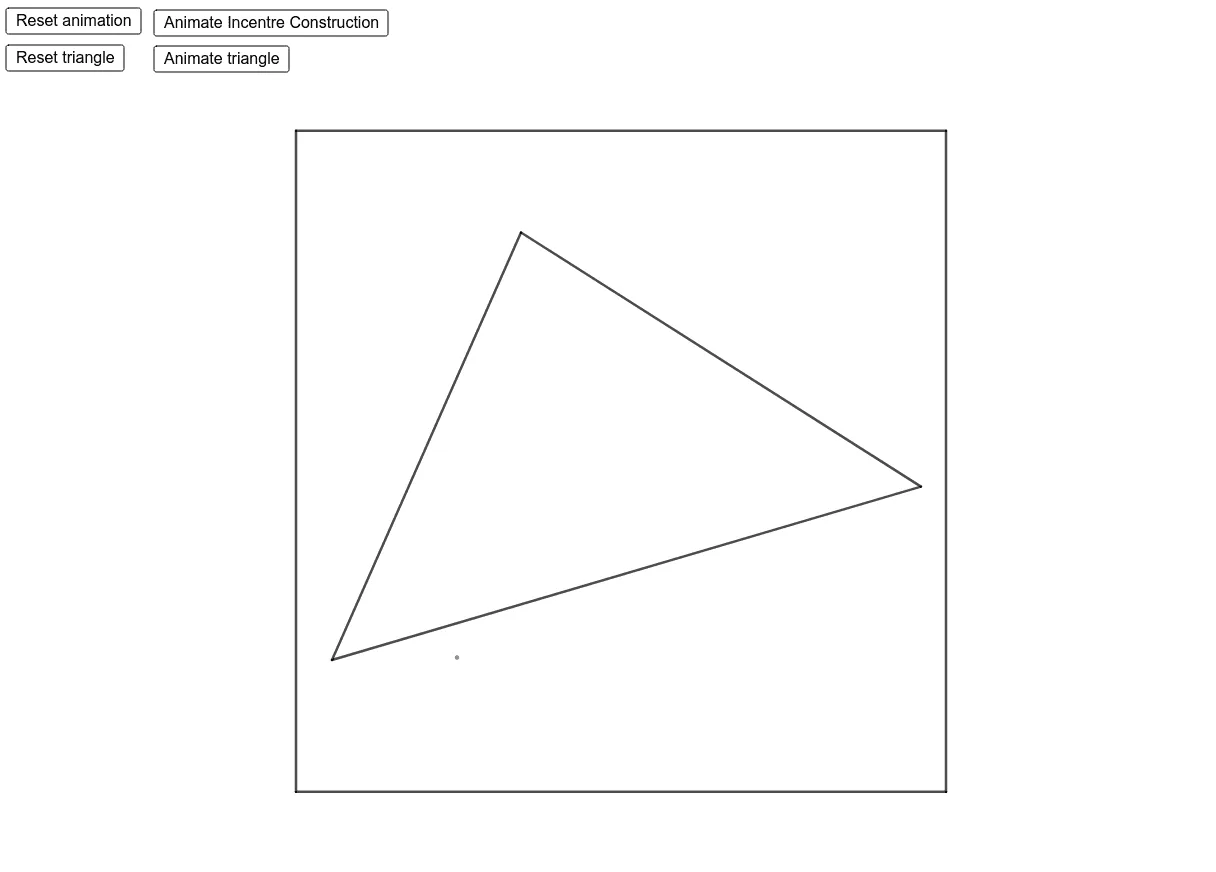
This example demonstrates the construction of the incenter of a triangle. Key mathematical concepts include angle bisectors and circle properties. Using GeoGebra commands such as Segment, Circle, Point, Rotate, etc., the construction process is clearly illustrated. Suitable for middle school and above students to learn geometric construction.
GeoGebra Commands & Parameters
Segment(N_1, N_2) → b_1Circle(A_1, A_0) → cCircle(B_1, B_0) → dCircle(C_1, C_0) → ePoint(c) → APoint(d) → BPoint(e) → CSegment(C, A) → fSegment(B, A) → gSegment(B, C) → hCircle(A, r_b) → kRotate(B, b_d, A) → B'Angle(B, A, B') → αRotate(B, (-b_d), A) → B'_1Angle(B'_1, A, B) → βRotate(C, b_d, A) → C'Angle(C, A, C') → γRotate(C, (-b_d), A) → C'_1Angle(C'_1, A, C) → δSegment(C'_1, A) → iSegment(C', A) → jSegment(B', A) → lSegment(B'_1, A) → mIntersect(k, j) → D,Intersect(k, i) → E,Intersect(k, l) → F,Intersect(k, m) → G,CircleArc(A, G, F) → pCircleArc(A, E, D) → qIntersect(p, g) → H,Intersect(q, f) → I,Circle(H, r_b) → sCircle(I, r_b) → t_1Intersect(s, t_1, 2) → A_bRotate(A_b, b_d, H) → JAngle(A_b, H, J) → εRotate(A_b, (-b_d), H) → KAngle(K, H, A_b) → ζRotate(A_b, b_d, I) → LAngle(A_b, I, L) → ηRotate(A_b, (-b_d), I) → MAngle(M, I, A_b) → θCircleArc(H, K, J) → c_1CircleArc(I, M, L) → d_1Segment(N, O) → g_1Distance(N, O) → NOPoint(Path_d) → Delay_1Segment(P, Q) → i_1Point(Path_e) → Delay_2Segment(R, S) → bPoint(Path_f) → Delay_3Ray(A, A_b) → l_1Segment(T, U) → m_1Point(Path_g) → Delay_4Point(p) → A_RCircleArc(A, G, A_R) → tSegment(A, A_R) → q_1Point(q) → A_LCircleArc(A, E, A_L) → s_1Segment(A_L, A) → f_2Point(c_1) → I_RSegment(I_R, H) → g_2CircleArc(H, K, I_R) → c_2Point(d_1) → H_RSegment(I, H_R) → h_2CircleArc(I, M, H_R) → e_2Circle(B, r_b) → e_1Intersect(e_1, h) → V,Intersect(e_1, g) → W,Rotate(V, b_d, B) → V'Angle(V, B, V') → ιRotate(V, (-b_d), B) → V'_1Angle(V'_1, B, V) → κRotate(W, b_d, B) → W'Angle(W, B, W') → λRotate(W, (-b_d), B) → W'_1Angle(W'_1, B, W) → μCircleArc(B, V'_1, V') → f_1CircleArc(B, W'_1, W') → h_1Circle(V, r_b) → p_1Circle(W, r_b) → k_2Intersect(p_1, k_2, 2) → B_bRotate(B_b, b_d, V) → ZAngle(B_b, V, Z) → νRotate(B_b, (-b_d), V) → D_1Angle(D_1, V, B_b) → ξRotate(B_b, b_d, W) → E_1Angle(B_b, W, E_1) → οRotate(B_b, (-b_d), W) → F_1Angle(F_1, W, B_b) → ρCircleArc(W, F_1, E_1) → p_2CircleArc(V, D_1, Z) → q_2Ray(B, B_b) → a_1Intersect(l_1, a_1) → G_1Point(Path_h) → Delay_5Circle(C, r_b) → r_2Intersect(r_2, f) → H_1,Intersect(r_2, h) → I_1,Rotate(H_1, b_d, C) → J_1Angle(H_1, C, J_1) → σRotate(H_1, (-b_d), C) → K_1Angle(K_1, C, H_1) → τRotate(I_1, b_d, C) → L_1Angle(I_1, C, L_1) → υRotate(I_1, (-b_d), C) → M_1Angle(M_1, C, I_1) → ϕCircleArc(C, K_1, J_1) → s_2CircleArc(C, M_1, L_1) → t_2Circle(H_1, r_b) → c_3Circle(I_1, r_b) → d_3Intersect(c_3, d_3, 2) → B_cRotate(B_c, b_d, H_1) → O_1Angle(B_c, H_1, O_1) → χRotate(B_c, (-b_d), H_1) → P_1Angle(P_1, H_1, B_c) → ψRotate(B_c, b_d, I_1) → Q_1Angle(B_c, I_1, Q_1) → ωRotate(B_c, (-b_d), I_1) → R_1Angle(R_1, I_1, B_c) → α_1CircleArc(I_1, R_1, Q_1) → e_3CircleArc(H_1, P_1, O_1) → f_3Ray(C, B_c) → l_2Segment(O_2, O_3) → m_2Point(Path_i) → Delay_6Segment(P_2, P_3) → n_2Point(Path_j) → Delay_7Segment(Q_2, Q_3) → g_3Segment(R_2, R_3) → h_3Segment(S_2, S_3) → i_3Point(Path_k) → Delay_8Point(Path_l) → Delay_9Point(Path_m) → Delay_10Segment(T_2, T_3) → j_3Point(Path_n) → Delay_11OrthogonalLine(G_1, h) → p_3OrthogonalLine(G_1, g) → q_3OrthogonalLine(G_1, f) → r_3Intersect(h, p_3) → S_1Intersect(q_3, g) → T_1Intersect(f, r_3) → U_1Segment(G_1, S_1) → s_3Segment(G_1, T_1) → t_3Segment(G_1, U_1) → f_4Angle(G_1, U_1, C) → β_1Angle(G_1, S_1, B) → γ_1Angle(G_1, T_1, A) → δ_1Circle(G_1, U_1) → c_4Segment(LT, RT) → g_4Segment(RT, RB) → h_4Segment(RB, LB) → i_4Segment(LB, LT) → j_4Distance(j_4, g_4) → o_3Distance(LT, LB) → u_3