
Explore Vertical Angles: Rotation and Angle Measurement
Loading the math board and drawing, please wait…
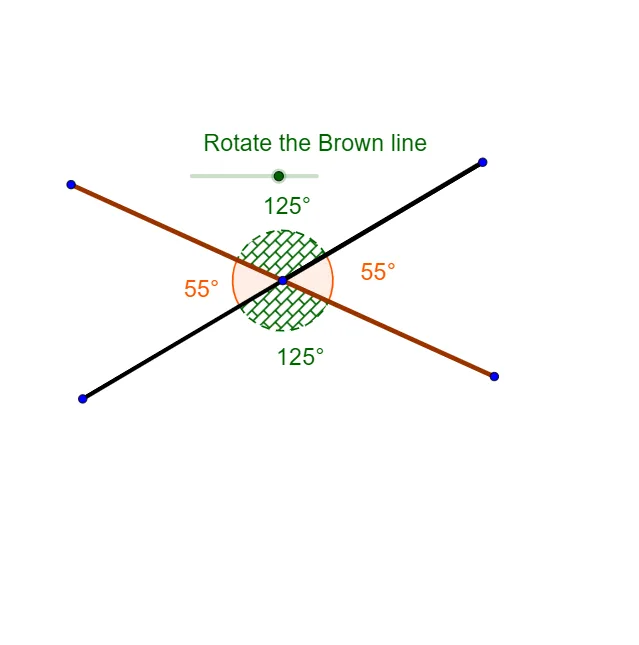
① This GeoGebra example demonstrates the property of vertical angles being equal when two lines intersect, using rotation and triangle construction. ② The core mathematical concept is vertical angles: the pairs of opposite angles formed by intersecting lines are congruent, along with angle measurement, rotational symmetry, and triangle angle relationships. ③ Construction highlights: the Rotate command transforms point A to A', the Angle command creates angles α, β₁, β₂, β₄, γ, and the Segment command builds segments f, g, h, i, forming multiple triangles and angles to dynamically show that vertical angles remain equal under rotation. ④ Suitable for middle school geometry lessons or high school review, this interactive tool helps students intuitively grasp the vertical angle theorem and supports inquiry-based learning.
GeoGebra Commands & Parameters
Rotate(A, α, B) → A'Angle(A, B, A') → β_1Segment(A, B) → fSegment(A', B) → gRotate(A, 180°, B) → A'_1Segment(B, A'_1) → hRotate(A', 180°, B) → A''Segment(B, A'') → iAngle(A'_1, B, A'') → γAngle(A'', B, A) → β_4Angle(A', B, A'_1) → β_2
AI Drawing Prompt Reference
Draw two intersecting lines and mark the intersection as A. Rotate a segment around A to form A', measure ∠ABA' as β₁. Draw segments AB and A'B, then rotate A' around A by 180 degrees to form A'', and draw segment BA''. Measure ∠BA'A'' as γ, ∠BA''A as β₄, and ∠A'BA'₁ as β₂ to demonstrate the property of vertical angles being equal.
The prompt above was compiled from the original drawing commands and is for reference only.