
Explore Equivalent Fractions by Juli Jurado i Llamas
Loading the math board and drawing, please wait…
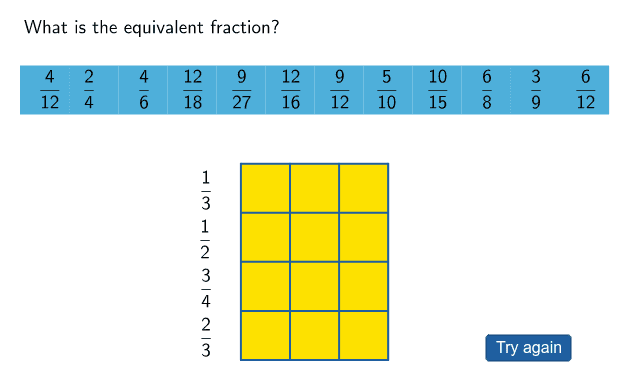
This example demonstrates how to find equivalent fractions using GeoGebra. It involves the concept of fractions and explores the properties of equivalent fractions through the construction of parallelograms and medians. Commands used include Polygon, Sequence, Random, IndexOf, If, Segment, and Sum. Suitable for high-grade elementary or junior high school students to learn about the equivalence of fractions.
GeoGebra Commands & Parameters
Polygon(A1, B1, 4) → Polígon1, a, b, c, d, A, BPolygon(A2, B2, 4) → Polígon2, e, f, g, h, C, DPolygon(A3, B3, 4) → Polígon3, i, j, k, l, E, FPolygon(A4, B4, 4) → Polígon4, m, n, p, q, G, HSequence(Sample[{1, 2, 3, 4, 5, 6, 7, 8, 9, 10, 11, 12}, 12, false], i, 1, 10) → matriu1Random(1, 10) → filaIndexOf(1, Element[matriu1, fila]) → E1IndexOf(2, Element[matriu1, fila]) → E2IndexOf(3, Element[matriu1, fila]) → E3IndexOf(4, Element[matriu1, fila]) → E4IndexOf(5, Element[matriu1, fila]) → E5IndexOf(6, Element[matriu1, fila]) → E6IndexOf(7, Element[matriu1, fila]) → E7IndexOf(8, Element[matriu1, fila]) → E8IndexOf(9, Element[matriu1, fila]) → E9IndexOf(10, Element[matriu1, fila]) → E10IndexOf(11, Element[matriu1, fila]) → E11IndexOf(12, Element[matriu1, fila]) → E12If(Mod[E1, 3] ≟ 1, E1 + 1, If[Mod[E1, 3] ≟ 2, E1 - 1, E1 - 2]) → F1If(Mod[E2, 3] ≟ 1, E2 + 1, If[Mod[E2, 3] ≟ 2, E2 - 1, E2 - 2]) → F2If(Mod[E3, 3] ≟ 1, E3 + 1, If[Mod[E3, 3] ≟ 2, E3 - 1, E3 - 2]) → F3If(Mod[E4, 3] ≟ 1, E4 + 1, If[Mod[E4, 3] ≟ 2, E4 - 1, E4 - 2]) → F4If(Mod[E5, 3] ≟ 1, E5 + 1, If[Mod[E5, 3] ≟ 2, E5 - 1, E5 - 2]) → F5If(Mod[E6, 3] ≟ 1, E6 + 1, If[Mod[E6, 3] ≟ 2, E6 - 1, E6 - 2]) → F6If(Mod[E7, 3] ≟ 1, E7 + 1, If[Mod[E7, 3] ≟ 2, E7 - 1, E7 - 2]) → F7If(Mod[E8, 3] ≟ 1, E8 + 1, If[Mod[E8, 3] ≟ 2, E8 - 1, E8 - 2]) → F8If(Mod[E9, 3] ≟ 1, E9 + 1, If[Mod[E9, 3] ≟ 2, E9 - 1, E9 - 2]) → F9If(Mod[E10, 3] ≟ 1, E10 + 1, If[Mod[E10, 3] ≟ 2, E10 - 1, E10 - 2]) → F10If(Mod[E11, 3] ≟ 1, E11 + 1, If[Mod[E11, 3] ≟ 2, E11 - 1, E11 - 2]) → F11If(Mod[E12, 3] ≟ 1, E12 + 1, If[Mod[E12, 3] ≟ 2, E12 - 1, E12 - 2]) → F12Polygon(A5, B5, 4) → Polígon5, r, s, t, a_1, I, JPolygon(A6, B6, 4) → Polígon6, b_1, c_1, d_1, e_1, K, LPolygon(A7, B7, 4) → Polígon7, f_1, g_1, h_1, i_1, N, OPolygon(A8, B8, 4) → Polígon8, j_1, k_1, l_1, m_1, R, SPolygon(A9, B9, 4) → Polígon9, n_1, p_1, q_1, r_1, T, UPolygon(A10, B10, 4) → Polígon10, s_1, t_1, a_2, b_2, V, WPolygon(A11, B11, 4) → Polígon11, c_2, d_2, e_2, f_2, Z, A_1Polygon(A12, B12, 4) → Polígon12, g_2, h_2, i_2, j_2, B_1, C_1IndexOf(10, Element[matriu1, fila]) → oIf(Mod[E1, 3] ≟ 1, E1 + 2, If[Mod[E1, 3] ≟ 2, E1 + 1, E1 - 1]) → G1If(Mod[E2, 3] ≟ 1, E2 + 2, If[Mod[E2, 3] ≟ 2, E2 + 1, E2 - 1]) → G2If(Mod[E3, 3] ≟ 1, E3 + 2, If[Mod[E3, 3] ≟ 2, E3 + 1, E3 - 1]) → G3If(Mod[E4, 3] ≟ 1, E4 + 2, If[Mod[E4, 3] ≟ 2, E4 + 1, E4 - 1]) → G4If(Mod[E5, 3] ≟ 1, E5 + 2, If[Mod[E5, 3] ≟ 2, E5 + 1, E5 - 1]) → G5If(Mod[E6, 3] ≟ 1, E6 + 2, If[Mod[E6, 3] ≟ 2, E6 + 1, E6 - 1]) → G6If(Mod[E7, 3] ≟ 1, E7 + 2, If[Mod[E7, 3] ≟ 2, E7 + 1, E7 - 1]) → G7If(Mod[E8, 3] ≟ 1, E8 + 2, If[Mod[E8, 3] ≟ 2, E8 + 1, E8 - 1]) → G8If(Mod[E9, 3] ≟ 1, E9 + 2, If[Mod[E9, 3] ≟ 2, E9 + 1, E9 - 1]) → G9If(Mod[E10, 3] ≟ 1, E10 + 2, If[Mod[E10, 3] ≟ 2, E10 + 1, E10 - 1]) → G10If(Mod[E11, 3] ≟ 1, E11 + 2, If[Mod[E11, 3] ≟ 2, E11 + 1, E11 - 1]) → G11If(Mod[E12, 3] ≟ 1, E12 + 2, If[Mod[E12, 3] ≟ 2, E12 + 1, E12 - 1]) → G12If(C1 ≟ Cell[4, E1] ∨ C1 ≟ Cell[4, F1] ∨ C1 ≟ Cell[4, G1], 1, 0) → H1If(C2 ≟ Cell[4, E2] ∨ C2 ≟ Cell[4, F2] ∨ C2 ≟ Cell[4, G2], 1, 0) → H2If(C3 ≟ Cell[4, E3] ∨ C3 ≟ Cell[4, F3] ∨ C3 ≟ Cell[4, G3], 1, 0) → H3If(C4 ≟ Cell[4, E4] ∨ C4 ≟ Cell[4, F4] ∨ C4 ≟ Cell[4, G4], 1, 0) → H4If(C5 ≟ Cell[4, E5] ∨ C5 ≟ Cell[4, F5] ∨ C5 ≟ Cell[4, G5], 1, 0) → H5If(C6 ≟ Cell[4, E6] ∨ C6 ≟ Cell[4, F6] ∨ C6 ≟ Cell[4, G6], 1, 0) → H6If(C7 ≟ Cell[4, E7] ∨ C7 ≟ Cell[4, F7] ∨ C7 ≟ Cell[4, G7], 1, 0) → H7If(C8 ≟ Cell[4, E8] ∨ C8 ≟ Cell[4, F8] ∨ C8 ≟ Cell[4, G8], 1, 0) → H8If(C9 ≟ Cell[4, E9] ∨ C9 ≟ Cell[4, F9] ∨ C9 ≟ Cell[4, G9], 1, 0) → H9If(C10 ≟ Cell[4, E10] ∨ C10 ≟ Cell[4, F10] ∨ C10 ≟ Cell[4, G10], 1, 0) → H10If(C11 ≟ Cell[4, E11] ∨ C11 ≟ Cell[4, F11] ∨ C11 ≟ Cell[4, G11], 1, 0) → H11If(C12 ≟ Cell[4, E12] ∨ C12 ≟ Cell[4, F12] ∨ C12 ≟ Cell[4, G12], 1, 0) → H12Polygon(D_1, E_1, F_1, G_1) → Polígon13, d_3, e_3, f_3, g_3Segment(G_1, D_1) → k_2Segment(D_1, E_1) → l_2Segment(E_1, F_1) → m_2Segment(F_1, G_1) → n_2Segment(H_1, M_1) → p_2Segment(L_1, Q_1) → q_2Segment(N_1, I_1) → r_2Segment(P_1, K_1) → s_2Segment(J_1, O_1) → t_2Sum(H1:H12) → H13Random(1, 10) → uPolygon(S_1, Z_1, W_1, T_1) → Polígon15, s_3, z_1, w_1, t_3If(L1 ≟ Cell[13, E1], 1, 0) → N1If(L2 ≟ Cell[13, E2], 1, 0) → N2If(L3 ≟ Cell[13, E3], 1, 0) → N3If(L4 ≟ Cell[13, E4], 1, 0) → N4If(L5 ≟ Cell[13, E5], 1, 0) → N5If(L6 ≟ Cell[13, E6], 1, 0) → N6If(L7 ≟ Cell[13, E7], 1, 0) → N7If(L8 ≟ Cell[13, E8], 1, 0) → N8If(L9 ≟ Cell[13, E9], 1, 0) → N9If(L10 ≟ Cell[13, E10], 1, 0) → N10If(L11 ≟ Cell[13, E11], 1, 0) → N11If(L12 ≟ Cell[13, E12], 1, 0) → N12Sum(N1:N12) → N13If(R1 ≟ Cell[13, E1], 1, 0) → S1If(R2 ≟ Cell[13, E2], 1, 0) → S2If(R3 ≟ Cell[13, E3], 1, 0) → S3If(R4 ≟ Cell[13, E4], 1, 0) → S4If(R5 ≟ Cell[13, E5], 1, 0) → S5If(R6 ≟ Cell[13, E6], 1, 0) → S6If(R7 ≟ Cell[13, E7], 1, 0) → S7If(R8 ≟ Cell[13, E8], 1, 0) → S8If(R9 ≟ Cell[13, E9], 1, 0) → S9If(R10 ≟ Cell[13, E10], 1, 0) → S10If(R11 ≟ Cell[13, E11], 1, 0) → S11If(R12 ≟ Cell[13, E12], 1, 0) → S12Sum(S1:S12) → S13
AI Drawing Prompt Reference
Draw four parallelograms, each with four points. Then randomly select 12 numbers and generate a series of new numbers by adding or subtracting 1 or 2. Finally, use these new numbers as coordinates to draw four more parallelograms.
The prompt above was compiled from the original drawing commands and is for reference only.