
Exploration: Trigonometric Ratios in Similar Triangles APS
Loading the math board and drawing, please wait…
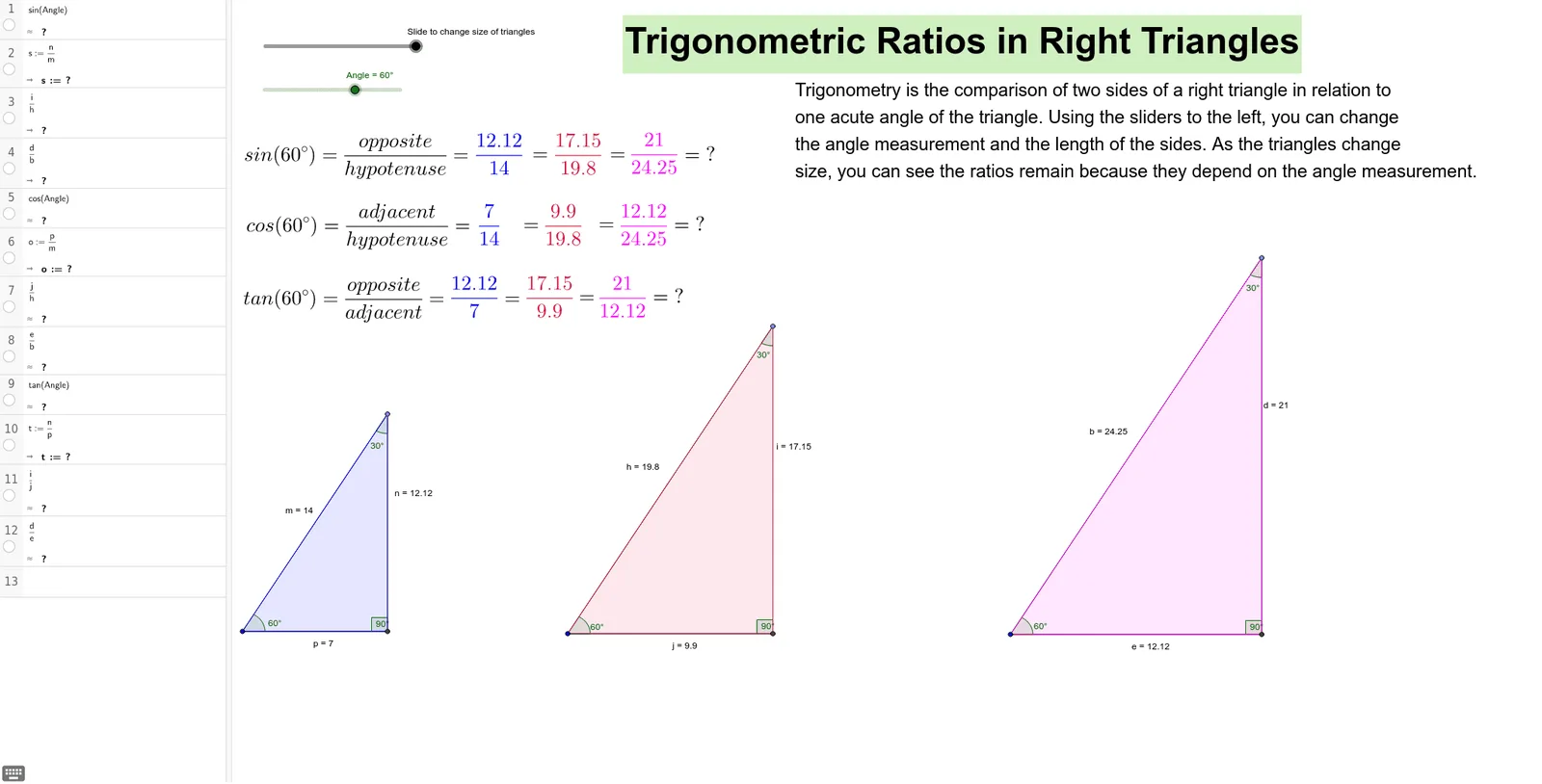
① This GeoGebra example dynamically demonstrates how trigonometric ratios (sine, cosine, tangent) relate to corresponding side ratios in similar triangles, showing that these ratios remain invariant under similarity. ② Core mathematical concepts include similar triangles, trigonometric ratios, angle-side relationships in right triangles, and the constancy of ratios for a given angle. ③ Construction details: The applet uses GeoGebra commands such as Point, Segment, Rotate, Angle, OrthogonalLine, Intersect, and Polygon to build triangles and their similar counterparts. Key objects include points A, B, C, sides a, b, c, angles α, β, γ, and additional constructed points and lines (e.g., B', D, E, F, G, H) created via rotation and perpendicular lines to form similar triangles. Side lengths and angles are measured to compute and compare trigonometric ratios. ④ This resource is suitable for upper middle school or early high school students learning introductory trigonometry and similarity, and for teachers to use in classroom demonstrations or student-led exploration to understand that trigonometric ratios depend only on the angle, not on the triangle's size.
GeoGebra Commands & Parameters
Point(Circle[A, (sqrt(3) * Length)]) → BSegment(A, B) → aRotate(B, Angle, A) → B'Angle(B, A, B') → αSegment(A, B') → bOrthogonalLine(B', a) → cIntersect(c, a) → CSegment(B', C) → dSegment(C, A) → eAngle(B', C, A) → βPoint(Circle[D, (Length * sqrt(2))]) → ESegment(D, E) → fRotate(E, Angle, D) → E'Angle(E, D, E') → γOrthogonalLine(E', f) → gIntersect(g, f) → FSegment(D, E') → hSegment(E', F) → iSegment(F, D) → jAngle(E', F, D) → δAngle(D, E', F) → εAngle(A, B', C) → ζPoint(Circle[G, Length]) → HSegment(G, H) → kRotate(H, Angle, G) → H'Angle(H, G, H') → ηOrthogonalLine(H', k) → lIntersect(l, k) → ISegment(G, H') → mSegment(H', I) → nSegment(I, G) → pAngle(G, H', I) → θAngle(H', I, G) → ιPolygon(G, H', I) → poly1, i_1, g_1, h'Polygon(D, E', F) → poly2, f_1, d_1, e'Polygon(A, B', C) → poly3, c_1, a_1, b'
AI Drawing Prompt Reference
Draw three right triangles of different sizes that share the same acute angle, making them similar. Each triangle consists of a horizontal base, a slanted side formed by rotating the base endpoint by that angle, and a vertical side dropped from the slanted endpoint to the base. Set the base lengths as sqrt(3), sqrt(2), and 1 units respectively. Mark all vertices and right angles. Use distinct colors for each triangle, and label side lengths and angles to show that corresponding side ratios are equal, demonstrating that trigonometric ratios depend only on the angle.
The prompt above was compiled from the original drawing commands and is for reference only.