
Exact Values on the Unit Circle (Degrees) by Adam Antonio
Loading the math board and drawing, please wait…
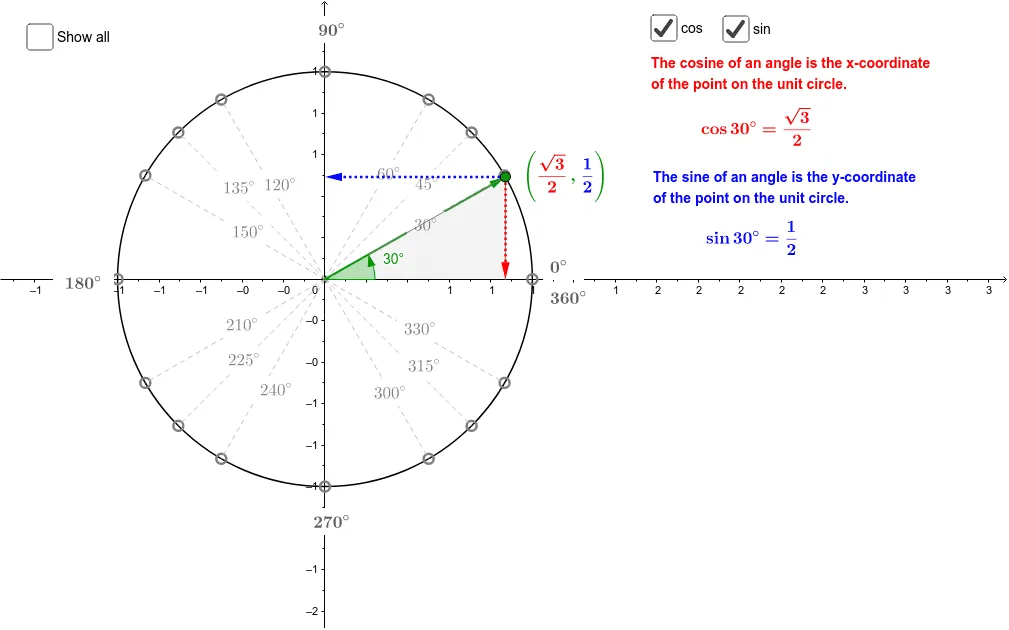
This example demonstrates how to mark exact trigonometric values on the unit circle corresponding to specific angles. Key math concepts include the unit circle, angles, trigonometric functions (sine, cosine, tangent), and geometric constructions. It utilizes GeoGebra commands like Intersect, Point, Circle, Segment, Distance, Angle, Vector, and Polygon. Suitable for high school students learning about trigonometric applications and geometric constructions.
GeoGebra Commands & Parameters
Intersect(xAxis, yAxis) → OPoint(xAxis) → ECircle(O, E) → c_1Point(c_1) → XSegment(O, X) → aDistance(X, A_1) → bAngle(E, O, X) → αSegment(A_1, (x(A_1), 0)) → fSegment(A_2, (x(A_2), 0)) → gSegment(B_2, B_1) → hSegment(C_2, C_1) → iVector(O, X) → uVector(X, (x(X), 0)) → vVector(X, (0, y(X))) → wPoint(u) → ASegment(A, C_2) → eSegment(A, B_2) → jSegment(A, A_2) → kSegment(A, A_3) → lSegment(A, B_3) → mSegment(A, C_3) → nSegment(A, C_4) → pSegment(A, B_4) → qSegment(A, A_4) → rSegment(A, A_1) → s_1Segment(A, B_1) → tSegment(A, C_1) → a_1Polygon(X, (x(X), 0), A) → poly1, a_2, B, b_1Polygon((abs(x(X)), abs(y(X))), A, (abs(x(X)), 0)) → poly2, d_1, e_1, a_3