
Eratosthenes Sieve 3D
Loading the math board and drawing, please wait…
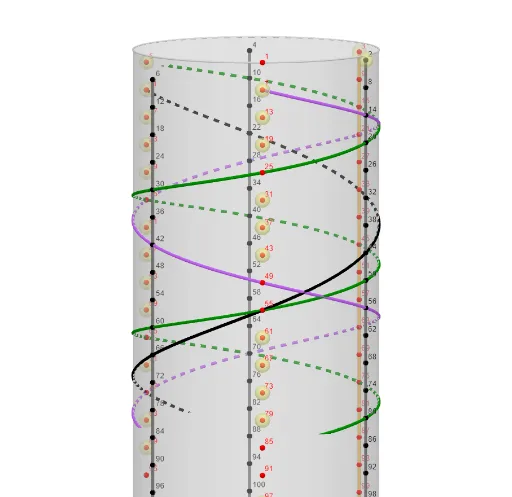
This example demonstrates the Eratosthenes Sieve for identifying prime and composite numbers. Key mathematical concepts include number theory, prime and composite numbers. Using GeoGebra commands such as Cylinder, Ray, Sequence, and CurveCartesian, a 3D sieve model is constructed. Suitable for students from upper elementary to middle school.
GeoGebra Commands & Parameters
Cylinder((0, 0, z0 - (200 * h)), (0, 0, z0), r) → a, a_2, a_3, a_4Ray(B2, B8) → r2Ray(B4, B10) → r4Ray(B6, B12) → r6Ray(B3, B9) → recta3Sequence(If[IsPrime[k], 1, 0], k, 1, 100) → primosCurveCartesian((r * cos((π / 3 * (t - 1)))), (r * sin((π / 3 * (t - 1)))), z0 - (6 * h) - ((7 * h) * (t - 1)), t, 1, 100) → helice7CurveCartesian((r * cos((π / 3 * (t - 1)) - (4 * π / 3))), ((-r) * sin((π / 3 * (t - 1)) - (4 * π / 3))), z0 - (4 * h) - ((5 * h) * (t - 1)), t, 1, 100) → helice5CurveCartesian((r * cos((π / 3 * (t - 1)) - (4 * π / 3))), ((-r) * sin((π / 3 * (t - 1)) - (4 * π / 3))), z0 - (10 * h) - ((11 * h) * (t - 1)), t, 1, 100) → helice11Sequence(Sphere[Element[puntos, k], Element[primos, k] / 4], k, 1, 100) → esferas