
Equivalent Fractions by Michael Karpman
Loading the math board and drawing, please wait…
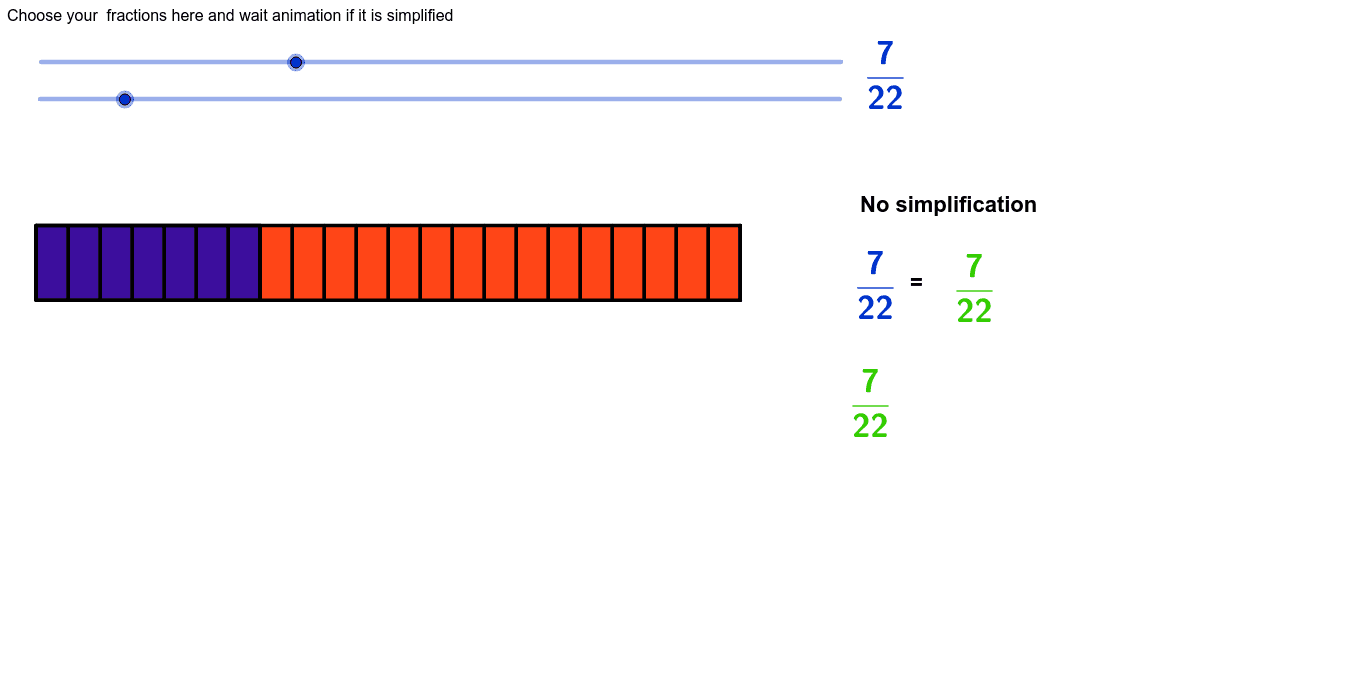
This example demonstrates the concept of equivalent fractions. It involves the basic properties of fractions, using commands and objects like GCD (Greatest Common Divisor), Segment, RandomNormal, etc., to show how equivalent fractions can be generated by changing the numerator and denominator. Suitable for high-grade elementary and junior high school students to learn the basic concepts and operations of fractions.
GeoGebra Commands & Parameters
GCD(n_1, d_1) → hSegment(A, B) → aRandomNormal(2, 4) → cRandomBinomial(2, 3) → bBinomial(4, 2) → dSequence((x(D) + (i * a / d_1), y(D)), i, 0, d_1) → PointbasSequence((x(A) + (i * a / d_1), y(A)), i, 0, d_1) → PointhautSequence(Segment[Element[Pointhaut, i], Element[Pointbas, i]], i, 1, d_1 + 1) → liste1Polygon(A, B, C, D) → Total, a_2, b_1, c_1, d_4Polygon(A, D, Element[Pointbas, n_1 + 1], Element[Pointhaut, n_1 + 1]) → Morceau, a_1, d_3, i, jPolygon(E, F, H, G) → poly1, e, f_1, h_1, g_1Sequence((x(G) + (i * e / (d_1 / h)), y(G)), i, 0, d_1 / h) → L2Sequence((x(E) + (i * e / (d_1 / h)), y(E)), i, 0, d_1 / h) → L3Sequence(Segment[Element[L3, i], Element[L2, i]], i, 1, d_1 / h + 1) → liste2Polygon(E, G, Element[L2, n_1 / h + 1], Element[L3, n_1 / h + 1]) → poly2, e_1, g, f, kLine(A, yAxis) → lIf((h * h) ≟ 1, 0, 5) → VitesseGCD(n_1, d_1) → h_2GCD(n_1, d_1) → h_3GCD(n_1, d_1) → h_4
AI Drawing Prompt Reference
Create a visual representation of equivalent fractions, showing how changing numerators and denominators generates equivalent fractions. Start by drawing a base line segment, then divide it using the greatest common divisor to create multiple points and connect them into small rectangles, illustrating the relationship between fractions. Next, use randomly generated values to form different fractional areas, combining them into polygons to visually demonstrate the composition and variation of fractions.
The prompt above was compiled from the original drawing commands and is for reference only.