
Equivalent Fractions by Melissa (2)
Loading the math board and drawing, please wait…
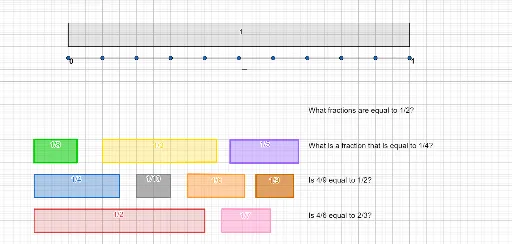
This example dynamically demonstrates the equivalence of fractions through geometric transformations, illustrating the geometric meaning of fractions. Core math concepts include fractions, geometric transformations, similar figures, LCM, and GCD. Construction involves commands like Segment, Point, Polygon, and objects such as f, K, L, M for transformations and annotations, with sliders to visualize fraction changes. Suitable for middle school and above mathematics education to understand the connection between fractions and geometric transformations.
GeoGebra Commands & Parameters
Segment(A, B) → fPoint(f) → CPoint(f) → GSegment(B, K) → gPoint(Circle[D_5, 2]) → E_5Polygon(D_5, E_5, F_5, G_5) → q1, d_5, e_5, f_5, g_5Point(Circle[P_5, 2]) → Q_5Polygon(P_5, Q_5, R_5, S_5) → q2, p_5, q_5, r_5, s_5Point(Circle[Z_5, 2]) → A_6Polygon(Z_5, A_6, B_6, C_6) → q3, z_5, a_6, b_6, c_6Point(Circle[D_6, 2]) → E_6Polygon(D_6, E_6, F_6, G_6) → q4, d_6, e_6, f_6, g_6Point(Circle[P_6, 3.7076237040084377]) → Q_6Point(Circle[Z_6, 6.692047753852707]) → A_7Polygon(Z_6, A_7, B_7, C_7) → q5, z_6, a_7, b_7, c_7Point(Circle[Z_7, 6.692047753852707]) → A_8Polygon(Z_7, A_8, B_8, C_8) → q5_1, z_1, a_1, b_1, c_1Point(Circle[Z_8, 6.692047753852707]) → A_9Polygon(Z_8, A_9, B_9, C_9) → q5_2, z_2, a_2, b_2, c_2Point(Circle[P_7, 2]) → Q_7Polygon(P_7, Q_7, R_7, S_7) → q2_1, p_1, q_1, r_1, s_1Point(Circle[P_8, 2]) → Q_8Polygon(P_8, Q_8, R_8, S_8) → q2_2, p_2, q_2, r_2, s_2Point(Circle[P_9, 2]) → Q_9Polygon(P_9, Q_9, R_9, S_9) → q2_3, p_3, q_3, r_3, s_3Point(Circle[D_7, 2]) → E_7Polygon(D_7, E_7, F_7, G_7) → q1_1, d_1, e_1, f_1, g_1Point(Circle[Z_9, 2]) → A_{10}Polygon(Z_9, A_{10}, B_{10}, C_{10}) → q3_1, z_3, a_3, b_3, c_3Point(Circle[Z_{10}, 2]) → A_{11}Polygon(Z_{10}, A_{11}, B_{11}, C_{11}) → q3_2, z_4, a_4, b_4, c_4Point(Circle[Z_{11}, 2]) → A_{12}Polygon(Z_{11}, A_{12}, B_{12}, C_{12}) → q3_3, z_7, a_5, b_5, c_5Point(Circle[Z_{12}, 2]) → A_{13}Polygon(Z_{12}, A_{13}, B_{13}, C_{13}) → q3_4, z_8, a_8, b_8, c_8Point(Circle[Z_{13}, 2]) → A_{14}Polygon(Z_{13}, A_{14}, B_{14}, C_{14}) → q3_5, z_9, a_9, b_9, c_9Point(Circle[Z_{14}, 2]) → A_{15}Polygon(Z_{14}, A_{15}, B_{15}, C_{15}) → q3_6, z_{10}, a_{10}, b_{10}, c_{10}Point(Circle[Z_{15}, 2]) → A_{16}Polygon(Z_{15}, A_{16}, B_{16}, C_{16}) → q3_7, z_{11}, a_{11}, b_{11}, c_{11}Point(Circle[D_8, 2]) → E_8Polygon(D_8, E_8, F_8, G_8) → q4_1, d_2, e_2, f_2, g_2Point(Circle[D_9, 2]) → E_9Polygon(D_9, E_9, F_9, G_9) → q4_2, d_3, e_3, f_3, g_3Point(Circle[D_{10}, 2]) → E_{10}Polygon(D_{10}, E_{10}, F_{10}, G_{10}) → q4_3, d_4, e_4, f_4, g_4Point(Circle[D_{11}, 2]) → E_{11}Polygon(D_{11}, E_{11}, F_{11}, G_{11}) → q4_4, d_7, e_7, f_7, g_7Point(Circle[D_{12}, 2]) → E_{12}Polygon(D_{12}, E_{12}, F_{12}, G_{12}) → q4_5, d_8, e_8, f_8, g_8Point(Circle[D_{13}, 2]) → E_{13}Polygon(D_{13}, E_{13}, F_{13}, G_{13}) → q4_6, d_9, e_9, f_9, g_9Point(Circle[D_{14}, 2]) → E_{14}Polygon(D_{14}, E_{14}, F_{14}, G_{14}) → q4_7, d_{10}, e_{10}, f_{10}, g_{10}Point(Circle[D_{15}, 2]) → E_{15}Polygon(D_{15}, E_{15}, F_{15}, G_{15}) → q4_8, d_{11}, e_{11}, f_{11}, g_{11}Point(Circle[D_{16}, 2]) → E_{16}Polygon(D_{16}, E_{16}, F_{16}, G_{16}) → q4_9, d_{12}, e_{12}, f_{12}, g_{12}Point(Circle[I_7, 3.318493038763244]) → J_7Polygon(I_7, J_7, K_7, I_8) → q6, i_7, j_7, k_7, i_8Point(Circle[I_9, 3.318493038763244]) → J_8Polygon(I_9, J_8, K_8, I_{10}) → q6_1, i_1, j_1, k_1, i_2Point(Circle[I_{11}, 3.318493038763244]) → J_9Polygon(I_{11}, J_9, K_9, I_{12}) → q6_2, i_3, j_2, k_2, i_4Point(Circle[I_{13}, 3.318493038763244]) → J_{10}Polygon(I_{13}, J_{10}, K_{10}, I_{14}) → q6_3, i_5, j_3, k_3, i_6Point(Circle[I_{15}, 3.318493038763244]) → J_{11}Polygon(I_{15}, J_{11}, K_{11}, I_{16}) → q6_4, i_9, j_4, k_4, i_{10}Point(Circle[I_{17}, 3.318493038763244]) → J_{12}Polygon(I_{17}, J_{12}, K_{12}, I_{18}) → q6_5, i_{11}, j_5, k_5, i_{12}Point(Circle[P_{10}, 4]) → Q_{10}Polygon(P_{10}, Q_{10}, R_{10}, S_{10}) → q7, p_{10}, q_{10}, r_{10}, s_{10}Point(Circle[P_{11}, 4]) → Q_{11}Polygon(P_{11}, Q_{11}, R_{11}, S_{11}) → q7_1, p_4, q_4, r_4, s_4Point(Circle[P_{12}, 4]) → Q_{12}Polygon(P_{12}, Q_{12}, R_{12}, S_{12}) → q7_2, p_6, q_6, r_6, s_6Point(Circle[P_{13}, 4]) → Q_{13}Polygon(P_{13}, Q_{13}, R_{13}, S_{13}) → q7_3, p_7, q_7, r_7, s_7Point(Circle[P_{14}, 4]) → Q_{14}Polygon(P_{14}, Q_{14}, R_{14}, S_{14}) → q7_4, p_8, q_8, r_8, s_8Point(Circle[J_{14}, 2.8477655083416864]) → K_{14}Polygon(J_{14}, K_{14}, H_{15}, J_{15}) → q8, j_{14}, k_{14}, h_{15}, j_{15}Point(Circle[J_{13}, 2.8477655083416864]) → K_{13}Polygon(J_{13}, K_{13}, H_{13}, J_{16}) → q8_1, j_6, k_6, h_1, j_8Point(Circle[J_{17}, 2.8477655083416864]) → K_{15}Polygon(J_{17}, K_{15}, H_{14}, J_{18}) → q8_2, j_9, k_8, h_2, j_{10}Point(Circle[J_{19}, 2.8477655083416864]) → K_{16}Polygon(J_{19}, K_{16}, H_{16}, J_{20}) → q8_3, j_{11}, k_9, h_3, j_{12}Point(Circle[J_{21}, 2.8477655083416864]) → K_{17}Polygon(J_{21}, K_{17}, H_{17}, J_{22}) → q8_4, j_{16}, k_{10}, h_4, j_{13}Point(Circle[J_{23}, 2.8477655083416864]) → K_{18}Polygon(J_{23}, K_{18}, H_{18}, J_{24}) → q8_5, j_{17}, k_{11}, h_5, j_{18}Point(Circle[J_{25}, 2.8477655083416864]) → K_{19}Polygon(J_{25}, K_{19}, H_{19}, J_{26}) → q8_6, j_{19}, k_{12}, h_6, j_{20}Point(Circle[P_{15}, 2.2024410791962357]) → Q_{15}Polygon(P_{15}, Q_{15}, R_{15}, S_{15}) → q9, p_{15}, q_{15}, r_{15}, s_{15}Point(Circle[P_{16}, 2.2024410791962357]) → Q_{16}Polygon(P_{16}, Q_{16}, R_{16}, S_{16}) → q9_1, p_9, q_9, r_9, s_9Point(Circle[P_{17}, 2.2024410791962357]) → Q_{17}Polygon(P_{17}, Q_{17}, R_{17}, S_{17}) → q9_2, p_{11}, q_{11}, r_{11}, s_{11}Point(Circle[P_{18}, 2.2024410791962357]) → Q_{18}Polygon(P_{18}, Q_{18}, R_{18}, S_{18}) → q9_3, p_{12}, q_{12}, r_{12}, s_{12}Point(Circle[P_{19}, 2.2024410791962357]) → Q_{19}Polygon(P_{19}, Q_{19}, R_{19}, S_{19}) → q9_4, p_{13}, q_{13}, r_{13}, s_{13}Point(Circle[P_{20}, 2.2024410791962357]) → Q_{20}Polygon(P_{20}, Q_{20}, R_{20}, S_{20}) → q9_5, p_{14}, q_{14}, r_{14}, s_{14}Point(Circle[P_{21}, 2.2024410791962357]) → Q_{21}Polygon(P_{21}, Q_{21}, R_{21}, S_{21}) → q9_6, p_{16}, q_{16}, r_{16}, s_{16}Point(Circle[P_{22}, 2.2024410791962357]) → Q_{22}Polygon(P_{22}, Q_{22}, R_{22}, S_{22}) → q9_7, p_{17}, q_{17}, r_{17}, s_{17}Point(Circle[P_{23}, 2.2024410791962357]) → Q_{23}Polygon(P_{23}, Q_{23}, R_{23}, S_{23}) → q9_8, p_{18}, q_{18}, r_{18}, s_{18}Point(Circle[Z_{16}, 20]) → A_{17}Polygon(Z_{16}, A_{17}, B_{17}, C_{17}) → q10, z_{16}, a_{17}, b_{17}, c_{17}
AI Drawing Prompt Reference
Draw a horizontal segment with two movable points dividing it into three parts. Construct a series of squares of varying sizes along the segment, with side lengths controlled by sliders. Use geometric transformations (translation, scaling) to demonstrate equivalent fractions: divide the whole shape into equal parts, shade some regions, and ensure that different fractions correspond to equal area proportions. Include multiple groups of similar squares, each representing a fraction, and adjust sliders to change the number of divisions, visually comparing fraction values.
The prompt above was compiled from the original drawing commands and is for reference only.