
Equations of Parallel and Perpendicular Lines
Loading the math board and drawing, please wait…
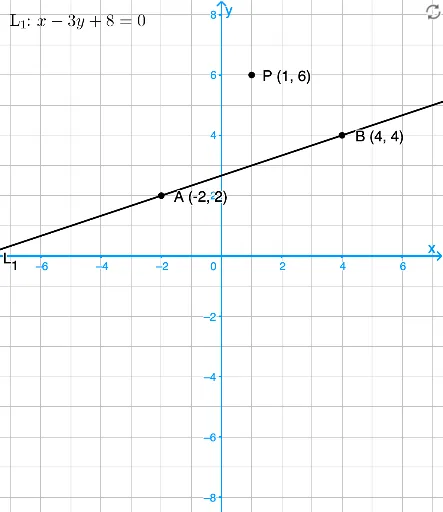
This example demonstrates the relationship between equations of parallel and perpendicular lines. Key math concepts include equal slopes for parallel lines and product of slopes being -1 for perpendicular lines. Construction highlights the use of DynamicCoordinates, Line, OrthogonalLine, GCD, LCM, Midpoint, Slope, If, Angle, Segment commands and objects in GeoGebra. Suitable for high school students learning coordinate geometry.
GeoGebra Commands & Parameters
DynamicCoordinates(C', (round(x(C') / 0.5) * 0.5), (round(y(C') / 0.5) * 0.5)) → PDynamicCoordinates(B', (round(x(B') / 0.5) * 0.5), (round(y(B') / 0.5) * 0.5)) → BDynamicCoordinates(A', (round(x(A') / 0.5) * 0.5), (round(y(A') / 0.5) * 0.5)) → ALine(B, A) → L_1OrthogonalLine(P, L_1) → L_3GCD({Numerator[x(L_3)], Numerator[y(L_3)], Numerator[z(L_3)]}) → hcf3LCM({Denominator[x(L_3)], Denominator[y(L_3)], Denominator[z(L_3)]}) → lcm3Line(P, L_1) → L_2Midpoint(A, B) → MSlope(L_3) → m_3If(m_3^(2) ≠ 1, FractionText[m_3], If[m_3 ≟ -1, "-", ""]) → textm3Angle(L_1, L_3) → αSlope(L_2) → m_2GCD({Numerator[x(L_2)], Numerator[y(L_2)], Numerator[z(L_2)]}) → hcf2LCM({Denominator[x(L_2)], Denominator[y(L_2)], Denominator[z(L_2)]}) → lcm2If(m_2^(2) ≠ 1, FractionText[m_2], If[m_2 ≟ -1, "-", ""]) → textm2Segment(M, A) → fSegment(M, B) → gGCD({Numerator[x(L_1)], Numerator[y(L_1)], Numerator[z(L_1)]}) → hcf1LCM({Denominator[x(L_1)], Denominator[y(L_1)], Denominator[z(L_1)]}) → lcm1Slope(L_1) → m_1