
Equal Vectors Recognition Exercises (03)
Loading the math board and drawing, please wait…
In collections
Complex Numbers as Vectors
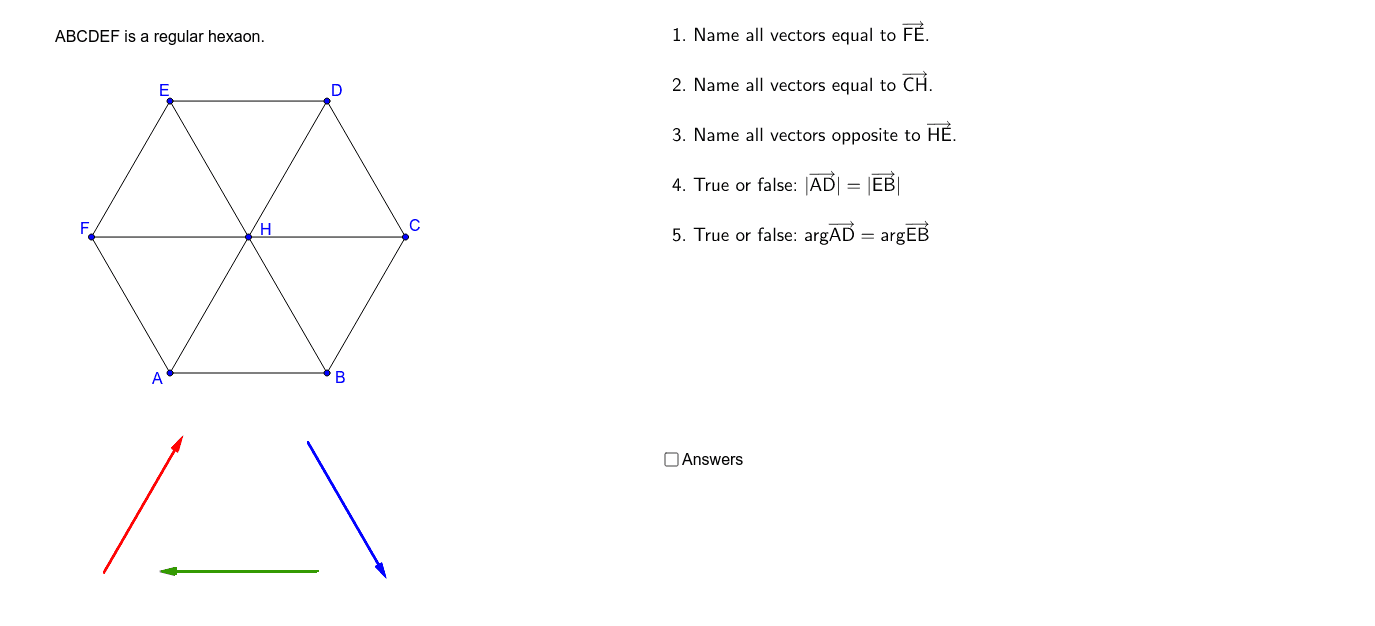
This interactive applet provides a set of exercises focused on recognizing equal vectors in geometric configurations. It demonstrates that two vectors are equal if they have the same magnitude and direction, regardless of their starting point. The core mathematical concept is the definition of vector equality and the idea of translation invariance. The construction uses GeoGebra commands such as Polygon, Segment, Intersect, Vector, and Translate to build polygons, segments, intersection points, vectors, and translated copies. Text objects (text1, text2, text3) are included to present prompts or feedback. This resource is suitable for high school or introductory college students learning vector basics, and can be used for self-study or classroom demonstration. By comparing vectors placed at different positions, learners gain an intuitive understanding of why equal vectors are not tied to a specific location.
GeoGebra Commands & Parameters
Polygon(A, B, 6) → poly1, a, F, b, c, d, e, f, C, D, ESegment(F, A) → gSegment(A, B) → hSegment(B, C) → iSegment(C, D) → jSegment(D, E) → kSegment(E, F) → lSegment(E, B) → mSegment(D, A) → nSegment(F, C) → pIntersect(m, n) → HVector(F, E) → uTranslate(G, u) → G'Translate(I, u) → I'Translate(J, u) → J'Translate(K, u) → K'Vector(C, H) → rTranslate(L, r) → L'Translate(M, r) → M'Translate(N, r) → N'Translate(O, r) → O'Vector(E, H) → w_1Translate(P, w_1) → P'Translate(Q, w_1) → Q'Translate(R, w_1) → R'Translate(S, w_1) → S'Polygon(A_1, B_1, 6) → poly1_1, a_3, F_1, b_3, c_3, d_1, e_1, f_1, C_1, D_1, E_1Segment(F_1, A_1) → g_1Segment(A_1, B_1) → h_1Segment(B_1, C_1) → i_1Segment(C_1, D_1) → j_1Segment(D_1, E_1) → k_1Segment(E_1, F_1) → l_1Segment(E_1, B_1) → m_1Segment(D_1, A_1) → n_1Segment(F_1, C_1) → p_1Intersect(m_1, n_1) → H_1Vector(F_1, E_1) → u_3Translate(G_1, u_3) → G'_1Vector(G_1, G'_1) → v_2Translate(I_1, u_3) → I'_1Vector(I_1, I'_1) → w_2Translate(J_1, u_3) → J'_1Vector(J_1, J'_1) → z_2Translate(K_1, u_3) → K'_1Vector(K_1, K'_1) → q_1Vector(C_1, H_1) → r_1Translate(L_1, r_1) → L'_1Vector(L_1, L'_1) → s_1Translate(M_1, r_1) → M'_1Vector(M_1, M'_1) → t_1Translate(N_1, r_1) → N'_1Vector(N_1, N'_1) → u_2Translate(O_1, r_1) → O'_1Vector(O_1, O'_1) → v_3Vector(E_1, H_1) → w_3Translate(P_1, w_3) → P'_1Vector(P_1, P'_1) → z_3Translate(Q_1, w_3) → Q'_1Vector(Q_1, Q'_1) → a_2Translate(R_1, w_3) → R'_1Vector(R_1, R'_1) → b_2Translate(S_1, w_3) → S'_1Vector(S_1, S'_1) → c_2
AI Drawing Prompt Reference
Draw a hexagon ABCDEF, connect F to A, A to B, B to C, C to D, D to E, and E to F, then connect E to C, D to A, and F to C to find their intersection point H. Draw vector FE, then translate G, I, J, and K along vector FE to get G', I', J', and K'. Next, draw vector CH, then translate L, M, N, and O along vector CH to get L', M', N', and O'. Finally, draw vector EH, then translate P, Q, R, and S along vector EH to get P', Q', R', and S'.
The prompt above was compiled from the original drawing commands and is for reference only.