
Equal Vectors: Exploring the Geometric Meaning of Vector Equality
Loading the math board and drawing, please wait…
In collections
Complex Numbers as Vectors
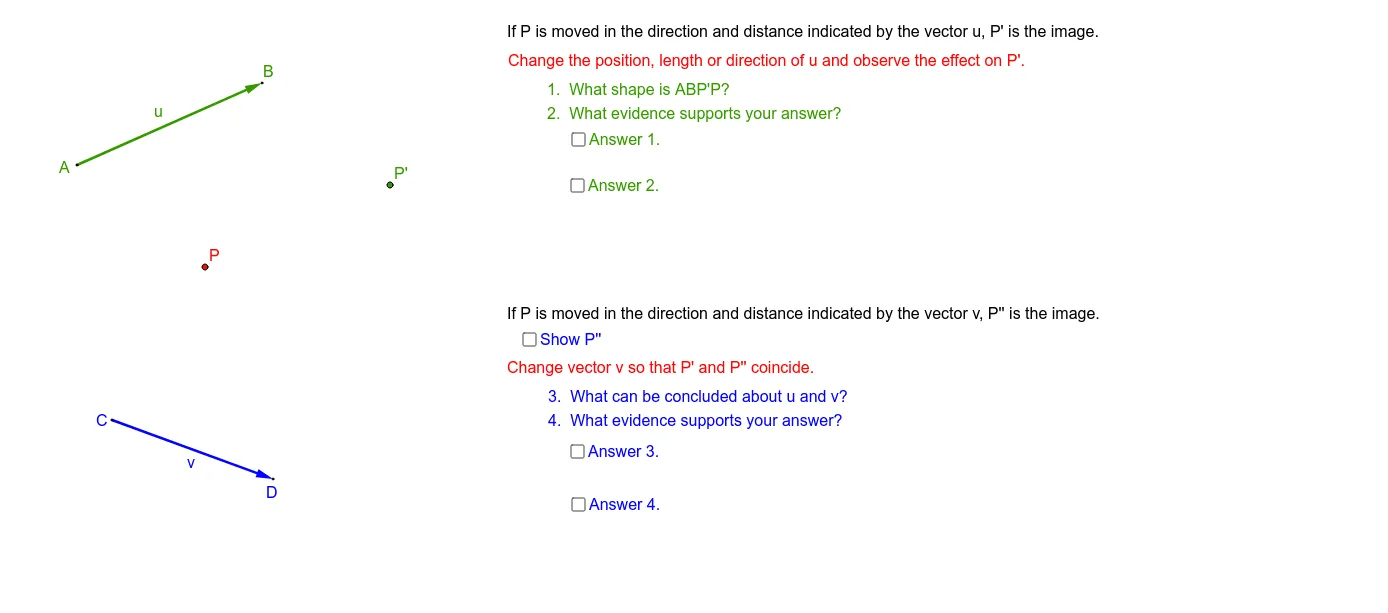
This applet demonstrates the geometric condition for two vectors to be equal: they must have the same direction and magnitude. The core mathematical concept is vector equality, emphasizing translation invariance. Construction details: using GeoGebra's Vector command to create vectors u and v, and the Translate command to shift vectors, with points A, B, C, D and translated points P, P', P''. Text objects display coordinates and equality relations. Suitable for high school or introductory college linear algebra students to intuitively grasp the definition of equal vectors and how translation preserves equality.
GeoGebra Commands & Parameters
Vector(A, B) → uVector(C, D) → vTranslate(P, u) → P'Translate(P, v) → P''
AI Drawing Prompt Reference
Draw two vectors starting from different points, showing their initial and terminal points. Then, translate one vector along the other using its starting point as the base, and mark the new point. Similarly, translate the first vector along the second using its terminal point as the base, and mark another new point. Finally, connect these two new points and compare their relationship with the original vectors to illustrate the invariance of vector translation.
The prompt above was compiled from the original drawing commands and is for reference only.