
Elliptic Dispersion 3D Model
Loading the math board and drawing, please wait…
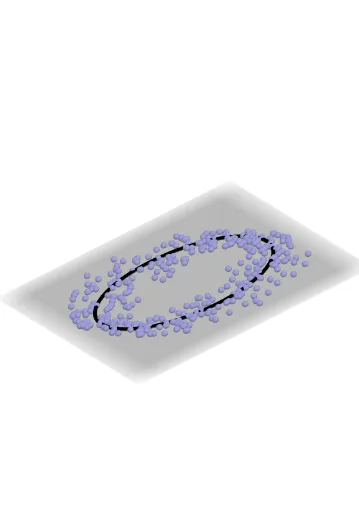
This example demonstrates a three-dimensional dispersion model based on elliptic equations, showing how elliptic curves evolve in 3D space with varying parameters. The core mathematical concepts include ellipse equations, parametric equations, sequence generation, and 3D coordinate transformations, combining conic sections with spatial surfaces. The construction uses GeoGebra's Sequence command to generate a series of elliptic curves, with sliders (a, b, c, n, v_min, v_max) controlling parameter changes, color objects (CB, CG, CR) for visual differentiation, and text objects (text1-text4) for annotations. Lists L_1 and L_2 are used to organize the geometric elements. This model is suitable for high school or university students studying analytic geometry, parametric equations, and 3D graphics, and can also serve as a mathematical simulation for wave dispersion phenomena in physics, helping to understand how elliptic parameters affect spatial distribution.
GeoGebra Commands & Parameters
Sequence(((a * cos(θ)), (b * sin(θ))), θ, 0°, 360°, (360 * ° / (n - 1))) → L_1Sequence(((a * cos(θ)) + Random[(10 * v_{min}), (10 * v_{max})] / 10, (b * sin(θ))) + Random[(10 * v_{min}), (10 * v_{max})] / 10, θ, 0°, 360°, (360 * ° / (n - 1))) → L_2