
Ellipse as a Cone Section, Geometric Proof
Loading the math board and drawing, please wait…
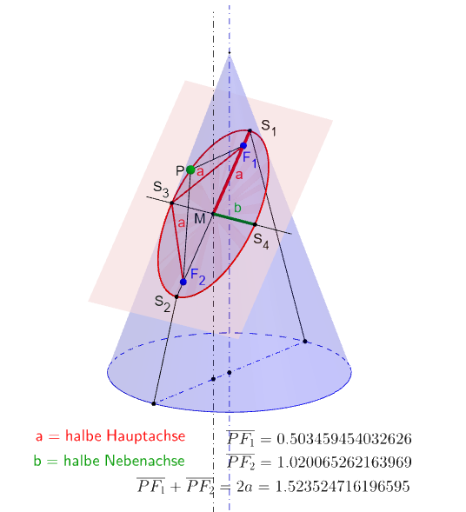
This example demonstrates the geometric proof of an ellipse as a cone section. Key math concepts include conic sections, geometric construction, and analytical geometry. GeoGebra commands and objects used in the construction are Intersect, Point, Cone, Line, Circle, Plane, PointIn, Polygon, IntersectPath, Segment, Midpoint, Cylinder, Corner, OrthogonalLine, and Mirror. It is suitable for high school students to learn and understand the properties of conic curves, serving as an educational demonstration tool.
GeoGebra Commands & Parameters
Intersect(yAxis, xAxis) → APoint(zAxis) → BCone(A, B, 1) → a_{5}, k_1, a_{4}Point(yAxis) → CPoint(zAxis) → DLine(D, xAxis) → fPoint(f) → ECircle(zAxis, D) → c_{2}Circle(zAxis, E) → dIntersect(f, d, 2) → FPlane(F, E, C) → pPointIn(p) → E_1PointIn(p) → G_1PointIn(p) → H_1PointIn(p) → I_1Polygon(E_1, G_1, H_1, I_1) → v2, b, f_1, m_1, b_1IntersectPath(p, a_{5}) → eIntersect(f, e, 1) → GIntersect(f, e, 2) → P_3Intersect(yAxis, k_1, 2) → ISegment(B, I) → gIntersect(g, e) → S_2,Intersect(yAxis, k_1, 1) → KSegment(B, K) → hIntersect(h, e) → L,Segment(S_2, L) → iMidpoint(S_2, L) → MLine(M, f) → jPoint(j) → NPoint(j) → OSegment(N, O) → k_{4}Segment(S_2, I) → lSegment(L, K) → mIntersect(k_{4}, e) → S_4, S_3Line(S_2, zAxis) → nLine(L, zAxis) → qLine(M, q) → rIntersect(yAxis, r) → R_{1}Intersect(yAxis, n) → SIntersect(yAxis, q) → TCircle(r, S) → sLine(L, yAxis) → tSegment(R_{1}, S) → cIntersect(r, t) → UCylinder(U, R_{1}, c) → o, c_1, d_1, uSegment(M, S_4) → b_{MR}Point(r) → VCylinder(V, R_{1}, b_{MR}) → v, e_1, g_1, wIntersectPath(p, v) → h_1Segment(S_2, I) → i_1Segment(L, K) → j_1IntersectPath(p, o) → k_{3}Corner(k_{3}) → S_1, ZIntersect(yAxis, d_1, 2) → A_1Segment(A_1, R_{1}) → l_1Intersect(k_{4}, r) → M_eCircle(r, M_e) → p_1Circle(r, M_e) → q_1Circle(r, M_e) → r_1Circle(M_e, l_1, r) → s_1Segment(M_e, S_1) → aOrthogonalLine(S_3, p) → n_1Circle(S_3, a, n_1) → k_{2}Intersect(a, k_{2}) → F_1,Mirror(F_1, k_{4}) → F_2Segment(S_3, F_1) → a_{2}Segment(S_3, F_2) → a_1Point(e) → PSegment(F_1, P) → f_{PF_1}Segment(P, F_2) → f_{PF2}Point(e) → P'Segment(F_1, P') → f_{P'F1}Segment(P', F_2) → f_{P'F2}Point(k_{2}) → kSegment(I, K) → t_1Line(A, r) → j_2PointIn(p) → HPointIn(p) → B_1PointIn(p) → C_1PointIn(p) → D_1
AI Drawing Prompt Reference
Create a 3D geometric demonstration showing an ellipse as a conic section of a cone. Start with the intersection of the coordinate axes as the cone’s apex, then place a second point on the z-axis to define the cone. Construct an auxiliary line through a point determined by intersections of a line with circles centered on the z-axis, and use another line through a point on the same circle to form the key intersecting directions. Define a plane using three noncollinear points obtained from these intersections, then select several points that lie on that plane and connect them into a polygon to visualize the cut region. Add construction lines using midpoints and intersections along the plane, and build cylinder-like auxiliary solids from intersected points with a circle to support the geometric proof layout. Display the cone, the cutting plane, and the auxiliary intersections to highlight the ellipse-as-conic-section relationship.
The prompt above was compiled from the original drawing commands and is for reference only.