
Einstein Velocity Addition
Loading the math board and drawing, please wait…
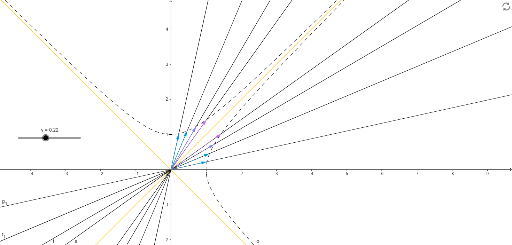
This example demonstrates the geometric representation of Einstein's velocity addition formula, visualizing the method of velocity composition in relativity. Core mathematical concepts include vector addition, coordinate geometry, and geometric construction. Construction highlights involve commands like CurveCartesian for plotting curves, Point for creating points, Intersect for finding intersections, Line for drawing lines, Vector for representing vectors, and Mirror for reflection, as listed in the construction summary. Suitable for high school physics and mathematics education to help students intuitively understand core relativistic concepts.
GeoGebra Commands & Parameters
CurveCartesian(sinh(t), cosh(t), t, -5, 5) → aPoint(h) → APoint(p) → BPoint(q) → CPoint(r) → DIntersect(f, g, 1) → ELine(E, A) → bLine(E, B) → cLine(E, C) → dLine(E, D) → eIntersect(b, a) → FIntersect(c, a) → GIntersect(d, a) → HIntersect(e, a) → IVector(E, F) → uVector(E, G) → wVector(E, H) → iVector(E, I) → jPoint(f) → JIntersect(f, g, 1) → KLine(K, J) → nMirror(j, n) → j'Mirror(i, n) → i'Mirror(w, n) → w'Mirror(u, n) → u'CurveCartesian(cosh(t), sinh(t), t, -5, 5) → oPoint(j') → LLine(L, K) → sPoint(i') → MLine(K, M) → tPoint(w') → NLine(K, N) → f_1Point(u') → OLine(K, O) → g_1