
Egyptian Fractions Demo
Loading the math board and drawing, please wait…
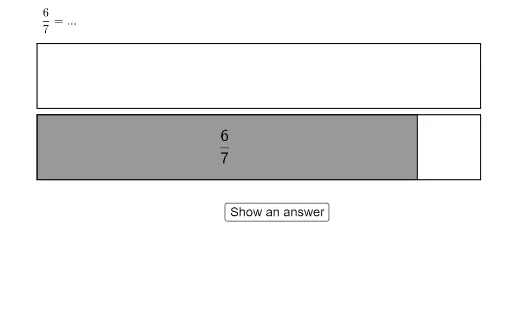
This example demonstrates how to decompose a fraction into Egyptian fractions (sum of fractions with numerator 1). It involves core math concepts like fractions, sequences, geometric drawing, and conditional probability. GeoGebra commands and objects used include Random, Polygon, Zip, Append, Sequence, FractionText, Flatten, Textfield. Suitable for middle school and above students to understand fraction decomposition and sequence generation.
GeoGebra Commands & Parameters
Random(3, 12) → DRandom(2, D - 1) → NPolygon((0, 0), (fraction, 0), (fraction, 0.1), (0, 0.1)) → drawnFraction, f, g, h, iPolygon((Sum[added], 0.11), (Sum[added] + 1 / availableDenoms(n), 0.11), (Sum[added] + 1 / availableDenoms(n), 0.21), (Sum[added], 0.21)) → liveFraction, j, k, l, mZip(FractionText[AAA], AAA, Last[added, Length[added] - 1]) → displayTextHelperAppend(0, Zip[1 / AAA, AAA, Last[greedyList, Length[greedyList] - 1]]) → greedyListAsFractionsSequence(Polygon[(Sum[greedyListAsFractions, i], -0.11), (Sum[greedyListAsFractions, i + 1], -0.11), (Sum[greedyListAsFractions, i + 1], -0.01), (Sum[greedyListAsFractions, i], -0.01)], i, 1, Length[greedyListAsFractions] - 1) → drawnGreedyFractionsSequence(Polygon[(Sum[added, i], 0.11), (Sum[added, i + 1], 0.11), (Sum[added, i + 1], 0.21), (Sum[added, i], 0.21)], i, 1, Length[added] - 1) → drawnAddedFractionsPolygon((0, 0), (1, 0), (1, 0.1), (0, 0.1)) → origWhole, p, q, r, sPolygon((0, -0.11), (1, -0.11), (1, -0.01), (0, -0.01)) → greedyWhole, t, a, b, cPolygon((0, 0.11), (1, 0.11), (1, 0.21), (0, 0.21)) → addedWhole, d, e, f_1, g_1FractionText(fraction) → text2Flatten(Sequence[displayTextHelper(i) + "+", i, 1, Length[displayTextHelper]]) → noAnswerYetSequence(Text[(("$\frac{1}{" * Element[usedDenoms, i]) * "}$")], i, 1, Length[usedDenoms]) → L_1Textfield(typedText) → InputBox1Zip(FractionText[1 / AAA], AAA, Last[greedyList, Length[greedyList] - 1]) → greedyDisplayHelper