
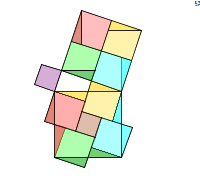
Edgardo Alandete's Proof of the Pythagorean Theorem #4
Loading the math board and drawing, please wait…
This example presents Edgardo Alandete's proof of the Pythagorean theorem, illustrating the relationship between the legs and hypotenuse of a right triangle through dynamic geometry. Key concepts include the Pythagorean theorem, triangle properties, and coordinate geometry. The construction uses GeoGebra commands such as Segment, Point, Polygon, and Intersect to create points and lines, with intersections verifying a² + b² = c². It is suitable for high‑school geometry classes and math contest preparation.
GeoGebra Commands & Parameters
Segment(A, B) → aSegment(A, C) → bSegment(C, D) → cSegment(D, B) → dSegment(A, E) → eSegment(E, B) → fSegment(E, F) → gSegment(A, G) → hSegment(G, F) → iSegment(E, H) → jSegment(H, I) → kSegment(I, J) → lSegment(J, K) → mSegment(K, B) → nSegment(L, M) → pSegment(A, L) → qSegment(M, C) → rSegment(N, O) → sSegment(N, B) → tSegment(O, D) → a_1Point(f) → PSegment(P, Q) → b_1Segment(Q, A) → c_1Segment(N, R) → d_1Segment(M, S) → e_1Point(e_1) → TSegment(Q, T) → f_1Point(d_1) → USegment(U, S) → g_1Segment(V, W) → h_1Segment(V, C) → i_1Segment(W, S) → j_1Segment(D, W) → k_1Point(j) → ZPoint(m) → A_1Segment(Z, A_1) → l_1Point(l_1) → B_1Segment(P, B_1) → m_1Point(l) → C_1Segment(B_1, C_1) → n_1Point(l_1) → D_1Segment(I, D_1) → p_1Point(n_1) → E_1Segment(J, E_1) → q_1Point(m_1) → F_1Segment(E, F_1) → r_1Point(l_1) → G_1Segment(B, G_1) → s_1Polygon(A, L, T, Q) → poly1, a_2, l_2, t_1, q_2Polygon(C_1, I, Z, B_1) → poly2, c_2, i_2, z, b_2Intersect(b, p) → H_1Polygon(C, M, H_1) → poly3, h_2, c_3, m_2Polygon(N, R, P, B) → poly4, n_2, r_2, p_2, b_3Intersect(a, b_1) → I_1Polygon(I_1, A, Q) → poly5, q_3, i_3, a_3Polygon(A_1, B_1, C_1, J) → poly6, a_4, b_4, c_4, j_2Polygon(D, W, U, O) → poly7, d_2, w, u, oIntersect(d, s) → J_1Polygon(B, N, J_1) → poly8, j_3, b_5, n_3Polygon(B_1, P, B, A_1) → poly9, b_6, p_3, b_7, a_5Polygon(M, C, V, S) → poly10, m_3, c_5, v, s_2Intersect(c, h_1) → K_1Polygon(W, K_1, D) → poly11, d_3, w_1, k_2Polygon(Z, E, P, B_1) → poly12, z_1, e_2, p_4, b_8Polygon(E, F, G, A) → poly13, e_3, f_2, g_2, a_6Polygon(R, T, S, U) → poly14, r_3, t_2, s_3, u_1Polygon(A, H_1, L) → poly15, l_3, a_7, h_3Polygon(H_1, M, C) → poly16, c_6, h_4, m_4Polygon(C, V, K_1) → poly17, k_3, c_7, v_1Polygon(K_1, D, W) → poly18, w_2, k_4, d_4Polygon(E, P, F_1) → poly19, f_3, e_4, p_5Polygon(I, D_1, Z) → poly20, z_2, i_4, d_5Polygon(C_1, E_1, J) → poly21, j_4, c_8, e_5Polygon(P, B, I_1) → poly22, i_5, p_6, b_9Polygon(I_1, Q, A) → poly23, a_8, i_6, q_4Polygon(G_1, A_1, B) → poly24, b_{10}, g_3, a_9Polygon(B, N, J_1) → poly25, j_5, b_{11}, n_4Polygon(D, O, J_1) → poly26, j_6, d_6, o_1Segment(F, E) → t_3Segment(E, A) → f_4Segment(A, G) → g_4Segment(G, F) → l_4Segment(E, B) → r_4Segment(B, A) → s_4Segment(A, C) → t_4Segment(C, D) → f_5Segment(D, B) → g_5Segment(B, J) → h_5Segment(J, I) → k_5Segment(I, E) → l_5Segment(Z, A_1) → m_5Segment(P, C_1) → n_5Segment(S, L) → q_5Segment(T, P) → r_5Segment(R, O) → s_5Segment(U, V) → t_5Segment(L, A) → e_6Segment(C, V) → f_6Segment(D, O) → g_6Intersect(k, l) → L_1Intersect(l_1, p_1) → M_1Segment(L_1, M_1) → h_6Segment(M_1, L_1) → k_6Intersect(n_1, q_1) → N_1Intersect(l, m) → O_1Segment(N_1, O_1) → l_6Segment(O_1, N_1) → m_6Segment(N_1, O_1) → n_6Segment(O_1, N_1) → q_6Segment(M_1, L_1) → r_6Segment(L_1, M_1) → s_6Segment(N_1, O_1) → t_6Point(l_1) → P_1Intersect(a, d) → Q_1Segment(P_1, Q_1) → d_7Segment(Q_1, P_1) → e_7Segment(P_1, Q_1) → f_7Segment(Q_1, P_1) → g_7Segment(P_1, Q_1) → h_7Segment(Q_1, P_1) → i_7Intersect(m_1, r_1) → R_1Intersect(e, f) → S_1Segment(R_1, S_1) → j_7Segment(S_1, R_1) → k_7Segment(R_1, S_1) → l_7Segment(S_1, R_1) → m_7Segment(R_1, S_1) → n_7Segment(S_1, R_1) → p_7Segment(R_1, S_1) → q_7Segment(Q_1, P_1) → r_7Segment(P_1, Q_1) → s_7Segment(R_1, S_1) → t_7Segment(S_1, R_1) → d_8Segment(R_1, S_1) → e_8Segment(S_1, R_1) → f_8Intersect(d, t) → T_1Intersect(s, t) → U_1Segment(T_1, U_1) → g_8Segment(U_1, T_1) → h_8Segment(T_1, U_1) → i_8Segment(U_1, T_1) → j_8Intersect(b_1, c_1) → V_1Intersect(a, b) → W_1Segment(V_1, W_1) → k_8Segment(W_1, V_1) → l_8Segment(V_1, W_1) → m_8Segment(W_1, V_1) → n_8Intersect(c, d) → Z_1Intersect(h_1, j_1) → A_2Segment(Z_1, A_2) → p_8Segment(A_2, Z_1) → q_8Segment(Z_1, A_2) → r_8Intersect(a, d) → B_2Point(l_1) → C_2Segment(B_2, C_2) → s_8Point(l_1) → D_2Intersect(f, n) → E_2Segment(D_2, E_2) → t_8Intersect(l, m) → F_2Intersect(n_1, q_1) → G_2Segment(F_2, G_2) → c_9Intersect(k, l) → H_2Intersect(l_1, p_1) → I_2Segment(H_2, I_2) → d_9Intersect(m_1, r_1) → J_2Intersect(e, f) → K_2Segment(J_2, K_2) → e_9