
Eccentricity Proof
Loading the math board and drawing, please wait…
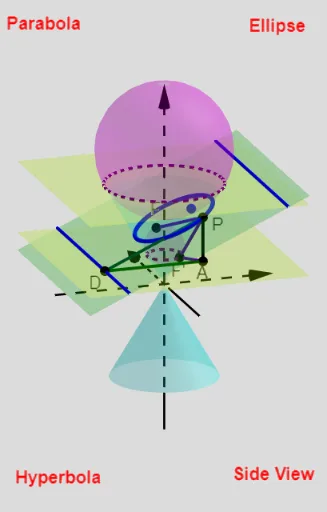
This example demonstrates that eccentricity equals the ratio of distances in 2D and the ratio of trigonometric ratios of angles of the plane and cone in 3D. It involves core mathematical concepts such as circle, cone, conic sections, ellipse, hyperbola, parabola, integers, congruence, quadratic equations, Pythagorean theorem, and variance. GeoGebra commands/objects used include Line, AngularBisector, Intersect, OrthogonalLine, Circle, Cone, Sphere, CurveCartesian, Segment, IntersectPath, Plane, Ray, and Angle. Suitable for high school and above mathematics learners to understand the relationship between eccentricity and geometric figures.
GeoGebra Commands & Parameters
If(abs(Z_{int}) > E_{psilon} ∧ abs(sin(θ_{plane-r})) < 0.9999, true, false) → S_{tandard}Line(P_{z}, (1, 0, z(P_{z}) + tan(θ_{plane-r}))) → L_{plane}Line((0, 0, 0), (r_{cone}, 0, 5)) → L_{cone-r}AngularBisector(L_{plane}, L_{cone-r}) → L_{bis-1}, L_{bis-2}Intersect(L_{bis-1}, zAxis) → P_{circle-1}OrthogonalLine(P_{circle-1}, L_{plane}, x = 0) → L_{perp-1}If(S_{tandard}, Intersect[L_{perp-1}, L_{plane}]) → F_{1}OrthogonalLine(P_{circle-1}, L_{cone-r}, x = 0) → L_{perp-1a}Intersect(L_{perp-1a}, L_{cone-r}) → P_{horz-1}Line(P_{horz-1}, xAxis) → L_{horz-1}Intersect(L_{horz-1}, L_{plane}) → P_{d1}Intersect(L_{bis-2}, zAxis) → P_{circle-2}OrthogonalLine(P_{circle-2}, L_{plane}, x = 0) → L_{perp-2}If(S_{tandard}, Intersect[L_{perp-2}, L_{plane}]) → F_{2}If(S_{tandard}, Distance[P_{circle-2}, L_{plane}], sqrt(-1)) → r_{2}Circle(P_{circle-2}, r_{2}, y = 0) → C_{circle-2}If(S_{tandard}, Distance[P_{circle-1}, L_{plane}], sqrt(-1)) → r_{1}Circle(P_{circle-1}, r_{1}, y = 0) → C_{circle-1}Line((0, 0, 0), ((-r_{cone}), 0, 5)) → L_{cone-l}Cone((0, 0, 5), (0, 0, 0), r_{cone}) → C_{cone-top}, C_1, C_3Cone((0, 0, -5), (0, 0, 0), r_{cone}) → C_{cone-bot}, c, C_2Intersect(L_{plane}, L_{cone-r}) → P_{r}Intersect(L_{plane}, L_{cone-l}) → P_{l}Sphere(P_{circle-1}, r_{1}) → s_{1}Sphere(P_{circle-2}, r_{2}) → s_{2}OrthogonalLine(P_{circle-2}, L_{cone-r}, x = 0) → L_{perp-2a}Intersect(L_{perp-2a}, L_{cone-r}) → P_{horz-2}Line(P_{horz-2}, xAxis) → L_{horz-2}Intersect(L_{horz-2}, L_{plane}) → P_{d2}CurveCartesian((((r(θ) * sin(θ)) * cos(θ_{plane-r})) * sgn(Z_{int+e})) + x(F_{1}), (r(θ) * cos(θ)), (((r(θ) * sin(θ)) * sin(θ_{plane-r})) * sgn(Z_{int+e})) + z(F_{1}), θ, 0, 6.3) → C_{conic}If(S_{tandard}, C_{conic}) → C_{conic-disp}If(¬S_{tandard}, Line[(0, 0, 0), (cot(θ_{plane-r}), (-y_{deg}), 1)]) → L_{degm}If(¬S_{tandard}, Line[(0, 0, 0), (cot(θ_{plane-r}), y_{deg}, 1)]) → L_{degp}If(S_{tandard}, Line[P_{d1}, yAxis]) → L_{d1}If(S_{tandard}, Line[P_{d2}, yAxis]) → L_{d2}If(S_{tandard}, C_{conic}) → aOrthogonalLine(P, L_{d1}, space) → L_{PD-line}Intersect(L_{PD-line}, L_{d1}) → DSegment(P, D) → L_{PD}Segment(P, F_{1}) → L_{PF}IntersectPath(P_{plane1}, s_{1}) → C_{s1-plane1}IntersectPath(P_{plane2}, s_{2}) → C_{plane2-s2}OrthogonalLine(P, P_{plane1}) → L_{P-plane1}Intersect(L_{P-plane1}, P_{plane1}) → ASegment(P, A) → L_{PA}Segment(D, A) → L_{DA}Plane(F_{1}, P, A) → P_{PFA}Line(P, (0, 0, 0)) → L_{P-0}Intersect(L_{P-0}, P_{plane1}) → F'Segment(P, F') → L_{PF'}Segment(F', A) → L_{F'A}Ray(D_g, (100, y(D_g))) → fCircle(D_g, L_{DA}) → dIntersect(d, f) → A_{g-plane},Circle(A_{g-plane}, L_{PA}) → hRay(A_{g-plane}, (x(A_{g-plane}), 100)) → gIntersect(h, g) → P_{g-plane},Segment(D_g, A_{g-plane}) → iSegment(A_{g-plane}, P_{g-plane}) → sSegment(P_{g-plane}, D_g) → tAngle(A_{g-plane}, D_g, P_{g-plane}) → θ_{plane}Ray(F'_g, (100, y(F'_g))) → jCircle(F'_g, L_{F'A}) → kIntersect(k, j) → A_{g-cone},Ray(A_{g-cone}, (x(A_{g-cone}), 100)) → lCircle(F'_g, L_{PF'}) → pIntersect(p, l) → P_{g-cone},Segment(F'_g, A_{g-cone}) → mSegment(A_{g-cone}, P_{g-cone}) → nSegment(P_{g-cone}, F'_g) → qAngle(A_{g-cone}, F'_g, P_{g-cone}) → θ_{cone}
AI Drawing Prompt Reference
Draw a 2D ellipse and a 3D cone to demonstrate the relationship between eccentricity and distance ratios. Start by drawing a line and an angle bisector in the plane, marking their intersection with a circle. Then, draw perpendiculars from the circle's center to the plane and the cone's generatrix, finding the foci and intersection points with the cone. Next, sketch the cone and spheres, highlighting their intersections with the plane. Finally, use a curve tool to plot the cone's cross-section, labeling key points and lines to show how eccentricity relates to the geometric figures.
The prompt above was compiled from the original drawing commands and is for reference only.