
Dynamic Proof of Incenters in Isosceles Triangle Divided by Cevian
Loading the math board and drawing, please wait…
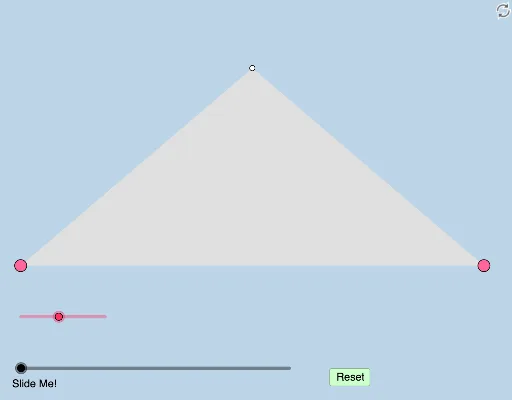
This example dynamically illustrates the proof of incenters in an isosceles triangle divided by a cevian. Key mathematical concepts include isosceles triangle properties, incenters, and angle relationships. Constructed using GeoGebra commands such as Rotate, Angle, Ray, Intersect, Segment, Polygon, and more, it is suitable for high school geometry students and educators.
GeoGebra Commands & Parameters
Rotate(A, (a * π / 180), B) → A'Angle(A, B, A') → αRotate(B, ((-a) * π / 180), A) → B'Ray(B, A') → fRay(A, B') → gIntersect(f, g) → CSegment(B, A) → hPolygon(B, A, C) → t1, c, b, a_1OrthogonalLine(C, h) → iIntersect(i, h) → HPoint(h) → DSegment(C, D) → jAngle(A, D, C) → βRotate(A, β / 2, D) → A'_1Angle(A, D, A'_1) → γRay(D, A'_1) → kRotate(C, (a * π / 360), A) → C'Angle(C, A, C') → δRay(A, C') → lIntersect(k, l) → F_1Rotate(A, α / 2, B) → A'_2Angle(A, B, A'_2) → εRay(B, A'_2) → mRotate(C, (π - β) / 2, D) → C'_1Angle(C, D, C'_1) → ζRay(D, C'_1) → nIntersect(m, n) → GOrthogonalLine(G, h) → pOrthogonalLine(F_1, h) → qIntersect(p, h) → EIntersect(q, h) → FDistance(E, H) → distanceHDDistance(D, F) → distanceEIDistance(D, E) → distanceDEDistance(H, F) → distanceHFAngle(B, C, D) → ηAngle(D, C, A) → θDilate(B, If[0 < d ≤ 1, 1 - d, 0], C) → B'_1Segment(B, B'_1) → rRotate(B, If[1 < d ≤ 2, ((d - 1) * (η + θ)), η + θ], C) → B'_2Rotate(B'_1, If[1 < d ≤ 2, ((d - 1) * (η + θ)), η + θ], C) → ISegment(B'_2, I) → r'Angle(C, H, B) → ιSegment(C, H) → sSegment(E, B) → tSegment(F, A) → eMin({s, t, e}) → oDilate(C, If[3 < d ≤ 4, 4 - d, 0], D) → C'_2Segment(C, C'_2) → f_1Circle(C, (0.3 * o)) → c_1Circle(B, (0.3 * o)) → d_1Circle(A, (0.3 * o)) → e_1Segment(B, C) → g_1Segment(C, D) → h_1Intersect(p, g_1) → JIntersect(f_1, h_1) → KIntersect(c_1, h_1) → L,Intersect(d_1, g_1) → M,Segment(C, A) → i_1Intersect(e_1, i_1) → N,Dilate(C, If[4 < d ≤ 5, 5 - d, 0], G) → C'_3Dilate(B, If[4 < d ≤ 5, 5 - d, 0], G) → B'_3Segment(B, B'_3) → k_1Segment(C, C'_3) → l_1Rotate(M, If[5 < d ≤ 6, ((-(d - 5)) * ε), (-ε)], B) → M'Rotate(J, If[5 < d ≤ 6, ((d - 5) * η / 2), η / 2], C) → J'CircleSector(B, M', M) → p_1Rotate(p_1, If[7 < d ≤ 8, ((-(d - 7)) * ε), (-ε)], B) → s_1Rotate(L, If[5 < d ≤ 6, ((-(d - 5)) * η / 2), ((-η)) / 2], C) → L'CircleSector(C, L', L) → q_1Rotate(q_1, If[7 < d ≤ 8, ((-(d - 7)) * η / 2), ((-η)) / 2], C) → r_1Polygon(B, D, C) → t2, c_2, b_1, d_2Polygon(D, A, C) → t3, c_3, d_3, a_2Rotate(L, If[9 < d ≤ 10, ((d - 9) * θ / 2), θ / 2], C) → L'_1Rotate(N, If[9 < d ≤ 10, ((d - 9) * δ), δ], A) → N'Dilate(C, If[8 < d ≤ 9, 9 - d, 0], F_1) → C'_4Dilate(A, If[8 < d ≤ 9, 9 - d, 0], F_1) → A'_3Segment(C, C'_4) → j_1Segment(A, A'_3) → m_1CircleSector(C, L, L'_1) → t_1CircleSector(A, N, N') → e_2Rotate(t_1, If[11 < d ≤ 12, ((d - 11) * θ / 2), θ / 2], C) → f_2Rotate(e_2, If[11 < d ≤ 12, ((d - 11) * δ), δ], A) → g_2Dilate(C, If[13 < d ≤ 14, 14 - d, 0], H) → C'_5Segment(C, C'_5) → n_1Angle(G, E, B) → κAngle(A, F, F_1) → λDilate(G, If[14 < d ≤ 15, 15 - d, 0], E) → G'Dilate(F_1, If[14 < d ≤ 15, 15 - d, 0], F) → OSegment(G, G') → h_2Segment(F_1, O) → i_2Dilate(D, If[15 < d ≤ 16, 16 - d, 0], F) → D'Segment(D, D') → j_2Distance(B, D) → uDistance(B, A) → vMidpoint(E, F) → PRotate(D, If[16 < d ≤ 17, ((-(d - 16)) * π), (-π)], P) → D'_1Rotate(D', If[16 < d ≤ 17, ((-(d - 16)) * π), (-π)], P) → D''Segment(D'_1, D'') → k_2Dilate(D, If[15 < d ≤ 16, 16 - d, 0], E) → D'_2Segment(D, D'_2) → l_2Rotate(D, If[16 < d ≤ 17, ((d - 16) * π), π], P) → D'_3Rotate(D'_2, If[16 < d ≤ 17, ((d - 16) * π), π], P) → QSegment(D'_3, Q) → m_2
AI Drawing Prompt Reference
Draw an isosceles triangle ABC with AB equal to AC. Construct a median AD from vertex A to side BC, intersecting at point D. Construct angle bisectors AE and AF, intersecting BC at points E and F respectively. Draw a perpendicular from D to BC, intersecting AE at H and AF at I. Draw a perpendicular from E to BC, intersecting AD at G. Mark points H, I, G, E, and F, and indicate their relationships with the sides of the triangle.
The prompt above was compiled from the original drawing commands and is for reference only.