
Dynamic Illustration of Parallel Lines Proportionality Theorem
Loading the math board and drawing, please wait…
In collections
Congruence (CO) Cluster
Congruence (Vol 2)
CCSS High School: Geometry (Congruence) Volume 2
CCSS High School: Geometry (Congruence) Volume 2
CCSS High School: Geometry (Congruence) Volume 2
Geometry (Congruence) Volume 2
CCSS High School: Geometry (Congruence) Volume 2
CCSS High School: Geometry (Congruence) Volume 2
CCSS High School: Geometry (Congruence) Volume 2
CCSS High School: Geometry (Congruence) Volume 2
CCSS High School: Geometry (Congruence) Volume 2
CCSS High School: Geometry (Congruence) Volume 2
CCSS High School: Geometry (Congruence) Volume 2
Gail LeBlancCCSS High School: Geometry (Congruence) Volume 2
CCSS High School: Geometry (Congruence) Volume 2
Parallel Lines & Related Angles
Parallel Lines & Related Angles
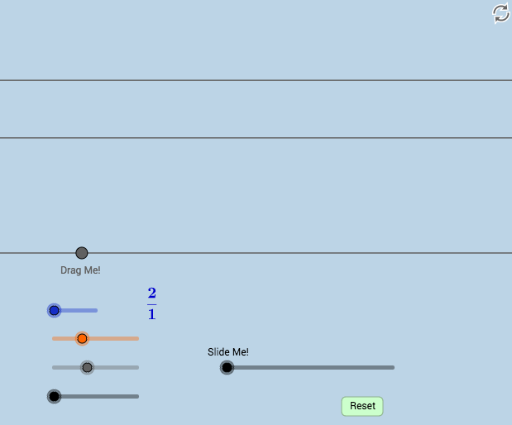
This example dynamically demonstrates the Parallel Lines Proportionality Theorem, illustrating geometric properties and phenomena. Key math concepts include parallel lines, ratios, similar triangles, and geometric transformations. Construction highlights involve commands/objects like Point, Line, Rotate, Angle, Ray, Circle, OrthogonalLine, Intersect, Segment, CircleSector, Dilate, Vector, and Translate from the GeoGebra command summary. It is suitable for high school geometry students to visually understand the theorem and explore its applications.
GeoGebra Commands & Parameters
Point(y = 0) → ALine(A, B) → fRotate(B, α, A) → B'Angle(B, A, B') → βLine(A, B') → gRotate(B', γ, A) → B''Angle(B', A, B'') → δRay(A, B'') → hCircle(A, a) → cOrthogonalLine(A, g) → iIntersect(c, i, 2) → CCircle(C, a) → dIntersect(d, i, 2) → DCircle(D, a) → eIntersect(e, i, 2) → ELine(C, g) → jLine(D, g) → kLine(E, g) → lIntersect(h, j) → FIntersect(k, h) → GIntersect(l, h) → HSegment(A, F) → mCircle(A, (0.3 * m)) → pPoint(l) → IPoint(g) → JSegment(I, J) → nIntersect(k, n) → KIntersect(j, n) → LIntersect(p, g, 2) → MIntersect(p, h, 1) → NCircleSector(A, M, N) → qDilate(A, If[0 < b ≤ 1, 1 - b, 0], F) → A'Segment(A, A') → rDilate(F, If[1 < b ≤ 2, 2 - b, 0], G) → F'Segment(F, F') → sDilate(G, If[2 < b ≤ 3, 3 - b, 0], H) → G'Segment(G, G') → tDilate(A, If[3 < b ≤ 4, 4 - b, 0], F) → A'_1Vector(A, A'_1) → uTranslate(q, u) → q'Dilate(F, If[4 < b ≤ 5, 5 - b, 0], G) → F'_1Vector(F, F'_1) → vTranslate(q', v) → q''Dilate(G, If[5 < b ≤ 6, 6 - b, 0], H) → G'_1Vector(G, G'_1) → wTranslate(q'', w) → q'''Rotate(q''', If[6 < b ≤ 7, ((-(b - 6)) * π), (-π)], H) → c_1Rotate(A, If[7 < b ≤ 8, ((b - 7) * π), π], F) → A'_2Rotate(A', If[7 < b ≤ 8, ((b - 7) * π), π], F) → A''Segment(A'_2, A'') → r'Rotate(A'_2, If[8 < b ≤ 9, ((b - 8) * π), π], G) → ORotate(A'', If[8 < b ≤ 9, ((b - 8) * π), π], G) → A'''Segment(O, A''') → r''Dilate(L, If[12.5 < b ≤ 13.5, 13.5 - b, 0], K) → K'Dilate(J, If[11.5 < b ≤ 12.5, 12.5 - b, 0], L) → L'Rotate(I, If[14.5 < b ≤ 15.5, ((-(b - 15.5)) * π), (-π)], K) → I'_1Rotate(I, If[14.5 < b ≤ 15.5, ((-(b - 14.5)) * π), (-π)], K) → I'_2Rotate(I'_2, If[15.5 < b ≤ 16.5, ((-(b - 15.5)) * π), (-π)], L) → PCircle(E, a) → d_1Intersect(d_1, i, 2) → RLine(R, g) → k_1Intersect(k_1, h) → SCircle(R, a) → e_1Intersect(e_1, i, 2) → ULine(U, g) → m_1Intersect(m_1, h) → VPoint(k_1) → TPoint(m_1) → WSegment(J, T) → l_1Segment(J, L') → j_1Segment(L, K') → q_1Dilate(K, If[13.5 < b ≤ 14.5, 14.5 - b, 0], I) → K'_1Segment(K, K'_1) → f_1Rotate(J, If[14.5 < b ≤ 15.5, ((b - 14.5) * π), π], L) → J'Rotate(L', If[14.5 < b ≤ 15.5, ((b - 14.5) * π), π], L) → L''Segment(J', L'') → g_1Rotate(J', If[15.5 < b ≤ 16.5, ((b - 15.5) * π), π], K) → J''Rotate(L'', If[15.5 < b ≤ 16.5, ((b - 15.5) * π), π], K) → L'''Segment(J'', L''') → h_1Intersect(l, l_1) → QCircle(T, Q) → r_1Circle(Q, Radius[r_1]) → s_1Intersect(s_1, l_1, 1) → ZCircle(Z, Radius[r_1]) → t_1Intersect(t_1, l_1, 1) → A_1Dilate(H, If[6 < b ≤ 7, 7 - b, 0], S) → H'Vector(H, H') → u_1Translate(q''', u_1) → c_2Rotate(c_2, If[7 < b ≤ 8, ((b - 7) * π), π], S) → d_2Segment(H, H') → i_1Rotate(O, If[9 < b ≤ 10, ((b - 9) * π), π], H) → O'Rotate(A''', If[9 < b ≤ 10, ((b - 9) * π), π], H) → B_1Segment(O', B_1) → r'''Dilate(J, If[10 < b ≤ 11, 11 - b, 0], A_1) → J'_1Segment(J, J'_1) → p_1Dilate(A_1, If[11 < b ≤ 12, 12 - b, 0], Z) → C_1Segment(A_1, C_1) → a_1Dilate(Z, If[12 < b ≤ 13, 13 - b, 0], Q) → Z'Segment(Z, Z') → b_1Dilate(Q, If[13 < b ≤ 14, 14 - b, 0], T) → Q'Segment(Q, Q') → g_2Rotate(J, If[14 < b ≤ 15, ((b - 14) * π), π], A_1) → J'_2Rotate(J'_1, If[14 < b ≤ 15, ((b - 14) * π), π], A_1) → D_1Segment(J'_2, D_1) → h_2Rotate(J'_2, If[15 < b ≤ 16, ((b - 15) * π), π], Z) → E_1Rotate(D_1, If[15 < b ≤ 16, ((b - 15) * π), π], Z) → F_1Segment(E_1, F_1) → i_2Rotate(E_1, If[16 < b ≤ 17, ((b - 16) * π), π], Q) → G_1Rotate(F_1, If[16 < b ≤ 17, ((b - 16) * π), π], Q) → H_1Segment(G_1, H_1) → j_2
AI Drawing Prompt Reference
Draw a set of parallel lines and construct a series of similar triangles to demonstrate the Parallel Lines Proportionality Theorem. Start by taking point A on the x-axis and drawing line f through A. Then rotate point B around A to get B', construct angle β, and rotate B' around A to get B'', constructing angle δ. Next, draw ray h, and construct circle c with center A. Draw the perpendicular line i to line g, intersecting circle c at point C. With C as the center, draw circle d, intersecting line i at point D, and continue this process to form a series of circles and intersection points, ultimately creating a series of similar triangles to illustrate the theorem's dynamic process.
The prompt above was compiled from the original drawing commands and is for reference only.