
Dynamic Excircle Relationship in Triangles
Loading the math board and drawing, please wait…
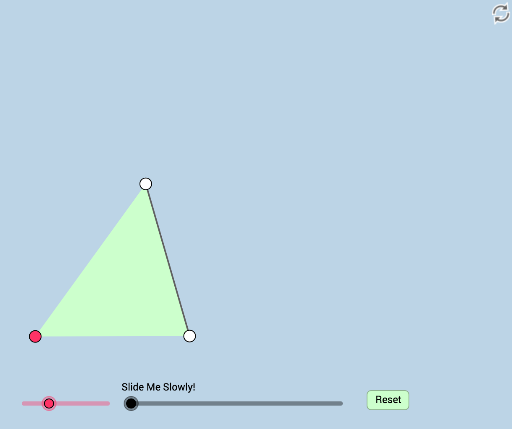
This example dynamically illustrates the relationships within any triangle's excircle. It involves core concepts like excircles, triangle vertices, angles, and geometric transformations. Construction uses commands such as Rotate, Ray, Point, Segment, Circle, Intersect, Angle, Min, Line, CircleSector, OrthogonalLine, Midpoint, Polygon, Dilate, CircleArc, Vector, and Translate. Suitable for high school mathematics education to understand the intrinsic connection and dynamic changes between triangles and their excircles.
GeoGebra Commands & Parameters
Rotate(B, (a * π / 180), A) → B'Ray(A, B') → gPoint(g) → CSegment(A, C) → jCircle(C, 4) → cIntersect(c, g, 2) → ERay(A, B) → fPoint(f) → DSegment(C, D) → hAngle(D, C, E) → γRotate(D, γ / 2, C) → D'Ray(C, D') → mSegment(A, D) → iMin({i, j, h}) → bCircle(D, (0.2 * b)) → dIntersect(d, f, 2) → FRay(D, F) → kAngle(F, D, C) → βRotate(F, β / 2, D) → F'Ray(D, F') → nIntersect(m, n) → JLine(J, h) → l_2Intersect(k, l_2) → PRay(C, E) → lIntersect(l, l_2) → OAngle(B, A, B') → αCircle(C, (0.2 * b)) → eCircle(D, (0.15 * b)) → pAngle(F, D, F') → δAngle(D, C, D') → εIntersect(e, m, 1) → GIntersect(e, h, 1) → HIntersect(p, h, 1) → ICircleSector(C, H, G) → qCircleSector(D, F, F') → rOrthogonalLine(J, k) → sOrthogonalLine(J, l) → tIntersect(s, k) → KIntersect(t, l) → LCircle(J, K) → c_1Segment(L, K) → f_1Midpoint(f_1) → MOrthogonalLine(M, f_1) → g_1Intersect(c_1, g_1, 2) → NSegment(N, C) → h_1Segment(N, D) → i_1Polygon(A, D, C) → poly1, c_2, a_1, d_2Angle(J, K, D) → ζAngle(C, L, J) → ηDilate(A, If[0 < o ≤ 1, 1 - o, 0], D) → A'Segment(A, A') → k_1Dilate(A, If[0 < o ≤ 1, 1 - o, 0], C) → A'_1Segment(A, A'_1) → l_1Dilate(C, If[1 < o ≤ 2, 2 - o, 0], J) → C'Dilate(D, If[1 < o ≤ 2, 2 - o, 0], J) → D'_1Segment(C, C') → m_1Segment(D, D'_1) → n_1Rotate(r, If[2.5 < o ≤ 3.5, ((o - 2.5) * δ), δ], D) → r'Rotate(q, If[3.5 < o ≤ 4.5, ((o - 3.5) * ε), ε], C) → q'Dilate(J, If[5 < o ≤ 6, 6 - o, 0], L) → J'Dilate(J, If[5 < o ≤ 6, 6 - o, 0], K) → J'_1Segment(J, J'_1) → p_1Segment(J, J') → q_1Angle(L, J, K) → θRotate(L, If[6 < o ≤ 7, ((o - 6) * θ), θ], J) → L'CircleArc(J, L, L') → e_1Rotate(K, If[7 < o ≤ 8, ((o - 7) * ((2 * π) - θ) / 2), ((2 * π) - θ) / 2], J) → K'CircleArc(J, K, K') → r_1Rotate(N, If[8 < o ≤ 9, ((o - 8) * ((2 * π) - θ) / 2), ((2 * π) - θ) / 2], J) → N'CircleArc(J, N, N') → s_1Dilate(N, If[11 < o ≤ 12, 12 - o, 0], D) → N'_1Dilate(N, If[11 < o ≤ 12, 12 - o, 0], C) → N'_2Min(c_2, d_2) → wCircle(A, (0.15 * w)) → e_2Segment(A, C) → m_2Intersect(e_2, m_2) → S,Segment(A, D) → n_2Intersect(e_2, n_2) → T,Min({h, k_1, l_1}) → b_1Intersect(d, h, 1) → UIntersect(e, h) → W,Angle(A, C, D) → λAngle(C, D, A) → κRotate(A, λ / 2, C) → A'_2Angle(A, C, A'_2) → ιRay(C, A'_2) → t_1Rotate(C, κ / 2, D) → C'_1Angle(C, D, C'_1) → μ_1Ray(D, C'_1) → f_2Intersect(d, f_2) → A_1,CircleSector(D, U, A_1) → r_2Intersect(t_1, f_2) → ZOrthogonalLine(Z, k_1) → s_2OrthogonalLine(Z, l_1) → t_2Intersect(s_2, k_1) → B_1Intersect(t_2, l_1) → C_1Intersect(k_1, t_1) → D_1Circle(A, (0.2 * b)) → q_2Angle(D, A, C) → μRotate(D, μ / 2, A) → D'_2Angle(D, A, D'_2) → νRay(A, D'_2) → a_2Intersect(q_2, a_2) → V,Intersect(q_2, k_1) → E_1,CircleSector(A, E_1, V) → p_2Dilate(D, If[1 < o ≤ 2, 2 - o, 0], Z) → D'_3Dilate(A, If[1 < o ≤ 2, 2 - o, 0], Z) → A'_3Segment(A, A'_3) → b_2Segment(D, D'_3) → f_3Rotate(r_2, If[2.5 < o ≤ 3.5, ((o - 2.5) * κ / 2), κ / 2], D) → c_3Rotate(p_2, If[3.5 < o ≤ 4.5, ((o - 3.5) * μ / 2), μ / 2], A) → d_3Dilate(Z, If[5 < o ≤ 6, 6 - o, 0], C_1) → Z'Dilate(Z, If[5 < o ≤ 6, 6 - o, 0], B_1) → Z'_1Segment(Z, Z') → g_3Segment(Z, Z'_1) → h_3Angle(Z, B_1, A) → ξAngle(A, C_1, Z) → οCircle(Z, Z') → e_3Rotate(C_1, If[6 < o ≤ 9, (((o - 6) * 2) * π / 3), (2 * π)], Z) → F_1Segment(C, D_1) → i_3Intersect(e, i_3) → G_1,Dilate(C, If[9.5 < o ≤ 10.5, 10.5 - o, 0], Z) → C'_2Dilate(J, If[9.5 < o ≤ 10.5, 10.5 - o, 0], Z) → J'_2Polygon(A, Z, C) → poly2, c_4, a_3, z_1Polygon(A, D, J) → poly3, j_2, a_4, d_4CircleArc(Z, Z', F_1) → k_3Dilate(C, If[11 < o ≤ 12, 12 - o, 0], J) → C'_3Vector(C, C'_3) → u_1Dilate(C, If[1 < o ≤ 2, 2 - o, 0], O) → C'_4Dilate(D, If[1 < o ≤ 2, 2 - o, 0], P) → D'_4Segment(C, C'_4) → j_1Segment(D, D'_4) → d_1Line(C, O) → g_2Line(D, P) → h_2Circle(P, 5) → k_2Circle(O, 5) → p_3Intersect(k_2, h_2) → Q, RIntersect(p_3, g_2) → H_1, I_1Ray(P, R) → i_2Ray(O, I_1) → j_3Line(O, J) → l_3Circle(O, C) → r_3Dilate(J, If[11 < o ≤ 12, 12 - o, 0], O) → J'_3Dilate(J, If[11 < o ≤ 12, 12 - o, 0], P) → J'_4Segment(J, J'_3) → s_3Segment(J, J'_4) → t_3Dilate(D, If[12 < o ≤ 13, 13 - o, 0], P) → D'_5Vector(D, D'_5) → w_1Translate(c_3, w_1) → e_4Translate(D, w_1) → D'_6Translate(D'_3, w_1) → K_1Segment(D'_6, K_1) → b_3Angle(C, D, Z) → ρRotate(e_4, If[13.5 < o ≤ 14.5, ((-(o - 13.5)) * ρ), (-ρ)], P) → q_3Angle(A, C, D) → σRotate(C, If[15 < o ≤ 16, ((o - 15) * σ), σ], O) → C'_5Rotate(C'_4, If[15 < o ≤ 16, ((o - 15) * σ), σ], O) → J_1Segment(C'_5, J_1) → m_3Rotate(D, If[16 < o ≤ 17, (((-(o - 16)) * 2) * ρ), (-2 * ρ)], P) → D'_7Rotate(D'_4, If[16 < o ≤ 17, (((-(o - 16)) * 2) * ρ), (-2 * ρ)], P) → L_1Segment(D'_7, L_1) → n_3
AI Drawing Prompt Reference
Draw a dynamic illustration of the relationship within a triangle's incircle. Start by constructing a triangle, then rotate one vertex to create a new ray. Find a point on this ray, connect it to the opposite side, and draw a circle centered at this point, intersecting the ray at two points. Draw smaller circles centered at these points, intersecting the opposite side again. Connect these points to form a dynamic geometric figure, showcasing the intrinsic connection between the incircle and the triangle's vertices.
The prompt above was compiled from the original drawing commands and is for reference only.