
Dynamic Equal-Angles Theorem Demo
Loading the math board and drawing, please wait…
In collections
Triangles: Points of Concurrency
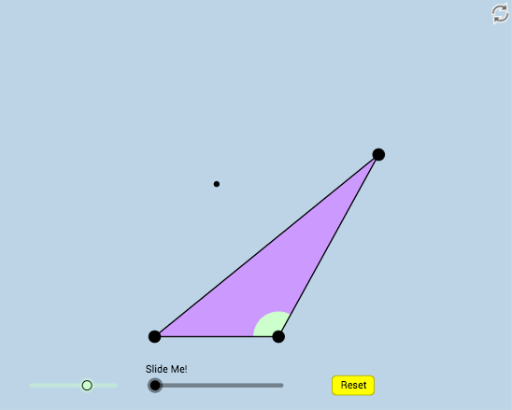
This example dynamically illustrates an equal-angles theorem involving a segment connecting a triangle's vertex to its circumcenter. It covers core concepts like the equal-angles theorem, circumcenter, and circle properties. Construction highlights include Rotate, Segment, LineBisector, and Circle commands from GeoGebra. Suitable for high school mathematics education to understand the relationship between the circumcenter and the theorem.
GeoGebra Commands & Parameters
Rotate(A, (-((a * π / 180))), B) → A'Angle(A', B, A) → αSegment(A, B) → fRay(B, A') → gPoint(g) → CSegment(A, C) → hSegment(B, C) → iLineBisector(i) → jLineBisector(f) → kIntersect(j, k) → DCircle(D, B) → cSegment(D, C) → lLine(A, B) → mOrthogonalLine(C, m) → nIntersect(m, n) → EMin({l, h, i}) → bCircle(C, (0.3 * b)) → dIntersect(d, h, 1) → FIntersect(d, l, 1) → GAngle(D, C, B) → βCircleSector(C, G, F) → eAngle(E, C, A) → γAngle(B, C, D) → δIntersect(d, i, 1) → HCircleSector(C, H, G) → pAngle(E, A, C) → εCircleSector(C, G, H) → qDilate(D, If[0 < o ≤ 1, 1 - o, 0], C) → D'Segment(D, D') → rRotate(C, If[1 < o ≤ 3, ((o - 1) * π), (2 * π)], D) → C'CircleArc(D, C, C') → sDilate(C, If[3 < o ≤ 4, 4 - o, 0], E) → C'_1Dilate(B, If[3 < o ≤ 4, 4 - o, 0], E) → B'Segment(B, B') → tSegment(C, C'_1) → f_1Angle(C, E, B) → ζCircleArc(C, G, F) → c_1Angle(F, C, G) → θRotate(e, If[5 < o ≤ 6, ((o - 5) * β), β], C) → e'Rotate(p, If[5 < o ≤ 6, ((-(o - 5)) * θ), (-θ)], C) → p'CircleArc(C, H, G) → d_1Point(f_1) → IMidpoint(A, B) → JSegment(A, E) → g_1Segment(A, J) → h_1Angle(I, C, H) → κRotate(q, If[5 < o ≤ 6, ((-(o - 5)) * κ), (-κ)], C) → q'CircleArc(C, G, H) → e_1CircleSector(C, F, G) → k_1Angle(G, C, H) → μRotate(k_1, If[5 < o ≤ 6, ((o - 5) * μ), μ], C) → p_1CircleArc(C, F, G) → q_1Polygon(A, B, C) → poly1, c_2, a_1, b_1Min(f, i) → uCircle(B, (0.2 * u)) → r_1Intersect(r_1, f) → K,Intersect(r_1, i) → L,CircleSector(B, L, K) → s_1