
Dynamic Drawing of Prism Nets
Loading the math board and drawing, please wait…
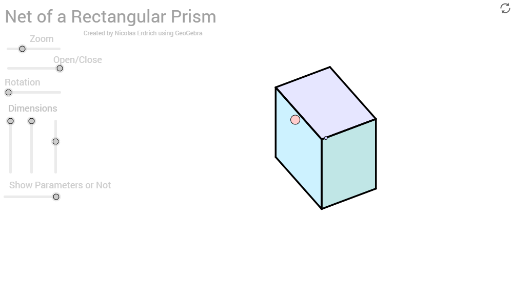
This example demonstrates how to dynamically draw the nets (unfolded surfaces) of prisms, such as triangular prisms, using GeoGebra, transforming 3D solids into 2D polygon arrangements. The core mathematical concepts involve solid geometry (prism structure, surface nets) and plane geometry (polygons, segments, equilateral triangles). Construction highlights: commands like Sequence, Element, Polygon, and Segment are used to build prism vertices and faces; rotation matrices (R_x, R_y, R_z) and trigonometric functions (sin, cos) control 3D rotations; sliders (α, β) enable dynamic viewpoint changes; lists (listepoints) and point objects (A, E, C_1, D, etc.) define the unfolded planar shapes. Suitable for high school or early college students to understand the correspondence between 3D solids and their 2D nets, and as a visual teaching aid in mathematics.
GeoGebra Commands & Parameters
Sequence((Mat * Element[cube, k]), k, 1, 8) → cube'Element(Element[AE, 3], 1) → droiteSequence(I + (Element[cube', k, 1, 1], Element[cube', k, 2, 1]), k, 1, 8) → listepointsElement(listepoints, 2) → AElement(listepoints, 1) → EElement(listepoints, 4) → C_1Element(listepoints, 3) → DPolygon(A, E, C_1, D) → poly1, a_1, b, c_1, dElement(listepoints, 6) → BElement(listepoints, 7) → FElement(listepoints, 8) → GElement(listepoints, 5) → HPolygon(B, F, G, H) → poly2, e, f, g, hElement(listepoints, 3) → CPolygon(F, C, A, B) → poly3, f_1, i, a_2, b_1Element(AB, 3, 1) → avantPolygon(C_1, G, H, E) → poly4, c_2, g_1, h_1, e_1Element(AC, 3, 1) → dessusPolygon(F, C, C_1, G) → poly5, f_2, c_3, c_4, g_2Polygon(A, B, H, E) → poly6, a_3, b_2, h_2, e_2Segment(E, A) → cSegment(A, C) → jSegment(A, B) → kSegment(C, C_1) → lSegment(C_1, E) → mSegment(A, B) → pSegment(B, H) → qSegment(H, E) → rSegment(H, G) → sSegment(B, F) → tSegment(G, C_1) → d_1Segment(F, G) → i_1Segment(F, C) → j_1Polygon(A, B, F', D') → poly7, a_4, b_3, f', d'Polygon(E, A, D'', C') → poly8, e_3, a_5, d'', c'Polygon(B, F'', G', H) → poly9, b_4, f'', g', h_3Polygon(H, G'', C''', E) → poly10, h_4, g'', c''', e_4Polygon(A_2, B_2, G'', C''') → poly11, a_6, b_5, g''_1, c'''_1