
Dynamic Demonstration of Vector Collinearity
Loading the math board and drawing, please wait…
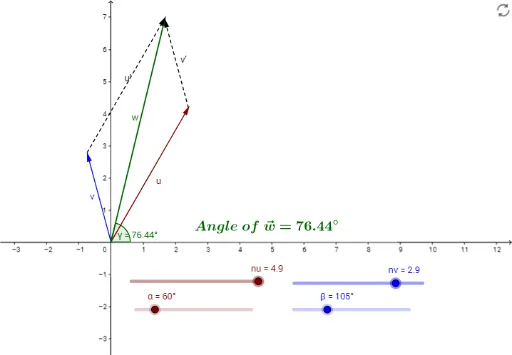
This GeoGebra example dynamically demonstrates the concept of vector collinearity (parallel vectors) and its geometric verification. It constructs vectors u, v, and their translated images using points, segments, translations, and angles, then visually relates the angles α, β, and γ to show when vectors are collinear. Core mathematical concepts include two-dimensional vector relationships, the geometric criterion for parallel vectors, and the interplay between vector translation and angle measurement. The construction uses commands such as Point (creating A, B, C), Segment, Translate (generating translated vectors), Vector (defining u, v, w), Angle (measuring α, β, γ), and a text object (texte1) to display the conclusion. This resource is suitable for high school or early university students learning vector geometry, and for teachers demonstrating the equivalence between algebraic and geometric conditions of collinearity. It also highlights the power of dynamic geometry software for interactive mathematical exploration.
GeoGebra Commands & Parameters
Point(w) → APoint(v) → BSegment(A, B) → fPoint(u) → CSegment(A, C) → gTranslate(B, u) → B'Vector(B, B') → u'Translate(C, v) → C'Vector(C, C') → v'Angle(w) → γ